I've been trapped by the cable service again, and find myself watching first the final third and then the first two thirds of "The Rainmaker" on AMC. That's the beauty of cable: 150+ standard channels, most of which show nothing of value, the rest of which show the same thing enough times in a row that it becomes valueless. I won't miss it; in CT we will have internet access but not cable television. I like to think this will mean I'll read more, but internet is even more likely to distract me -- it already does, after all.
"The Rainmaker" is one of a string of 90's Grisham novels-cum-blockbusters about the legal profession. In this one, Matt Damon plays the role of newly-minted Memphis State Law School graduate Rudy Taylor, who stumbles on to the perfect client: a young man dying because he was denied a bone marrow transplant by a corrupt (read: ordinary) health insurance company, said company represented by a stereotypically slimy megafirm personified wonderfully by Jon Voight. (Voight is adept at these types: cerebral, casually corrupt apparatchiks.)
"Rainmaker" refers to two things: the case or client that makes the heavens rain money, and/or the attorney who finds clients like that.
Damon's Rudy wins the case, mainly through overwhelming evidence sustained through a combination of blind luck and a remote assist from a corrupt shyster on the lam. The not-so-subtle lesson is that even unstained righteousness requires ruthless and unprincipled champions to prevail. Christ himself would need more than Clarence Darrow; he'd need some combination of Johnny Cochrane, Don King and Jack Abramoff. Rudy, having won whilst keeping his shoes relatively free of putrescence, departs stage right with willowy domestic battery survivor Claire Danes in tow. Not a bad way to quit the law.
I left in a far less dramatic fashion, jumping ship early in the summer of 2004 after barely 8 months of billables. I was (and am) blessed to have a beauty of my own, who never blinked a lash though her glittering prince fell abruptly from elite-educated attorney-on-the-make to journeyman apprentice carpenter in two swift weeks. But I had no cache to take with me, to buoy me on my travels, nor did I understand quickly (or as it turns out, slowly) where I was headed or what it means to leave the law.
Spiritually, you're ever on the doorstep: never quite going away, yet never to reenter the hall; a beguiling contraption that others puzzle over, like an Archimedes' Trammel without a scribe. "Fascinating," they muse, "but whatever does it do?," while to lawyers you look a gelding.
What I've found myself doing is the title of this post. Most people call it "conservation," though.
In the "Rainmaker" we hear evidence (however fictionalized) of the brokenness of both our legal system and our healthcare system. We are even warned of the spectre of "government controlled" medical care -- a dire evil, ever to be feared. As the movie (and my second glass of wine) came to an end bitterness rose along with indigestion; bitter because in spite of the acrimony and strife of the intervening 13 years we haven't improved either of those systems. Indeed, with every passing year we slide further down the gullet. Since that movie was made, it is harder to win a lawsuit, harder to get a judgment, harder to get healthcare. But still we pay -- taxes, premiums, fees.
In conservation, we've reached a point where we argue the relative merits of development. We no longer argue its essential value. We no longer say "Not here." We are remaindered to "oh, well, here -- ok, but could you maybe move the building a few feet away from the wetland, the vernal pool, the already impossibly fractured habitat? And could you vent your waste in a different direction? Maybe bury it? Or store it next to the aquifer rather than dumping directly into the stream?"
We are witnesses. We may be the last witnesses, but there are millions of us. My friends who are teachers are witness to the end of the dream of equal public education. My friends in government are witness to the end of all manner of regulations and policies that either protect workers or the air or the water or the mom-and-pop saving for retirement. My scientist friends are witness to the end of endeavor for wonder's sake.
I am a witness to the vanished land. But I can't even protest its loss. The moment I raise my voice to say, "this is wrong -- more than wrong, it's suicide" the power is cut, the conversation is over, eyes glaze, doors close.
We have the power to do so much. We could do so much differently, so much better.
"Oh, we were like glory's gate, my darling. We were like that bloody shark of yours. We swam with the, um, uh — Oh, goddamn it. I had it on the plane. What was I gonna say? Ah, well." But I'll write about middle age when it's over, or more fully here.
For now I just want to record my sense of futility.
Showing posts with label Under the Suit. Show all posts
Showing posts with label Under the Suit. Show all posts
Tuesday, March 22, 2011


Monday, August 3, 2009
Drinks! Drinks for my friends!
That classic line is from Micky Rourke's first incarnation, in his role as Bukowski, the great street poet (who always reminds me of Tom Waites -- or maybe it's the other way around) in the movie Barfly. If you haven't seen the movie, you should.
First of all, it features the absurd and pathetic life of the talented Charles Bukowski. Bukowski wrote searing poetry, and steadfastly refused to clean up his act. Like many drunks and addicts, he believed his own hype and it made him an unbearably self-righteous person to be around. But his words were worth it (if you didn't have to live with him).
Second, it's probably Rourke's best role. It prefigures his turn as "The Wrestler," before his face was battered by his earnest courtship of boxing and equally earnest pursuit of chemical living. I guess that as a man he was already tiptoeing along the edge and that gives his portrait of Bukowski/Henry Chinaski a reckless core, convincing, probably because he was barely acting.
 Finally, you'll get a dose of 1987 Faye Dunaway. If you're my age or younger, you're probably not quite old enough to remember the power of Faye's sexuality (or, she may have tormented your early adolescence). In "Barfly," she plays, like Rourke, an unrepentant booze-hound. But no matter how slovenly or sick she gets, her allure burns a hole in the film. Part of the tragedy of the movie is watching that light boxed off and traded away.
Anyway, drinks.
In what will surely go down as one of his many strokes of genius, my friend Rich married my friend Kristin. Together they came up with another nice idea: revive the cocktail hour.
There are many institutions from the first half of the 20th century that have thankfully fallen to the dustbin of history: segregation, smoking in restaraunts, sock suspenders. Yet in our headlong rush into the new, we've thrown the baby out with the bathwater: Vive l'Heure de Cocktail!
In support of that effort, Kristin and Rich bring you "52 Drink-up," now added to the "Stuff and Fun" blogroll to the right of this column. Drink along, and bring the "happy" back to "happy hour!"
First of all, it features the absurd and pathetic life of the talented Charles Bukowski. Bukowski wrote searing poetry, and steadfastly refused to clean up his act. Like many drunks and addicts, he believed his own hype and it made him an unbearably self-righteous person to be around. But his words were worth it (if you didn't have to live with him).
Second, it's probably Rourke's best role. It prefigures his turn as "The Wrestler," before his face was battered by his earnest courtship of boxing and equally earnest pursuit of chemical living. I guess that as a man he was already tiptoeing along the edge and that gives his portrait of Bukowski/Henry Chinaski a reckless core, convincing, probably because he was barely acting.
 Finally, you'll get a dose of 1987 Faye Dunaway. If you're my age or younger, you're probably not quite old enough to remember the power of Faye's sexuality (or, she may have tormented your early adolescence). In "Barfly," she plays, like Rourke, an unrepentant booze-hound. But no matter how slovenly or sick she gets, her allure burns a hole in the film. Part of the tragedy of the movie is watching that light boxed off and traded away.
Anyway, drinks.
In what will surely go down as one of his many strokes of genius, my friend Rich married my friend Kristin. Together they came up with another nice idea: revive the cocktail hour.
There are many institutions from the first half of the 20th century that have thankfully fallen to the dustbin of history: segregation, smoking in restaraunts, sock suspenders. Yet in our headlong rush into the new, we've thrown the baby out with the bathwater: Vive l'Heure de Cocktail!
In support of that effort, Kristin and Rich bring you "52 Drink-up," now added to the "Stuff and Fun" blogroll to the right of this column. Drink along, and bring the "happy" back to "happy hour!"
Thursday, October 30, 2008
Just a few more days.
The results will soon be in. Please get out and do what you can to help.
On this end, I'll be in New Hampshire for the weekend canvassing in CD#2. On the 1st and the 2nd, I'll be GOTV in Maine, wherever they choose to send me. Just give me one shift. Get to your local office and offer to do something for a few hours this weekend. Go to this website, enter your zip code, and find something to do.
It's a bitch, this democracy racket. It only works if you do.
In other, much less important, news, the Patriots renew their rivalry with the hated Colts of Indianapolis on Sunday. These two storied franchises are struggling through similarly frustrating seasons. The fact that they're not on the top of their respective games has caused a minor detente among the fan bases -- something like Adams and Jefferson, bitter rivals who in the end realized they only had each other. Except not as vital to our country. Nor as touching.
In that spirit, Pats Pulpit, the Patriot fansite I occasionally write for, is exchanging blogging privileges with Stampede Blue, internet home of Colts faithful. My contribution is a feature on Patriots' stalwart, Kevin Faulk.
I've been enjoying writing about the Pats. It's a hell of a lot less stressful than contemplating the possibility of President McCain and Vice President Palin.
I just puked in my mouth a little.
Which is exactly why I'm going out from 11/1 through 11/4. And why you should, also.
Sunday, October 19, 2008
The Stretch Run: Canvassing NH for Obama
click on pictures for larger images
I do not like making phone calls. I do not like meeting new people. I don't like bothering strangers. I take rejection personally.
I am not a natural canvasser.
Ian, my friend, knows this. But he also knows how to motivate me. When he called to ask me to canvass New Hampshire with him for a day he said, "I don't really want to do it either, but if John McCain wins the Presidency and there was something I could have done about it, and I didn't, I don't think I could live with myself."

So that's how I found myself in Portsmouth, New Hampshire today, standing among a group of 40 strangers and listening to a young woman give me my marching orders. She is the Field Organizer for Obama's Portsmouth office, and she knows exactly what she needs from us.
Speaking to us like adults (which we were--I estimate the average age of that morning's group at around 44), Ellen gave us our territory, and clipboards with a list of contact names on it. "Be polite, be energetic. Do not engage in a debate. Get contact information if you can, and be sure to leave literature with everyone who wants it and at every door where no one is home. Be upbeat, polite and energetic: you are the face of this campaign."
Staff at work, 6:30pm. We were late.
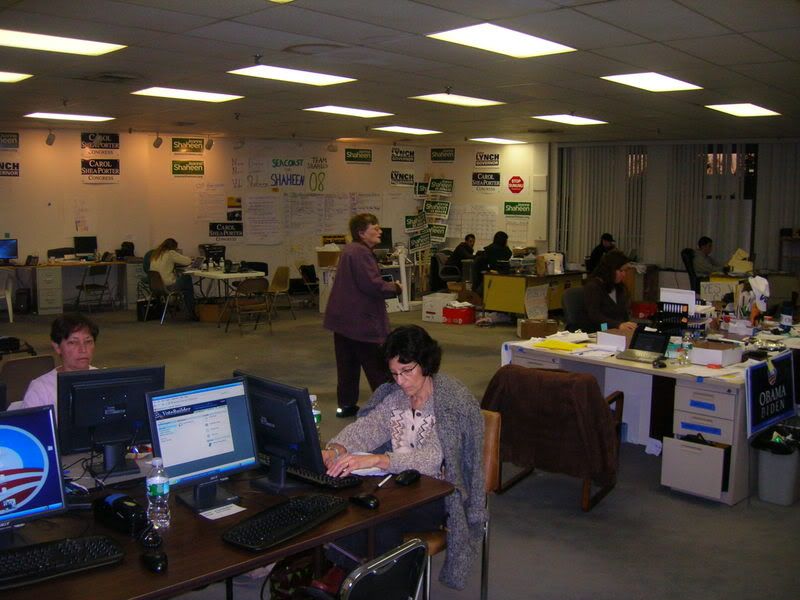
Canvassing right now is about data gathering -- not persuasion. At least not if you walk in off the street like we did. The lists are targeted. Everyone in the packet of addresses they give you is either undecided or as yet un-contacted. Our job was very simple: find out what they're thinking. Everyone we met would be graded on a continuum of Obama, Leaning Obama, Undecided, Leaning McCain, McCain.
Honestly, it was a bit refreshing. So late in the game, it's not like the candidates need an introduction. It opened the door to a few long conversations and it kept encounters with those who had decided to vote McCain very short and sweet. And even occasionally polite.
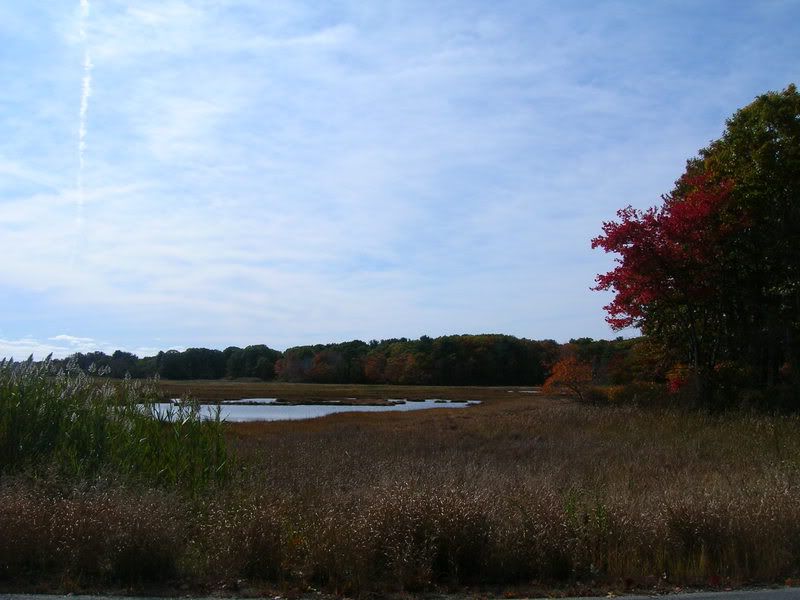
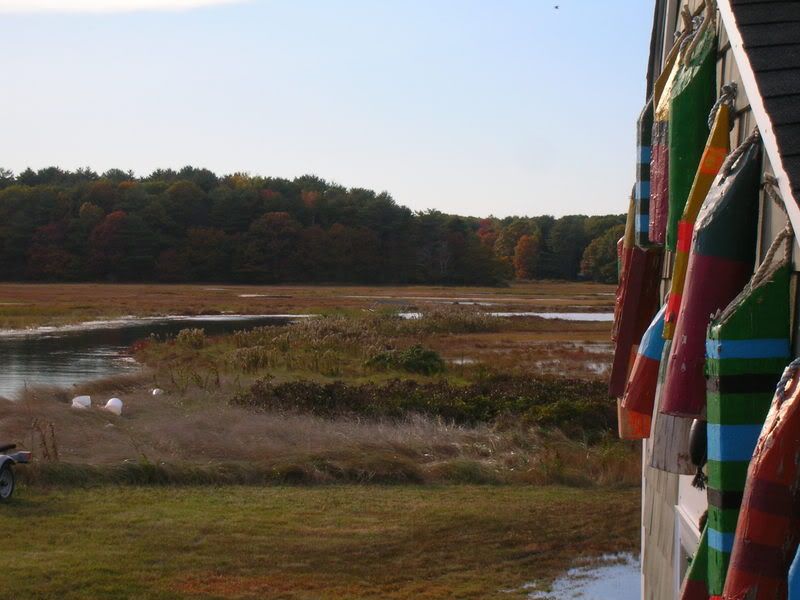
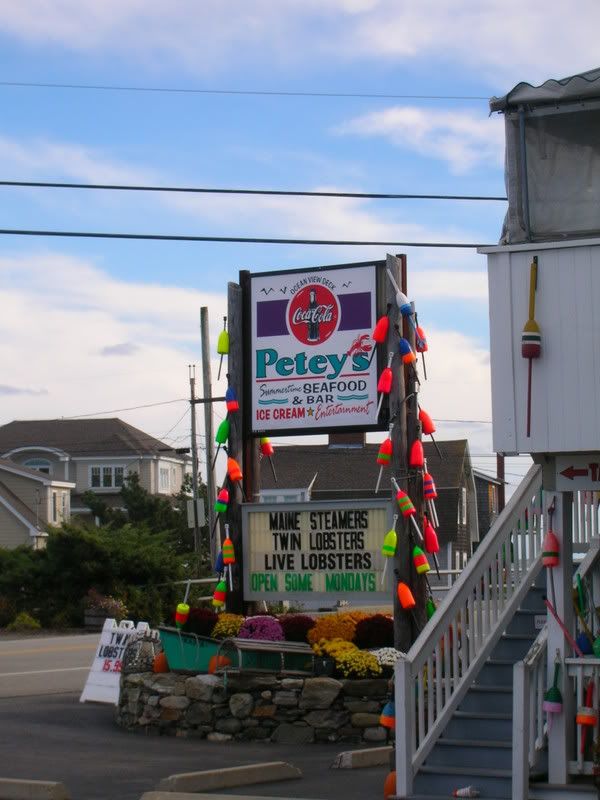
Ian and I were sent to Rye. (I wish I had a rhyme to follow that.) We counted ourselves very lucky--this stretch of US Route 1A runs right along the shingle of the coast, and it has been perhaps the most beautiful fall I can remember.
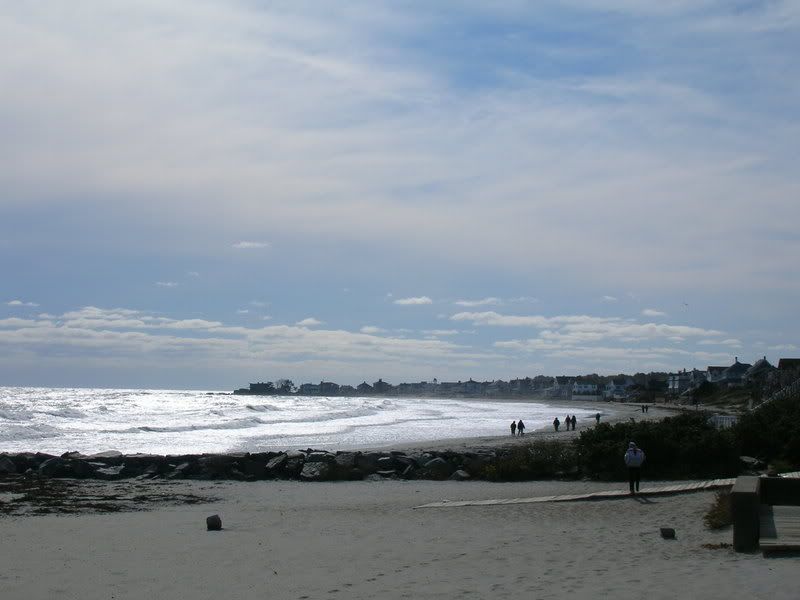
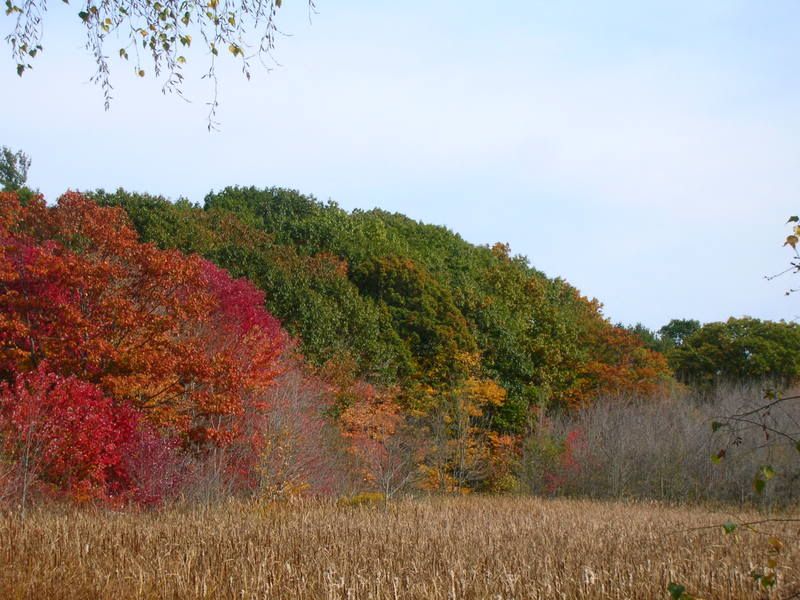
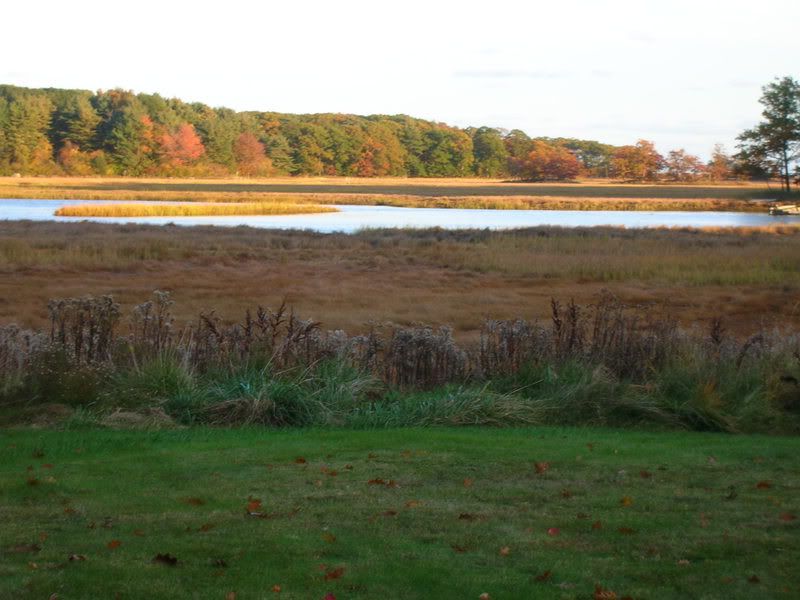
The homes in our territory were spread relatively far apart--not least because we weren't going to visit every house in the neighborhood, just a subset of a subset. Some were very clearly monuments to wealth. Others were small; some few of the old capes that have escaped trophy-hunting renovators, some 60's era single-level bungalows. A scattering of condos converted from beach houses. It took us about 5 hours to knock on about 30 doors. Many people were not home, most conversations were short. But occasionally we met someone who wanted to talk.
We met Lorraine, mowing her lawn on this beautiful day. She was looking forward to voting for Obama very much. In her 70's, she and her husband had lived in the same house for 46 years, watching this once quiet stretch of New Hampshire's coast gradually become busier and wealthier. We met another woman with a houseful of five independents and a Republican mater familias, all of whom will be voting for the Democrat this year. She was pensive, but hopeful.
Worth noting: This campaign is explicitly working for down-ticket races as well. When we queried people about their preferences for president, we also asked about Jeanne Shaheen in the Senate race and Carol Shea-Porter for the House. Obama is clearly seeking to lengthen his coattails if his bid is successful.
Our area seemed roughly 60-40 for Obama, but many of the people we spoke with claimed to still be making up their minds. This boggles me, as I can't remember or come up with two candidates less like one another in modern Presidential history. Ian's take was that anyone still thinking about it would in other years have been a McCain lock. My feeling is more along the line that if you were once a McCain lock, or you're really still undecided because they seem so similar to you, you have the same issue: brain freeze.
But there was one guy who sticks with me. He was pleased that we knocked on his door. He wasn't sure who he wanted to vote for. He'd seen Powell's endorsement this morning. To me he felt genuinely worried, afflicted by the times he found himself living through, a little adrift. His wife couldn't come to the door--she has MS. Did we think Obama would be ok? Yes, we did. Did we see that Powell had endorsed him? We had. "A lot of people think of Colin Powell as a truthful, trustworthy man," I offered. He agreed--it was a good sign, he felt. Would he take an absentee ballot for his wife? He would. Perhaps some literature, with information about Obama's plan for healthcare? Yes, and thank you. He shook our hands.
I've been thinking about him since. He was in his early 70s, but could have been anywhere between there and 55. The older I get, the younger my elders seem. He looked like he could have been my Dad's age. A wife with late-onset MS. A small house with a new ramp to the door. And a clear worry. Thinking about him now, I almost feel like he was frozen -- petrified, really. I don't know if that's fair, but it was the feeling I got from him; as if the next move he made would either set his world safely down or shatter it beyond redemption or repair.
Does any President have an answer for that man? I don't know.
In all, it was a very good day. I strongly encourage you to do this, if you have any free time. Take this Saturday or Sunday. There is a very limited amount of time left to keep our country from going completely off a cliff and there is a very specific thing you can do to stop that. Contact your local office and put in some time.
It's easy--even for the antisocial.
How will you feel on November 5th if McCain wins, and you did nothing to prevent it?
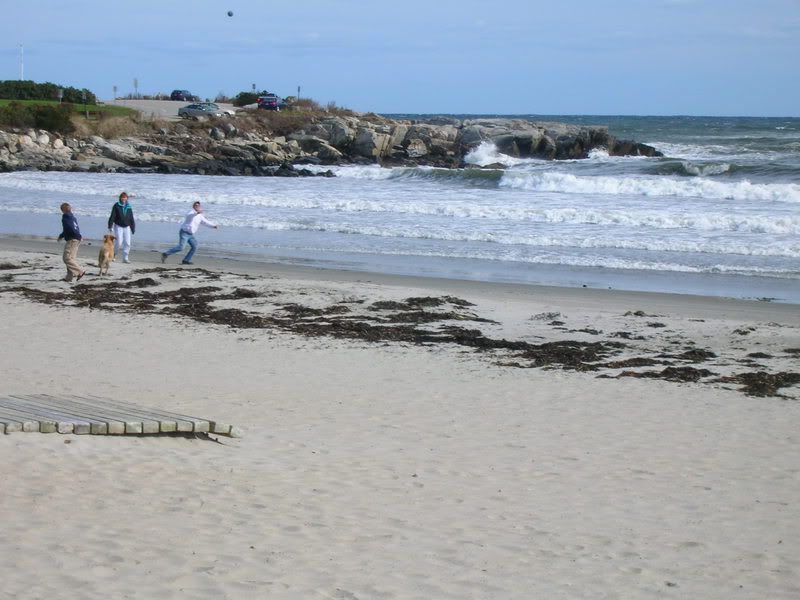
Fried lunch. Yum.


When we came back, the car was still there, but the board was gone. Way, way down the surf line you could see this guy paddling out. We don't stop up here just 'cause it's cold. It's always cold. In fact, the water is probably warmer now than it was in May. Not that I verified that for myself, you understand.
Monday, August 18, 2008

Thursday, July 31, 2008
New gig.
Cool news from my end: I've been asked to be one of the front-page writers over at Pats Pulpit, a New England Patriots fanblog. Those of you who enjoy my writing about American Gridiron can chase me over there for at least one post a week.
Sorry, though, to those of you who are bored/disinterested/hostile to my football writing, 'cause I'm going to continue to post random thinks on this site as well--if it's in my head and socially acceptable, chances are it's going to show up on this site sooner or later.
I've already got a couple of stories up: Running Down the Line is a snapshot of where I think the Patriots' offensive line stands at the beginning of training camp; Camp Rules is an admonishment to hardcore fans (yes, sadly, like myself) to take pre-season reporting with a grain of salt.

My screen name over there is JohnHannahRules. When I was growing up in Giants country (Connecticut south of Hartford), John Hannah was one of the only things the Pats (then "Patsies") had going for them. Since it was already pretty clear that if I was going to do anything on the football field it was going to be in the trenches, he made a good football role model. I had a poster of him on my wall.
You can find a link to Pats Pulpit under the sports links, right.
Sorry, though, to those of you who are bored/disinterested/hostile to my football writing, 'cause I'm going to continue to post random thinks on this site as well--if it's in my head and socially acceptable, chances are it's going to show up on this site sooner or later.
I've already got a couple of stories up: Running Down the Line is a snapshot of where I think the Patriots' offensive line stands at the beginning of training camp; Camp Rules is an admonishment to hardcore fans (yes, sadly, like myself) to take pre-season reporting with a grain of salt.

My screen name over there is JohnHannahRules. When I was growing up in Giants country (Connecticut south of Hartford), John Hannah was one of the only things the Pats (then "Patsies") had going for them. Since it was already pretty clear that if I was going to do anything on the football field it was going to be in the trenches, he made a good football role model. I had a poster of him on my wall.
You can find a link to Pats Pulpit under the sports links, right.
Monday, July 28, 2008
Back.
Howdy. I've been back for about a week and I've got a long, long story about my trip. I don't know if I'm going to put it up all at once or serialize it. We'll see. I'm leaning to the all-at-once, though that's usually better for long-form journals than the web. But hell, I'm not going to publish it. If you'll read it, you'll read it together. The internet never forgets--you can always finish it off later. I want to pretty it up with links and pictures, and that's going to have to wait until tomorrow as I'm all tuckered out right now and it's past bed time.
But just to show you how much I love my gentle readers, and let you know you're not forgotten (no, not ever), I'm going to leave you with a poem that I uncovered in my Alaska reading. I can't even express how relieved I was to find this poem.
Cheerio.
But just to show you how much I love my gentle readers, and let you know you're not forgotten (no, not ever), I'm going to leave you with a poem that I uncovered in my Alaska reading. I can't even express how relieved I was to find this poem.
Cheerio.
The Men That Don't Fit In
There's a race of men that don't fit in,
A race that can't stay still;
So they break the hearts of kith and kin,
And they roam the world at will.
They range the field and they rove the flood,
And they climb the mountain's crest;
Theirs is the curse of the gypsy blood,
And they don't know how to rest.
If they just went straight they might go far;
They are strong and brave and true;
But they're always tired of the things that are,
And they want the strange and new.
They say: "Could I find my proper groove,
What a deep mark I would make!"
So they chop and change, and each fresh move
Is only a fresh mistake.
And each forgets, as he strips and runs
With a brilliant, fitful pace,
It's the steady, quiet, plodding ones
Who win in the lifelong race.
And each forgets that his youth has fled,
Forgets that his prime is past,
Till he stands one day, with a hope that's dead,
In the glare of the truth at last.
He has failed, he has failed; he has missed his chance;
He has just done things by half.
Life's been a jolly good joke on him,
And now is the time to laugh.
Ha, ha! He is one of the Legion Lost;
He was never meant to win;
He's a rolling stone, and it's bred in the bone;
He's a man who won't fit in.
Robert Service, "Songs of the Yukon"
1907
Tuesday, July 8, 2008
Lighting out for the territory.
I reckon I got to light out for the territory ahead of the rest, because Aunt Sally she’s going to adopt me and sivilize me, and I can’t stand it. I been there before.Borrowed Suits will be observing at least 10 days of radio silence as your corresp. heads out to the great northwest. I will be leaving from Boston's Logan airport tomorrow morning early headed for Ruby, Alaska. The flight will go from Beantown to Coffee Town (Seattle), to Fairbanks. I'll layover one night in Fairbanks then hop a bush plane to Ruby. From ruby it's about 5 miles downstream on the Yukon River to the home of the future Yukon River Lodge. Hopefully I won't have to swim.
--Huck Finn
The YRL is a project started about 2 years ago by Sam and Tamara Clark, seeking their own version of Dick Proenneke's "Back and Beyond."
Sam and Tamara haven't gone that extreme. They're building a lodge on the river to cater to sportsmen and outdoor enthusiasts looking for a spot tight against the Nowitna National Wildlife Refuge. The Yukon enjoys good salmon fishing, among other things.
Even though they're relatively close to Ruby, there are no roads to their place but the river. During early freeze-up and before ice-out, this means the place is as isolated as can be. In the winter they get to town by dogsled and snow machine; in the summer they rely on boats.
I don't expect to be doing too much sightseeing -- though the place itself is beautiful. The time will largely be devoted to building.
I met Sam's parents through my work. Once they discovered that I used to be a nail-banger, they asked if I ever wanted to go to Alaska.Food cache, YRL

Well, yeah. But I could never afford the ticket.
"Not to worry," they said, "we have plenty of air miles built up. Why don't you come up this summer and help us build?"
I doubt I'd ever get a better offer, so I'm taking it. Expect a full report upon my return. In the meantime, you can check out this quicktime photoessay they've put together and nose around their site for pictures and descriptions.
See you soon.
Saturday, May 31, 2008
In Memory of...
Introductory rambling: So much to write about these days, what with the rules committee hearing going on in DC (moot in any case), the war, the Democratic Convention in Augusta, the Celtics, international disasters--it's all been on my mind to comment, disparage or celebrate. Instead, I'm going to write about Memorial Day.
I've been thinking about this since I went to Portland's parade on Monday, and links sent by Petrie have kept it in the front of my mind. Last night I had pizza and beer with my city councilor and we chatted about it as well. Time to write.
Portland's Memorial Day Parade was pathetic. Embarrassing, actually, on several levels. It was thinly attended. The delegations were small. The community was not represented. The American Legion and VFW were predictably bitter. I was pissed.
I shot off a text message to the three city councilors who I know, and they all had the same general response. It is the VFW and the American Legion who organize the parade, and they only talk to each other. I don't mind beefing with those guys--you have to involve the community. Here are my thoughts, in no particular order:
In Memory of Memorial Day
Reverend Shuttlesworth was speaking about slavery when he said that. I feel the quote is appropriate, nevertheless. Like slavery, our American wars -- and war wounded and war dead -- are self-inflicted strokes. Bear with me while I explain what I mean.If you don't tell it like it was, it can never be as it ought to be.
-- Rev. Fred Shuttlesworth

No matter how obvious the need, ultimately we take it upon ourselves to war. The Revolution was a choice -- we decided that bloodshed was necessary. We severed ourselves from England to become the cutting for a new flower.
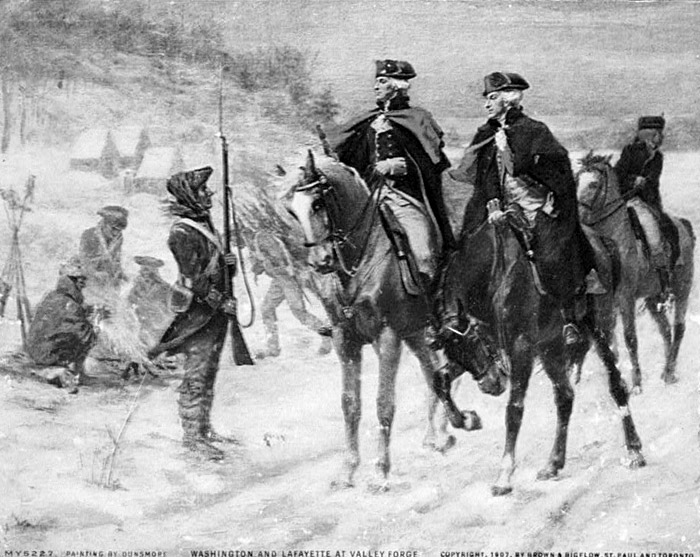
Even the most obvious wars -- World War I and II, the war with Afghanistan -- reflect a policy choice that sends Americans to kill and die. The rightness of a choice is debatable; that it was a choice is not.Washington and Lafayette
Joshua Chamberlain
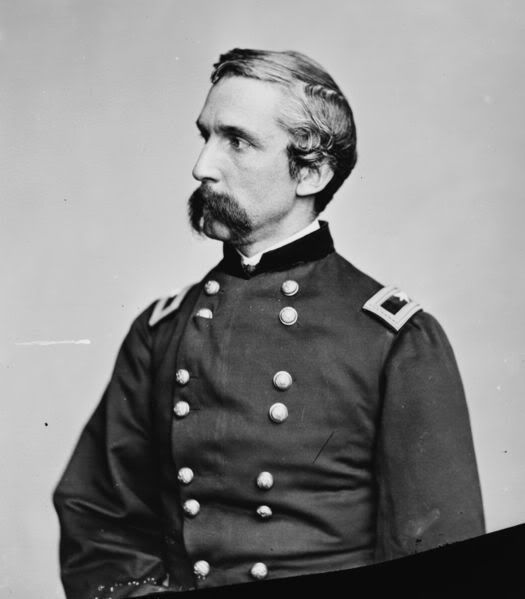
It is also appropriate to tie the remembrance of slavery to Memorial Day because we have, in part, freedmen to thank for it.
During the Civil War, a racetrack near Charleston was converted into a military prison for captured Union soldiers. At least 257 of those men died from exposure and disease and were buried in a mass grave. In April of 1865, two dozen or so black men dug up the grave and properly reinterred the bodies of those dead Union men in the racetrack's infield. (Who cares to imagine that gruesome task?) A fence was built around the new cemetery, whitewashed, with an archway entrance inscribed, "To the Martyrs of the Racecourse." Then, on May 1st, Something remarkable occurred:
At 9 am on May 1, the procession stepped off led by three thousand black schoolchildren carrying arm loads of roses and singing "John Brown's Body." The children were followed by several hundred black women with baskets of flowers, wreaths and crosses.(Of course, the "official" Memorial Day wasn't established until 1868, when General John Logan, Commander of the Grand Army of the Republic, signed General Order No.11.)Then came black men marching in cadence, followed by contingents of Union infantry and other black and white citizens. As many as possible gathering in the cemetery enclosure; a childrens' choir sang "We'll Rally around the Flag," the "Star-Spangled Banner," and several spirituals before several black ministers read from scripture. No record survives of which biblical passages rung out in the warm spring air, but the spirit of Leviticus 25 was surely present at those burial rites: "for it is the jubilee; it shall be holy unto you ... in the year of this jubilee he shall return every man unto his own possession."
Following the solemn dedication the crowd dispersed into the infield and did what many of us do on Memorial Day: they enjoyed picnics, listened to speeches, and watched soldiers drill. Among the full brigade of Union infantry participating was the famous 54th Massachusetts and the 34th and 104th U.S. Colored Troops, who performed a special double-columned march around the gravesite. The war was over, and Decoration Day had been founded by African Americans in a ritual of remembrance and consecration.

Finally, the act of warring ploughs deep furrows in the mind. This is not to say that years on the battlefield are one-to-one in ratio to lifetimes of slavery. It is simply to note a consonance of mental rupture.
The "double consciousness" of WEB DuBois that many black Americans live in is not unlike the double consciousness of the soldier in autumn (even if it's still his or her spring).
 Whether lately returned from the war in Iraq or guarding the memory of the last "Great War;" whether nursing a beer at the VFW or quietly living with all the horror clamped down and only the fierce memories of heightened life and comradeship allowed to percolate to the surface; whether having found an equipoise (no matter how delicate) or desperately seeking to replicate, or escape from, the high of combat; whether a soldier, a marine, an airman or a sailor, that person is always searching for a place in civil society, and for the right tone of life in the place to which that service was rendered. To paraphrase DuBois, it is a struggle to be both a warrior and a civilian, both from within and from without.
  For myself, I struggle to harmonize my love of this nation with my sickness at the things we've been up to lately. My heart is broken; I long to be as proud of this nation as I am of many of her soldiers. And once we open this window into the contradictions of American citizenship, we can see it is a fun-house mirror-maze of double images. Like all mazes, though, there is the promise of finding a way out.
Memorial Day is a day to acknowledge the wounds on the body politic. To see, no matter our own position on any of the litany of conflicts in which our nation has engaged, that those wars have torn a hole in the civic fabric. It is a day for us to acknowledge our national wounds: psychic, moral, bodily -- even political. To look at that place where we have gashed ourselves in the throes of this experiment and say, "Here have we hurt, and yet, we are."
The fulcrum of "and yet" is why the parade. Early Memorial Day parades had two distinct parts: A procession to the cemetery on the edge of town and a recession from there to the town center. On the way to the cemetery, the marchers would be solemn. The band would play a hymn-like tune. The procession would arrive for a dedication and "Taps" -- a Civil War bugle call that once simply signaled the end of the day -- would be played. But on the return to the center of the town, the march becomes a celebration--not of victory, but of enduring hope.
Here have we hurt, and yet, we are.
Hope in this setting is so important. It is the feeling that we are still moving forward, together. A belief that the dream is still viable, still worthwhile. That whatever we do, we do together. That however bitterly we tear at one another, we share a nation and, at root, hold the same essential liberties sacred. That above all we might one day come to a place where discord is marginal, not central, to civic life.
Memorial Day, therefore, is about our community. In order to celebrate it, we should be drawing the community in. This isn't a celebration for the VFW and the Legion (an organization that I am ambivalent about to say the least), though they may be its organizers. Rather than organizing the Day and then expecting the public to come, we need to be reaching out the public and inviting them to participate, not just watch.
I "marched" in my first Memorial Day parade wearing a T-Ball uniform and sneakers. And I marched in every one after that until I graduated from High School. I marched as a Cub Scout, a Boy Scout and a member of the High School Band. In our parade we had: the 4-H; the Pony Club; every kid who played in the town's recreational T-ball, Softball, Jr. Little League and Little League; Mr. Criz and his clydesdales; the community garden group; the Lions Club; the Kiwanis; the High School Band; the Combined Jr. High Bands; the Bethany Community School band, pounding away on their drums and glockenspiels; the Library; the Bethany VFD; the Staties; the Governor's Horse Guard (stabled in town); the EMT's; the Downs brothers, dressed as clowns to pick up after the horses; the Brownies and Girl Scouts; the Bethany Wanderers (hiking group); the Bethany Conservation Commission (us. w/ the Wanderers); the Shriners; at least half a dozen antique automobiles. And that's just off the top of my head.
The parade route was 1.7 miles long. Yes, it was. I mapped it on Google maps. It included two right-wheels (three if you count the start): one onto Peck Road (a steep uphill), and one just past the reviewing stand (yes, there was a reviewing stand) into the parking lot of the Town Hall. Gordon Carrington was always on the reviewing stand (1st Selectman for about 80 years), and the kid who played "Taps" during the laying of the wreath hid out on the side stairs of the Town Hall and always seemed to crack a note or two. Then, after the wreath, we'd all troop back down Peck Road to the Fire Station and get hotdogs from Mr. DiMayo, who grilled squinting into the smoke with a little bit of dip in his lip, and we'd play on the fire trucks.
In 1990, the year before I graduated high school and left town, the population of Bethany was 4,670. The population of Portland is 64,000. The Portland Parade could have chased itself around the monument in Monument Square, around the base of Columbia, "To Her Sons Who Died for the Union." There were few people on the street.
There are a couple of reasons, I think. One is that it has become a three-day holiday weekend. The other is that no one has asked them, or their kids, to participate. Where were the neighborhood groups? Munjoy Hill, Bayside, East Bayside, Western Promenade and the West End all have neighborhood groups. What about the Friends of Deering Oaks Park? What about the historical society/Portland Monuments? Portland Parks and Rec? Friends of Evergreen Cemetery? Portland Trails? A Company of Girls Theater Group? Were the Kiwanis there? What about the Portland Boxing Club? What about our new immigrant communities--don't you think we can do a better job with that? Don't they have something to celebrate here? And shouldn't we, a nation of immigrants, be equally excited to celebrate them? (I guarangoddamtee you the Legion didn't reach out to them.) What about PATHS and Casco Bay HS? I bet those PATHS guys could make up a ripping float.
My point is, this should be a community event. It should be a moment to look around and see who we are, to come together to share sorrow, to honor sacrifice and loss, and then to celebrate ourselves for moving this democracy forward, one day at a time.
We're in an historic moment where the only sacrifice we've been called to make as a community is to support the troops by shopping. But Memorial Day is a chance to stitch the fabric of our Community (capitalized on purpose) a little tighter together.
We need to take that chance.
KJG 1919-2001

Monday, May 26, 2008
Run, Chubby, Run!
I'm a'gonna testify: No man! Can call him self a MAN! IF he canNOT bear the COMPany of a STRONG WOMAN!
In that vein, please allow me to introduce my sister.
You may have heard her obliquely referred to here and elsewhere as "Chubby." Both a moniker and a descriptor (as me), she is in the habit of daring me to do crazy stuff like run many miles with her. Last year, I begged and wheedled whereever they'd let me for support in what eventually became a one-runner race.
Although she had shamed me into preparing for the half-marathon, poor Chubby was unable to join me. Nevertheless, thanks to your generosity the effort was successful. I finished the run and raised over $1000 for the cause. I immortalized the day here, if you're interested in wasting your time surfing the tubes: The Final Adventure of Fat Man and Chubby.
Well, the Chubster is at it again. Actually, she's often at it (it being pretty much anything). In this case, however, it's a run and a cause that is close to both of our hearts.
The Norris Cotton Cancer Center at Dartmouth Hitchcock is where my one of my grandfathers received the last medical treatment of his life. Both of them died from cancer, as did Chubby's father-in-law. As did many of the people we once knew--you may have heard: cancer is quite common. While the CHaD race was my big fundraiser, Chubby attempts the Covered Bridges Half Marathon every year in memory of our grandfathers and as a way to help raise some money for such a fine institution.
IN JUST FIVE DAYS, she will try the run. You have JUST FIVE DAYS to pitch in and donate. Please help us out. This is one gritty, determined person. Read the race report in that link for a look inside her head. I know that part of what drives her on is knowing that, while she has the option of quiting, cancer doesn't give you that chance.
Chubby's more than halfway to her $1000 goal. Please help me help her get to that line--she will take care of the rest.
Thanks, (all) you reader(s). You (guys) are the best.
In that vein, please allow me to introduce my sister.
You may have heard her obliquely referred to here and elsewhere as "Chubby." Both a moniker and a descriptor (as me), she is in the habit of daring me to do crazy stuff like run many miles with her.
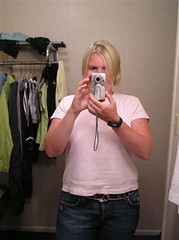 Last year, I begged and wheedled whereever they'd let me for support in what eventually became a one-runner race.
 Although she had shamed me into preparing for the half-marathon, poor Chubby was unable to join me. Nevertheless, thanks to your generosity the effort was successful. I finished the run and raised over $1000 for the cause. I immortalized the day here, if you're interested in wasting your time surfing the tubes: The Final Adventure of Fat Man and Chubby.
Well, the Chubster is at it again. Actually, she's often at it (it being pretty much anything). In this case, however, it's a run and a cause that is close to both of our hearts.
The Norris Cotton Cancer Center at Dartmouth Hitchcock is where my one of my grandfathers received the last medical treatment of his life. Both of them died from cancer, as did Chubby's father-in-law. As did many of the people we once knew--you may have heard: cancer is quite common. While the CHaD race was my big fundraiser, Chubby attempts the Covered Bridges Half Marathon every year in memory of our grandfathers and as a way to help raise some money for such a fine institution.
IN JUST FIVE DAYS, she will try the run. You have JUST FIVE DAYS to pitch in and donate. Please help us out. This is one gritty, determined person. Read the race report in that link for a look inside her head. I know that part of what drives her on is knowing that, while she has the option of quiting, cancer doesn't give you that chance.
Chubby's more than halfway to her $1000 goal. Please help me help her get to that line--she will take care of the rest.
Thanks, (all) you reader(s). You (guys) are the best.
Thursday, February 14, 2008
Chubby Gears Up
Many of you will remember Chubby, my almost faithful side-kick of last summer's half-marinsanothon-bikewreckstravaganza. Well, she's at it again. And this time, very likely without my help.
Her goal: raise some cash for the Norris Cotton Cancer Center.

Both of our grandfathers died from cancer. Our mom's dad, Jim, was able to die with dignity, in our home with my mom and my Gram at his bedside. Much of that was due to the fine care--first curative then palliative--he received at Norris Cotton. Here is a link about where your donation will go.
Chubby's a tough nut, but she's got her work cut out for her. Last attempt at the Covered Bridges half ended in a drop-out due to extensive foot blisters. You know (or can read) the story of last summer's assault on the CHaD with me--plantar fasciitis was the culprit then.
Please chip in with a donation and help her reach her goal of raising $1000. A dollar donated is 100% inspiration, and every bit helps.
Her goal: raise some cash for the Norris Cotton Cancer Center.

Both of our grandfathers died from cancer. Our mom's dad, Jim, was able to die with dignity, in our home with my mom and my Gram at his bedside. Much of that was due to the fine care--first curative then palliative--he received at Norris Cotton. Here is a link about where your donation will go.
Chubby's a tough nut, but she's got her work cut out for her. Last attempt at the Covered Bridges half ended in a drop-out due to extensive foot blisters. You know (or can read) the story of last summer's assault on the CHaD with me--plantar fasciitis was the culprit then.
Please chip in with a donation and help her reach her goal of raising $1000. A dollar donated is 100% inspiration, and every bit helps.
Tuesday, February 5, 2008
Coupla New Links
"Time for an update," says one of my few loyal listeners. So today's a twofer: an obligatory Super Bowl post (confront the pain) and this, an introduction to two new links on my side-bar.
I'd like to introduce you all to my bud Petrie, his wife Trixie and the fruit of her womb, Mia (the only one of the three who gets her real name on the interwebs). Mia's my new girlfriend and she has her own blog titled at right "My Buddy's Baby Girl," a title more explanatory to the average Borrowed Suits reader than its real name, "Mia's Adventure Through Babyland."
OK, it's the human version of a "cat blog," and it seems like everyone and their sister writes a blog about their kids. Who gives a shit about your damn kids?! But Petrie is a good writer -- downright entertaining, actually -- and like I said, Mia's my new girlfriend, so they're up there. When he puts in a real post (rather than just putting up a bloody picture so everyone can see how impossibly cute his issue is) Petrie's a fun read. Go get to know him. (No children were harmed in the making of this blog.)

The other new link is "Poor Sports," a site where four buddies put their bitching on line. Because they're Philadelphia guys, there's plenty to bitch about. I admit to a significant sprinkling of schadenfreude in my affinity for these guys, especially since what shall henceforth be known as Black Sunday, February 3, 2008. That said, any time you get to listen to four buddies intelligently and glibly skewer the teams they love (and everyone else's), it's fun to eavesdrop. Plus, Philly fans hate the Giants more than they resent the Patriots (generally speaking), which makes it one of the few sports blogs that are safe viewing for Pats fans.

First Poor Sports post today is a gem: A recipe for Rose Jam Tartlettes with Cream Topping. "WTF?" you ask. The answer is in the comments:
I can get behind that.
I'd like to introduce you all to my bud Petrie, his wife Trixie and the fruit of her womb, Mia (the only one of the three who gets her real name on the interwebs). Mia's my new girlfriend and she has her own blog titled at right "My Buddy's Baby Girl," a title more explanatory to the average Borrowed Suits reader than its real name, "Mia's Adventure Through Babyland."
OK, it's the human version of a "cat blog," and it seems like everyone and their sister writes a blog about their kids. Who gives a shit about your damn kids?! But Petrie is a good writer -- downright entertaining, actually -- and like I said, Mia's my new girlfriend, so they're up there. When he puts in a real post (rather than just putting up a bloody picture so everyone can see how impossibly cute his issue is) Petrie's a fun read. Go get to know him. (No children were harmed in the making of this blog.)

The other new link is "Poor Sports," a site where four buddies put their bitching on line. Because they're Philadelphia guys, there's plenty to bitch about. I admit to a significant sprinkling of schadenfreude in my affinity for these guys, especially since what shall henceforth be known as Black Sunday, February 3, 2008. That said, any time you get to listen to four buddies intelligently and glibly skewer the teams they love (and everyone else's), it's fun to eavesdrop. Plus, Philly fans hate the Giants more than they resent the Patriots (generally speaking), which makes it one of the few sports blogs that are safe viewing for Pats fans.

First Poor Sports post today is a gem: A recipe for Rose Jam Tartlettes with Cream Topping. "WTF?" you ask. The answer is in the comments:
I understand that you are upset with the Giants talk, but this is such a harsh reaction.
-- by PotsNPans
I can get behind that.
Thursday, December 20, 2007
(Don't) Steal This Book
Finally.
I've been thinking about doing this for more than 10 years. That might be a personal record for procrastination (in a lifetime of perfecting my technique). After much fiddling, I've finally complied recipes from my Great Grandmother Colarusso in an effort to preserve a small part of my family's history, and to keep tabs on the recipes.
The book is being carried by Lulu, an online self-publishing house. You can view, pre-view and order the book here. Here's a picture of the cover:

I've been thinking about doing this for more than 10 years. That might be a personal record for procrastination (in a lifetime of perfecting my technique). After much fiddling, I've finally complied recipes from my Great Grandmother Colarusso in an effort to preserve a small part of my family's history, and to keep tabs on the recipes.
The book is being carried by Lulu, an online self-publishing house. You can view, pre-view and order the book here. Here's a picture of the cover:

Monday, November 12, 2007
Veterans in my life
My Dad: US Army, Regular and Reserve, Corps of Engineers. Service in Canal Zone and Viet Nam, numerous domestic duty stations.
My Dad's Dad: US Navy. Service in WWII, stationed in Australia and New Zealand as part of a bomb squad (munitions detection and disarm), domestic ds in DC.
Uncle: US Navy. Ret'd from Portsmouth Naval Shipyard a few years ago.
Mom's Grandfather: US Army, WWI. Purple Heart.
Cousin Chris, USA Corps of Engineers, VA.
Family friend Margaret H., formerly JAG, now with the State Dept., I believe.
My buddies Jerry (US Army) and Pete (US Army). Jerry jumps out of planes for fun. Pete's a new dad just this past month. Pete's buddies Sam and Devil: I'm rooting for them.
My good friend and role model, Dr. John, USN.
Thank you.
My Dad's Dad: US Navy. Service in WWII, stationed in Australia and New Zealand as part of a bomb squad (munitions detection and disarm), domestic ds in DC.
Uncle: US Navy. Ret'd from Portsmouth Naval Shipyard a few years ago.
Mom's Grandfather: US Army, WWI. Purple Heart.
Cousin Chris, USA Corps of Engineers, VA.
Family friend Margaret H., formerly JAG, now with the State Dept., I believe.
My buddies Jerry (US Army) and Pete (US Army). Jerry jumps out of planes for fun. Pete's a new dad just this past month. Pete's buddies Sam and Devil: I'm rooting for them.
My good friend and role model, Dr. John, USN.
Thank you.
Monday, October 29, 2007
Front-running with the Sox and Pats
I got a short email today from a good friend and replied with an avalanche. Let's share:
Congratulations again.My reply:
Boston wins another world series and the Pats hang 52 on the Redskins (without running up the score).
I can't help but ponder the existential effect this all has on The Brown Psyche -- to go from backing perennial down and out underdogs to supporting 800-pound gorillas can't be easy ...
--C.S.Peirce
Professor:
Odd. I was thinking about that very thing this morning on my walk to work. I was also thinking about what you'd be thinking about it, given our conversations around 2001 and then again in 2004.
When people brought up this (former) harmony between me and my teams, I used to say something like, "I don't know whether I'm a Red Sox fan because of the way I am, or I am the way I am because I'm a fan of the Red Sox." Well, things are changing. I'm not as much that way anymore, for one thing. And obviously, neither are the Sox or the Pats.
I can't really say what effect it's had on me personally, yet, but I can tell you that I care a lot less about MLB now than I used to. It's lost a lot of the romance I used to attach to it and I come face to face with an important truth: unless the game in question has some inherent drama to it, I don't much care to watch. Baseball on TV (especially regular season) is boring. That's all there is too it--turns out I'm just not a fan the way I am with football.
With the Pats, it's different. Now we're winning, but not like the last 6 years or so. This is out of the realm of experience for me and, I think, everyone who's a fan of the NFL. Depending very heavily on this tilt with the Colts, we could be seeing something that is historic. If this kind of thing continues throughout the season and the playoffs, we might find ourselves referring to this team, without hyperbole, as the greatest football team ever assembled since the invention of the forward pass. In some ways, this has gone beyond "fandom," team allegiances or anything like that. It doesn't matter if I root for them or against them. It doesn't matter if I'm worried about the game or not. It doesn't seem to matter whether they're playing at home or on the road, if there are fans or no fans, if it's grass or fieldturf, rain or shine, hot or cold.
Of course, that bit about my support has always been the case. But this team is a machine like no other I've ever seen on TV or on tape. It's impressive and a little scary. If they lose (not counting the last few games of the year -- the 'perfect season' is meaningless in the context of the modern NFL), I won't be disappointed just because we lost (unless it's the playoffs). I'll be disappointed because what I think I might be witnessing will have proven not to be.
But if this keeps up, it will be impossible to argue that this is anything less than the greatest football team ever assembled and still be thought in touch with reality. That would be something to see.
With both, there is another problem: you get saddled with a lot of people who need to identify themselves by the team they're rooting for--it really means something to them, says something about who they are. Or they desperately want it to. This is hugely annoying to me. I love the Pats, and love rooting for them. I used to hate rooting for them (but I still rooted for them). It still makes me down when they lose (more than winning brings me up). But I don't self-identify in the aggressive, in-your-face way that some people seem to do. When all you can think to do is chant "Yankees Suck" something's the matter with your psychology. A winning team seems to hatch these folks like a basement of horseshit sprouts mushrooms.
There's something funny about it. When I was a kid (I was thinking about this this morning as well), we had a short string of station wagons that led ineluctably to the Dodge Caravan. I was on the brink of early adolescence when my Dad was driving the Ford Zephyr. The Zephyr was a light tan on the outside and a dark tan on the inside. It had vinyl seats and manual everything and an AM radio and I couldn't understand how my father stood to drive it. I certainly hid my face riding in it. It was only much later that I realized he had moved past thinking of a car as an expression and into a world where it was a straight-up tool for getting his family from place to place. It didn't bother him to drive it because he didn't care what people thought about his car.
Now, rooting for a team is an extravagance for the ego in the first place. But it doesn't represent some reality where you are the team and the team is you. Or it shouldn't. But successful sports teams seem to draw people out of the woodwork who need that to be true. That used to be me, all the time. I used to be that guy. Oddly, the more successful my teams have become, the less "that guy" I am. I don't know if that's because I've gotten older as they've gotten better, or if it's because I only identify with near-misses and not actual successes. But the more a given team seems to win, the more people like that seem to appear around them, wearing their gear and getting in people's personal space. It's like they're waiting for some semblance of dominance before they'll come out of the closet, as if they identify so completely that any whiff of weakness in the team would expose them as a weakling. And they are supremely obnoxious and annoying.
With the the Sox and the Pats winning regularly, it's become obvious that my failures and mishaps aren't part of a cosmic scheme anymore. Clearly they're just mine. Which is actually kind of nice.
And rooting for lovable losers is overrated. Winning is way more fun.
Friday, October 26, 2007
"For the grapes’ sake, if they were all, Whose leaves already are burnt with frost, Whose clustered fruit must else be lost—"
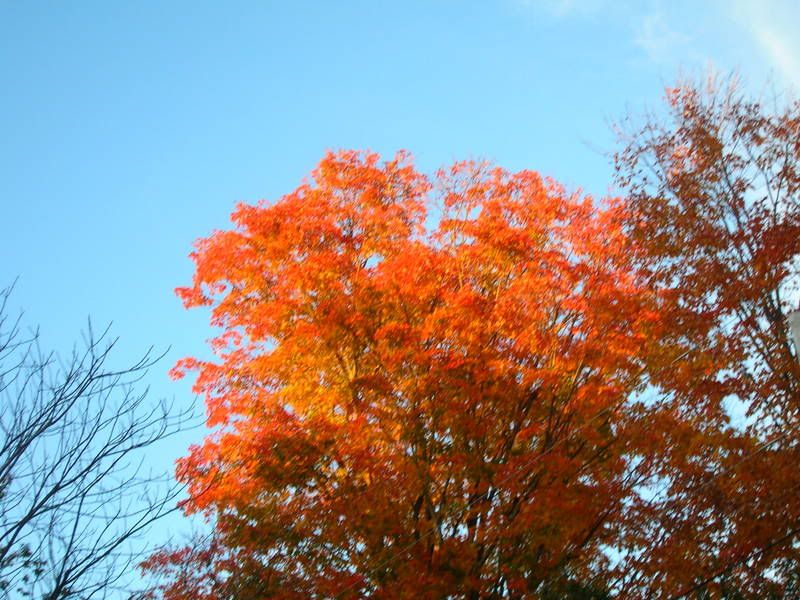
Today was the apotheosis of autumn. It reached in me all of the things I love about this season: its crystalline beauty, its bold fragility, the sense of ending, receding, of time and light dwindling. The seduction of something fleeting, the exhilaration of perfection that cannot last.
I visited the Kennebunkport Conservation Trust at their offices, in a post-and-beam building on a dirt road in the middle of what was once a farm. It was a perfectly mellow autumn day. Brilliant, slanted light of the late year, air that would be cold if not for the sun. Apples from the tree behind the Trust building had fallen. The straw had been cut from the field. A steady breeze shivered the birch leaves and, from time to time, would sweep the field. When it did, I could smell dirt, the thick scents of decaying dead grass and leaves, the tart-sweet tang of rotting apples. Through now-naked branches, the sun sparkled off the brook.
A red-shouldered hawk was circling above the trees across the field. It seemed to be riding the updrafts, but not to a great height. Once or twice the hawk flexed its wings—just to maintain. I thought it would hunt. Finally, seeming to have lost interest in the land in front of me, or perhaps sensing greater luck in a different place, it took off on the wind. Barely a stirring of wing, but rather a silent, still coast; yet incredibly quickly he was gone, over the forest.
There is something about the light in fall, the way it strikes us obliquely, as if through clear water. The further north you go, the more marked is this phenomenon. Last year at this time I spent a couple of weeks working on an island in Penobscot Bay. So sharp those pines stood against the sky! The air was optically perfect—seeming to make my eyes sharper. I could see every needle, every cone, every brush of witches broom stood out like a spot on the sun.
That place and this time are achingly seductive. They beg to be lived in—that singular smell of dead and dying leaves bears no comparison, has no analogue. The smell of the earth is so sharp yet always seems just beyond sensing; shyly, adamantly present. The colors are truer, richer somehow than spring or summer ever could be.
Yet there is such weight in this time, like the unseen side of the basement door when you’re five years old. There is the certainty of winter. The shortness of the day, each day darker, sooner, and noticeably so. The earth seems to linger at a doorway, on a step by the churchyard. Time is whittled away, we are stripped down to what we are, beyond pretense. We find ourselves no longer drawn backward into the future, like Fitzgerald said, but suddenly facing it squarely, seeing it clearly. We look into time coming toward us as it blows the leaves from the trees, takes the hawk from the sky, and irresistibly reveals the pewter light of winter. Winter will cast its watery light on the bones of summer – the only truth is the bones – dark boles of maples, cold granite and schist, the faded straw of the stubble field.
For a brief few weeks, we have truth. Then, if we’re lucky, snow will fall.
I visited the Kennebunkport Conservation Trust at their offices, in a post-and-beam building on a dirt road in the middle of what was once a farm. It was a perfectly mellow autumn day. Brilliant, slanted light of the late year, air that would be cold if not for the sun. Apples from the tree behind the Trust building had fallen. The straw had been cut from the field. A steady breeze shivered the birch leaves and, from time to time, would sweep the field. When it did, I could smell dirt, the thick scents of decaying dead grass and leaves, the tart-sweet tang of rotting apples. Through now-naked branches, the sun sparkled off the brook.
A red-shouldered hawk was circling above the trees across the field. It seemed to be riding the updrafts, but not to a great height. Once or twice the hawk flexed its wings—just to maintain. I thought it would hunt. Finally, seeming to have lost interest in the land in front of me, or perhaps sensing greater luck in a different place, it took off on the wind. Barely a stirring of wing, but rather a silent, still coast; yet incredibly quickly he was gone, over the forest.
There is something about the light in fall, the way it strikes us obliquely, as if through clear water. The further north you go, the more marked is this phenomenon. Last year at this time I spent a couple of weeks working on an island in Penobscot Bay. So sharp those pines stood against the sky! The air was optically perfect—seeming to make my eyes sharper. I could see every needle, every cone, every brush of witches broom stood out like a spot on the sun.
That place and this time are achingly seductive. They beg to be lived in—that singular smell of dead and dying leaves bears no comparison, has no analogue. The smell of the earth is so sharp yet always seems just beyond sensing; shyly, adamantly present. The colors are truer, richer somehow than spring or summer ever could be.
Yet there is such weight in this time, like the unseen side of the basement door when you’re five years old. There is the certainty of winter. The shortness of the day, each day darker, sooner, and noticeably so. The earth seems to linger at a doorway, on a step by the churchyard. Time is whittled away, we are stripped down to what we are, beyond pretense. We find ourselves no longer drawn backward into the future, like Fitzgerald said, but suddenly facing it squarely, seeing it clearly. We look into time coming toward us as it blows the leaves from the trees, takes the hawk from the sky, and irresistibly reveals the pewter light of winter. Winter will cast its watery light on the bones of summer – the only truth is the bones – dark boles of maples, cold granite and schist, the faded straw of the stubble field.
For a brief few weeks, we have truth. Then, if we’re lucky, snow will fall.
Tuesday, August 28, 2007
The Final Adventure of Fat Man and Chubby, or, How Not to Prepare for a Half-Marathon
It’s been a short summer for our dynamic duo, who have found myriad ways to avoid preparing for the Big Day. But the day dawned, as days do, regardless of our steadfast procrastination. And it dawned with a vengeance. Would our heroes survive?
Fat Man had been circling Portland’s Back Cove like a dog prepping its bed for most of the summer. Now intimately acquainted with every pothole, washout and linden tree on the route, he finally turned 7 miles at 9:20 per, and added longer runs of 10 and 12 miles. He was feeling reasonably prepared until the Monday before the race, when a fateful telephone call informed him that he was to be without his race partner.
Chubby’s plantar faciitis had put her on the back foot (pun intended) since the beginning of the summer. What with one thing and another, she simply didn’t feel ready to tackle the full 13.1 miles of running in Hanover. “I’ve tried to run a half-marathon before I was ready, once. I’m not going to do it again. But you can still come and stay with us, and I’ll pass you gu during the race.” OK.
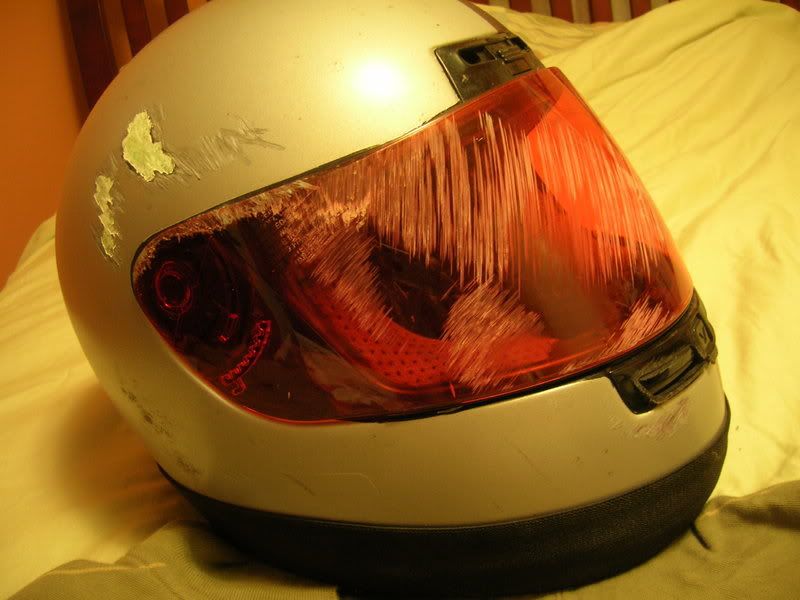
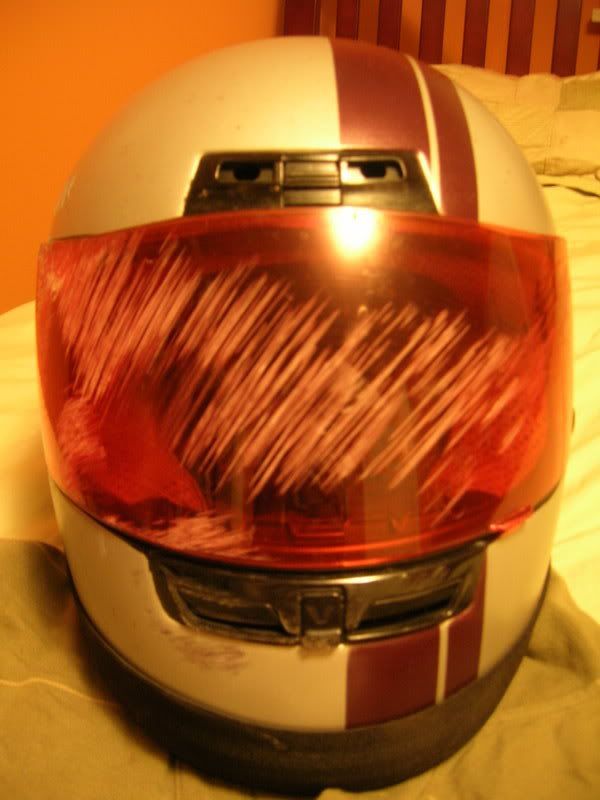
Now alone in his quest, Fat Man commenced a final week of training: A solid 9.5-mile jog near Squam Lake in New Hampshire on Saturday. Back to Portland for a 3 mile Monday, a 5 mile Wednesday and a 7 mile Thursday. It was a beautiful week, with clear skies and temperatures in the mid-70s. My times were right on target. I was feeling so good about my preparation that I left work early on Friday and wrecked my motorcyle.


There’s really nothing like rolling along an entrance ramp to pack a whole afternoon of rugby fun into about 10 seconds. When your soft brain hits your hard skull, you see stars. That’s a minor concussion.
Instead of an early start to Vermont, I had to wrangle with two of Portland’s finest, who were hell bent on telling me that what I said happened couldn’t possibly have happened. They were pissed that they couldn’t write me a ticket, so they compromised by insisting that I either move the bike immediately or let them call a wrecker. Here’s the picture: I’m standing on a median, bleeding from my arms and talking with my insurer on the phone while a motorcycle (!) cop insists that I get my bike out of the median RIGHT NOW or I’ll call a wrecker and then stare you down until you get off the phone and MOVE THAT BIKE OFF THE MEDIAN, YOU CAN’T LEAVE IT HERE. Well no shit, buddy. Give me five minutes to stop bleeding and rent a truck at the U-Haul (a 2 minute walk away) and I’ll move the wreckage anywhere you want it.
2 hours and a U-Haul later, I was on my bloody way to Vermont. (Many thanks to my colleague Wolfe, who babysat me by the side of the road whilst I sorted the mess out, and let me have his Vitamin Water after I asked him for iced tea and then changed my mind.)
Alas, my relations with the Boys In Blue were just beginning. Driving through Moultonborough, NH, I was pulled over for having a headlight out. “Why is your hand bloody?”
“I was in a motorcycle accident this afternoon.”
“Then why isn’t that covered up?”
“Well, it isn’t bleeding, so I thought I’d let it air out a bit.”
“Where was the accident?”
“Portland, Maine.”
“Wait right here.”
…Waiting…
...waiting...
“Where did you say the accident was?
“It was in Portland, Maine, at about 2:30 this afternoon.”
“Was an officer called to the scene?”
“Not by me, but yes, there were two. No public or private property, except for my bike, was harmed, and no one but me was involved.”
“Wait here.”
…Waiting…
“Well, Portland PD has no record of that. Where was it specifically?”
“I don’t know why they have no record; there were two officers there: an officer in a cruiser and a motorcycle cop. The younger officer, the one in the cruiser, was filing the report. The accident occurred at about 2:30 on the Washington Avenue on-ramp to I-295 North –“
“Alright, well, I can’t hold you here. Get that headlight looked at.”
Oh, you can’t hold me here for, what? Public bleeding? Go figure.
About an hour later, I was pulled over in Vershire, VT, for the same reason. Those guys were pretty nice, though.
After spending the night with Chubby and Husband Mick, the day of the race dawned.
Actually, it didn’t dawn so much as it oozed over the horizon and covered the world with gooey, sticky humidity. The sun struggled to shine through air that was positively chewy. The temperature began to rise. And rise. By the time of the race, humidity was at 75% and the air temperature was 94 degrees. Here’s a picture of me before the start of the race, looking like the victim of an accident involving an electric loofa and a tube of toothpaste:

And they’re off! No one looked really excited to be out in this heat, but there were about 520 of us there anyway. That's me -- in the back...

Chubby and Mick met me at two places along the course with (mercifully) cold water and gu. The water supplied by the race staff was about as warm as my sweat, singularly unrefreshing and slow to leave my stomach. Bad news. Worse yet, after a week of race prep in mild Casco Bay breezes, the temperature continued to climb. After meeting me at mile 6, Chubby and Mick headed over to mile 10. Along the way, the outside temperature thermometer in their Jeep, which is mounted under the front bumper, read 100 degrees.
I don’t do well with heat. Too big, too fair, too northern European. Through mile 7 I was right on time for such a hot day, but by mile 8 I was toast. Even when the humidity was relieved by a violent thunderstorm, I couldn’t get it back. The wind blew sand into my mouth, so I chewed on that for about a mile. It also blew down several trees along the course. After the rain passed through, the temperature remained high but the humidity lessened slightly. Not that I noticed. Check out my David Marcus Memorial Racing Stripes:

Embarrassingly personal detail: I’ve been wearing little round band-aids on my nipples to keep this from happening, and they work well. But with the weather, my shirt stuck to my chest enough to wear through the small amount of skin not covered by the band-aids.
Finally, some 2 hours and 43 minutes after I started, I finished, and was finished. I had been shooting for 2:11, but that’ll have to wait until next time. Plenty of lessons from this, my first long running event (and only my 3rd event ever).
.JPG)

My very sincere thanks to everyone who contributed by sponsoring me. Together, we raised $1088.70 – an impressive figure! The special efforts at CHaD are well worth supporting. Chubby, who has had a chance to work there from time to time, reports that CHaD focuses relentlessly on improving the experience from a child’s point of view. The work they do is critical to children in the upper valley. Thanks for chipping in.
Altogether, the race raised over $142,000 for CHaD. Thanks to you all, and remember: Always wear your helmet.


Fat Man had been circling Portland’s Back Cove like a dog prepping its bed for most of the summer. Now intimately acquainted with every pothole, washout and linden tree on the route, he finally turned 7 miles at 9:20 per, and added longer runs of 10 and 12 miles. He was feeling reasonably prepared until the Monday before the race, when a fateful telephone call informed him that he was to be without his race partner.
Chubby’s plantar faciitis had put her on the back foot (pun intended) since the beginning of the summer. What with one thing and another, she simply didn’t feel ready to tackle the full 13.1 miles of running in Hanover. “I’ve tried to run a half-marathon before I was ready, once. I’m not going to do it again. But you can still come and stay with us, and I’ll pass you gu during the race.” OK.
Now alone in his quest, Fat Man commenced a final week of training: A solid 9.5-mile jog near Squam Lake in New Hampshire on Saturday. Back to Portland for a 3 mile Monday, a 5 mile Wednesday and a 7 mile Thursday. It was a beautiful week, with clear skies and temperatures in the mid-70s. My times were right on target. I was feeling so good about my preparation that I left work early on Friday and wrecked my motorcyle.


There’s really nothing like rolling along an entrance ramp to pack a whole afternoon of rugby fun into about 10 seconds. When your soft brain hits your hard skull, you see stars. That’s a minor concussion.
Instead of an early start to Vermont, I had to wrangle with two of Portland’s finest, who were hell bent on telling me that what I said happened couldn’t possibly have happened. They were pissed that they couldn’t write me a ticket, so they compromised by insisting that I either move the bike immediately or let them call a wrecker. Here’s the picture: I’m standing on a median, bleeding from my arms and talking with my insurer on the phone while a motorcycle (!) cop insists that I get my bike out of the median RIGHT NOW or I’ll call a wrecker and then stare you down until you get off the phone and MOVE THAT BIKE OFF THE MEDIAN, YOU CAN’T LEAVE IT HERE. Well no shit, buddy. Give me five minutes to stop bleeding and rent a truck at the U-Haul (a 2 minute walk away) and I’ll move the wreckage anywhere you want it.
2 hours and a U-Haul later, I was on my bloody way to Vermont. (Many thanks to my colleague Wolfe, who babysat me by the side of the road whilst I sorted the mess out, and let me have his Vitamin Water after I asked him for iced tea and then changed my mind.)
Alas, my relations with the Boys In Blue were just beginning. Driving through Moultonborough, NH, I was pulled over for having a headlight out. “Why is your hand bloody?”
“I was in a motorcycle accident this afternoon.”
“Then why isn’t that covered up?”
“Well, it isn’t bleeding, so I thought I’d let it air out a bit.”
“Where was the accident?”
“Portland, Maine.”
“Wait right here.”
…Waiting…
...waiting...
“Where did you say the accident was?
“It was in Portland, Maine, at about 2:30 this afternoon.”
“Was an officer called to the scene?”
“Not by me, but yes, there were two. No public or private property, except for my bike, was harmed, and no one but me was involved.”
“Wait here.”
…Waiting…
“Well, Portland PD has no record of that. Where was it specifically?”
“I don’t know why they have no record; there were two officers there: an officer in a cruiser and a motorcycle cop. The younger officer, the one in the cruiser, was filing the report. The accident occurred at about 2:30 on the Washington Avenue on-ramp to I-295 North –“
“Alright, well, I can’t hold you here. Get that headlight looked at.”
Oh, you can’t hold me here for, what? Public bleeding? Go figure.
About an hour later, I was pulled over in Vershire, VT, for the same reason. Those guys were pretty nice, though.
After spending the night with Chubby and Husband Mick, the day of the race dawned.
Actually, it didn’t dawn so much as it oozed over the horizon and covered the world with gooey, sticky humidity. The sun struggled to shine through air that was positively chewy. The temperature began to rise. And rise. By the time of the race, humidity was at 75% and the air temperature was 94 degrees. Here’s a picture of me before the start of the race, looking like the victim of an accident involving an electric loofa and a tube of toothpaste:

And they’re off! No one looked really excited to be out in this heat, but there were about 520 of us there anyway. That's me -- in the back...

Chubby and Mick met me at two places along the course with (mercifully) cold water and gu. The water supplied by the race staff was about as warm as my sweat, singularly unrefreshing and slow to leave my stomach. Bad news. Worse yet, after a week of race prep in mild Casco Bay breezes, the temperature continued to climb. After meeting me at mile 6, Chubby and Mick headed over to mile 10. Along the way, the outside temperature thermometer in their Jeep, which is mounted under the front bumper, read 100 degrees.
I don’t do well with heat. Too big, too fair, too northern European. Through mile 7 I was right on time for such a hot day, but by mile 8 I was toast. Even when the humidity was relieved by a violent thunderstorm, I couldn’t get it back. The wind blew sand into my mouth, so I chewed on that for about a mile. It also blew down several trees along the course. After the rain passed through, the temperature remained high but the humidity lessened slightly. Not that I noticed. Check out my David Marcus Memorial Racing Stripes:

Embarrassingly personal detail: I’ve been wearing little round band-aids on my nipples to keep this from happening, and they work well. But with the weather, my shirt stuck to my chest enough to wear through the small amount of skin not covered by the band-aids.
Finally, some 2 hours and 43 minutes after I started, I finished, and was finished. I had been shooting for 2:11, but that’ll have to wait until next time. Plenty of lessons from this, my first long running event (and only my 3rd event ever).
.JPG)

My very sincere thanks to everyone who contributed by sponsoring me. Together, we raised $1088.70 – an impressive figure! The special efforts at CHaD are well worth supporting. Chubby, who has had a chance to work there from time to time, reports that CHaD focuses relentlessly on improving the experience from a child’s point of view. The work they do is critical to children in the upper valley. Thanks for chipping in.
Altogether, the race raised over $142,000 for CHaD. Thanks to you all, and remember: Always wear your helmet.
Monday, June 4, 2007
Provincetown
A long time had passed since my lady and I had a chance to sneak away together, when we finally made it happen this past weekend. With the Memorial Day blowout behind it Cape Cod takes a three week's breath to prepare for the summer onslaught, and we took advantage of the slack to make a long weekend trip to Provincetown.Yes, we were now in that enchanted calm which they say lurks at the heart of every commotion. ...
...Like household dogs they came snuffing round us, right up to our gunwales, and touching them; till it almost seemed that some spell had suddenly domesticated them. Queequeg patted their foreheads; Starbuck scratched their backs with his lance; but fearful of the consequences, for the time refrained from darting it.
But far beneath this wondrous world upon the surface, another and still stranger world met our eyes as we gazed over the side. For, suspended in those watery vaults, floated the forms of the nursing mothers of the whales, and those that by their enormous girth seemed shortly to become mothers.
...Some of the subtlest secrets of the seas seemed divulged to us in this enchanted pond. We saw young Leviathan amours in the deep.
...But even so, amid the tornadoed Atlantic of my being, do I myself still for ever centrally disport in mute calm; and while ponderous planets of unwaning woe revolve round me, deep down and deep inland there I still bathe me in eternal mildness of joy.
--Herman Melville, Moby Dick, Ch. 87 "The Grand Armada"


We had a really wonderful time. We stayed at The Gallery Inn, where we were made to feel very welcome. This guesthouse is squarely in the middle of the Commercial Street strip, with the majority of artist galleries to the east and the majority of bars, restaurants and shops-of-nothing (and nothing-to-mention) to the west. We spent most of the time on foot, with a half-day spent exploring the bike paths of the National Seashore. Much drinking and eating, though I did get up for an early-morning jog two days.
Those early mornings threatened rain, and I enjoyed empty streets shrouded in fog and mist, and lonesome views of the salt flats behind the breakwater. That land is blessedly useless to us. Still pools of salt water reflect the sand and stubborn plants that hold it all in place, gradually giving way to the dunes of the Province Lands. On those mornings, the pools were silvery mirrors to low clouds and beyond them the sky came down to touch the sea.
The dramatic highlight for both of us, however, was a whale-watching trip with the Dolphin Fleet company. Words cannot capture the amazement, the child-like wonder, that seems to thrill anyone who has had a lucky whale-watching cruise. I've been on two before this one, with limited results. Last Friday, however, we were given a real gift.
It is the beginning of the feeding season for Humpback whales. They've been breeding in the warm waters of the Dominican Republic all winter (a past-time seemingly enjoyed by most mammals who have the chance to winter there). The clear Caribbean waters are nutritional deserts, however. The whales make their way north to Stellwagen Bank just off the tip of the Cape to feed on tiny krill all summer. Almost all of the great fishing banks in the Gulf of Maine enjoy some whale presence at this time; Stellwagen Bank just happens to be very close to Provincetown and to Boston, making it an ideal whale-watching destination. Even with that advantage, it takes a bit of luck:


That particular show, the breaching whale, was repeated many times by the same individual -- a very rare treat. We also saw several whales lazing idly on their backs and sides, repeatedly slapping the water with their pectoral fins. We witnessed a mother and calf, swimming close to the surface and breifly accompanied by another whale, slowly cruising the feeding grounds.
The humpback is one of four great whale species that populate the Gulf of Maine and like both the Right and Fin Whales, is endangered. (The Minke enjoys a population of some 3-4000 and is, for the moment, safe from extinction.) The humpback, so named for the distinctive dorsal not-quite-fin, is the most playful on the surface of the water, slapping its tail, rolling, breaching. Although all these behaviors are well-known to the naturalists who track individuals for years and years, no one has yet figured out why they do it.
They should be exhausted. They've just reached the bank after a starving winter and a prodigious journey. On the other hand, I've been known to react similarly to the sudden availability of food. So I think they're just happy to be back in New England waters.
Humpback whales are distinguished by the unique markings on their tails--a "tailprint" as unique as the whorls on your thumb. Our showoff is known as "Wave." The whale pictured with fins in the air was "Eruption." The mother of the calf we saw is "Black Hole." When her calf is one year old and the pigment in its tail has finally settled, the calf will be given a name as well.
Stellwagen Bank National Maritime Sanctuary offers limited protection. There's still shipping and fishing and pleasure boating. Commercial and military shipping poses by far the greatest threat to the whales in these waters. Scientists reckon that collisions with a ship traveling less than 13 knots would not be fatal. The reduced speed also gives the whales a chance to get out of the way. The military strikes more whales than anyone else (they have more ships and they zip about and they aren't willing to not zip about). The military are not subject to the regulations and of course the shipping industry is averse to anything that would slow down their "just in time" supply chain.
The World Shipping Council (Partner's in America's Trade) is primarily concerned with the way a reduced speed over whale routes would affect the timing of their constituents' ships' arrival in port. Of course, once the limit is in place, the timing is easily adjustable to match the tides. It's pretty much a simple math problem - the same problem, in fact, that they've already solved based on a constant rate of speed.
Their stronger argument is that the evidence for reduced speed is "inconclusive." But that's the standard industry response to all regulation, no matter the industry or the regulation. Find one scientist or study with a varying opinion and you've got "inconclusive." This is what happens when you substitute legal reasoning for scientific reasoning. It is the perennial bugaboo of the conservation lobby, as scientists will never evince unanimity. Because rules and regulations are black-and-white, lawyers like the evidence in support of those rules to reflect certainty, rather than probability.
What is not up for debate is that unless we take care, we will kill off the right whale. At least when we were harvesting them for oil, there was some justification for the carnage. Now, we're just being indifferent.
There are approximately 8-900 humpback whales left.
There are maybe 300 right whales left.
When all the shipments are on time, will we be glad we killed the whales?
Whale-watching itself is ambiguous. The ambient noise of the boats creates a constant wash of noise in the water. That noise has been shown to disorient the animals, although not all of the time. The crew of the Dolphin Fleet follow a series of guidelines promulgated by NOAA (not a lot on the site--I have a pamphlet if you're interested in more). But there's little enforcement; the guidelines are largely voluntary (although there are penalties in the unlikely event a violator is caught).
No one really knows, and that's the terrible paradox: there is so much we have yet to learn, but we're irredeemably clumsy sometimes, even when we're trying our best.
But when we fail even to try, we're positively lethal.
Monday, May 28, 2007
On Memorial Day: Why we don't fight
May 28, 2007 and the list of those we're called to honor and remember continues to grow. Like many people, I needn't search for soldiers to honor. Both of my grandfathers (US Army, US Navy), my uncle (USN) and my father (US Army and Army Reserve) have worn the uniform of my country.
I have deep admiration for my father's service. But in the example he offered to me was a lesson of ambivalence and caution and, ultimately, the reason I've never signed on the line: you cannot trust this government to use honorable men honorably. There is always the chance that you will be sent to kill for a mistake, or a lie.
I've been tempted more than once. Often, in fact. I regret not serving as often as I know it was the right choice for me. My father also taught me by his example that there are many ways to serve your country. Perhaps the best way is by being an active citizen. Take an interest in your community, your city, your state and your nation. His father lived that way, and he does as well. And I'm trying.
My Dad's legacy to me, on this day that is reserved for memory of service in war, is this: let us never spend the blood of our fellow citizens for any but the most righteous and unavoidable reasons. Let us value the blood of the stranger as highly, and let violence be our last, regrettable option.
This is my Memorial Day post, dedicated to my Dad and to everyone who has served our Nation. It is a long post, but incomplete. I will return to its themes again, particularly those I raise at the end of this entry. For the moment, this is a small expression of one of my obligations as a citizen: to see that our men and women are never wrongly or vainly used. To ask, "Have we set ourselves to violence and war in service of our Nation, or only of the government?"
A while ago, I stuck up a post titled, Remind Me: This was necessary why?. Well, I got an answer. It's free of snark, sarcasm or superiority. Here it is in full:
I couldn't agree more strongly with the basic philosophy of my commenter. You do have to fight for freedom, sometimes with bullets and always with vigilance. And sometimes it is morally necessary to take up your gun and fight for someone else's freedom -- even if they haven't asked for your help. British soldiers in Sierra Leone, for example. Of course, the Kurds begged for our help after the first Gulf War. Instead, we let Saddam gas them (with gas we had sold to him in the 80's). But when we invaded Iraq this time, it wasn't to liberate the Iraqis or to bring democracy. That reason got tacked on after the fact. Long after the fact.
When I asked the question, "why was this necessary," it was posted above a photo of an anguished man who had been searching the morgue for his brother, and above a story about a man whose children are slowly dying from starvation and dehydration. The question has two levels: why was this (the Iraq war) necessary, and why was this (murder and anarchy on an unprecedented scale; starvation and the creation of refugees) necessary?
The first thing I have in mind when I think about the war in Iraq is this: we chose it. Iraq and Saddam Hussein had no hand in planning or supporting the attacks of September 11. This is so well recognized that Dick Cheney and George Bush are both on record to that effect. In fact, they were more interested in making a case for invasion than actually targeting known terrorists. We were told by the President and the Vice President and the Secretary of State and the Secretary of Defense that Iraq had weapons of mass destruction, and that Iraq constituted an imminent threat to the safety of the United States. We were told that if we waited for evidence of that fact, "the smoking gun would come in the shape of a mushroom cloud."
At the time, UN weapons inspector Hans Blix (whose name has become a punch-line) was saying a) that there was no evidence that this was so, and b) that it would take a couple of months to prove it: "It will take not years, nor weeks, but months." In spite of Blix's excellent reputation, we, with the support of Great Britain, declined to give him the time he needed. We created an arbitrary deadline for a process that was ongoing, and then we went to war. As we know, Blix has been proven right. There were no weapons of mass destruction, and there was no ongoing weapons program. (Although that did not stop the President from making a big joke about it -- right about the time, I think, that my commenter had his boots in the sand.)
So those were the two big themes: Iraq poses a threat to the US, and Iraq has weapons of mass destruction. This wasn't a war for freedom, in the beginning. It was a war of self-defense. That's how it was sold to us. This is the beginning of my anger: If the administration had come to the American people and said, "Saddam Hussein is a terrible tyrant. He is oppressing his people, jailing and torturing them on the basis of their religion (Shiites) and their ethnicity (Kurds). The Iraqi people are so beaten down that they need a hand up, and we're the ones to give it to them," I think that would have worked. Not only that, but working through the United Nations and other diplomatic channels, I think the administration could have marshaled the significant coalition that would be necessary to topple a dictator and occupy a country -- a much larger force than we have ever committed to Iraq.
International support would have fallen away quickly, of course, once other nations started researching Iraq and its history of internal violence and strife. We would have quickly been forced to see that this would be a much more complicated task than we thought. But when yours is the only voice that matters, you believe your own propaganda.
The invasion and occupation of Iraq was never about freedom for Iraqis -- at least not for their sake. If the Iraqi people obtain freedom, we'll be very happy about that, but we didn't go there to deliver them from tyranny. It is important to distinguish between why we said we went and the real reasons for going. If it is your belief that the President always tells the truth, the whole truth and nothing but the truth, the following argument will not have much weight for you. But since I don't think you honestly believe that, here it is. He didn't go with "freedom for Iraqis." He went with "our freedom is threatened by Iraq." It was only much later, when the weapons and weapons programs hadn't been found, that he fell back on the 'liberators' theme.
Had those arguments been true, or even supportable, perhaps I could understand the decision. But for some reason, the rest of the world wasn't buying it. Not even after Colin Powell did his thing at the UN. Sure, Britain signed up. At the time, their interests seemed indistinguishable from ours (at least to Jack Straw and Tony Blair). And there were a few countries that offered aid in transport and rear-echelon support (and billed for it). But where was the coalition, really? If Saddam was such a threat, regionally and globally, why weren't the Arab nations lining up behind us as they had done in the first Gulf War? And why were the chief military powers of Europe and the Soviet Union so against this?
Obviously, one answer is oil. I'll discuss that in a bit. But the other answer is that there was no real evidence of the things Bush claimed. There was no evidence of a nuclear program. There was no evidence of a chemical weapons program. There was no indication that Saddam was a threat outside his own borders. Why then did the US seem to have this great case? If the evidence was there and we failed to act (as happened on 9/11), then that would be a crime. But how is it that we had this evidence that no one else had? And were our intelligence agencies really that bad? How could they have gotten this wrong?
Well, the truth is that they didn't. As George Tenet has finally seen fit to reveal in a book basically designed to redeem himself from the firey pit, good intelligence was ignored, censored and thrown in the trash in order to make the case for war. As the Baltimore Sun has explained in a scathing editorial [ed. note: original link, now dead, replaced w/copy of editorial cached at Common Dreams]:
Stovepiping:
The military strategist von Clauswitz famously described war as "the continuation of policy by other means." (A phrase fraught with substantial ambiguity. See here.) As an observation, perhaps this is true. But there is a piece missing: why must policy that leads to war be continued at all? The answer is supplied by Tony Benn who, on the last day of the Gulf War said to the House of Commons, "All war represents a failure of diplomacy."
Ten years later, as Bush mounted the war horse, Benn didn't get a chance to be right. Diplomacy didn't fail -- it ceased. Hussein was contained. We didn't even get to manufacture our own "Gulf of Tonkin incident." The Iraqis couldn't -- or didn't -- even shoot down one of our planes. Instead, we simply called off the weapons inspections and invaded.
People who want to argue this point often point to the failure of the UN "Oil for food" program as evidence that diplomatic means would never work. But why did Oil-for-food fail? It failed because it enriched Saddam Hussein, rather than starving him. How? Because American oil companies paid he and his government substantial kick-backs on the oil he sold them. As Condoleeza Rice has said:
So how did oil-for-food fail? Oil companies subverted it. Did we go to war to free Iraqis? Or did we go to war to free their oil? Or do we just not give a shit? After all, these are the very same companies who wrote our energy policy.
Last year, a man named Kevin Phillips wrote a book called American Theocracy: The Peril and Politics of Radical Religion, Oil, and Borrowed Money in the 21st Century. I confess that I haven't finished it yet. It's hard to take 400 pages of relentlessly rational and documented bad news. Phillips is an interesting cat: He was a young hot-shot political strategist who helped elect Nixon. He penned "The Emerging Republican Majority" in 1969. He also authored one of the more cynical political tactics ever: the Republic party's "southern strategy." Just a refresher on that:
The "southern strategy" was to exploit racial hatred to raise Republicans. Phillips, in 1970:
For his part, Saddam was playing both ends against the middle: dangling contracts in front of all comers to squeeze cash out of them up front. Concessions that lingered with non-US names on them were insurance against the day when the Chevrons and Exxons of the world tired of paying the vig. A backstop at the end of the streak that would leverage Saddam's position by threatening the complete upheaval of the global oil game. But the US oil companies had something the French and Russians didn't: a government composed of oilmen.
But not just oilmen: oilmen with a new religion.
The church these men worship in is better known as the Project for a New American Century (PNAC). Here is the sum of their statement of Principles:
Yet, somehow, we didn't attack Iran, which had a nuclear development program at the time. Nor did we attack North Korea, which had an indisputably advanced nuclear armament program at the time. We attacked the country with the most oil. Even though they had nothing to do with 9/11 and they had no significant regular military and no WMDs or program to develop WMDs. Even though they did not harbor al-Queda, nor al-Zarqawi. What constitutes a threat that justifies invasion and occupation? I promise you, we weren't there to liberate Iraqis.
How do I know that the doctrines outlined by PNAC on their website informed our decision to invade Iraq? On that same page is a list of the signatory members to PNAC's prinicples, including Elliot Abrams, Bill Bennett, Florida Governor Jeb Bush, Steve Forbes, Donald Kagan (architect of the "surge"), Scooter Libby (convicted of lying to a grand jury and obstruction of justice), Dan Quayle, Donald Rumsfeld, Paul Wolfowitz and Dick Cheney.
I think that answers the first level of the question: why was this necessary. It wasn't. This war wasn't about freeing the Iraqi people. It was about some combination of preserving our perceived right to the oil under the sand and a desire to protect American hegemony by attacking an unstable dictatorship that wouldn't get with the program. We didn't bargain for the hornet's nest.
The second level of the question is "why is the incredible suffering of the Iraqi people necessary?" And if you've come this far, doubtless you know my answer to that question is also "it wasn't."
This isn't just "hard." This is unconscionable:
What would it take to make you leave the United States? How bad would things have to get before you would beg to be allowed to leave this land?
The invasion of Iraq has caused a deeper humanitarian crisis than the simple death and torturing of thousands of Iraqi civilians. It has created over two million refugees:
Let me say this again: Forming a democracy does not require this. It does not require torture. It does not require refugees. It does not require Haditha. It does not require Abu Ghraib.
What ends will ever justify these means?
?
A great deal has been written about the way we prepared for an executed our post-invasion behavior. Perhaps one of the more readable accounts is Rajiv CHandrasekaran's Imperial Life in the Emerald City. I'm not going to delve too deeply into it here. Suffice it to say that you wouldn't want these guys planning a tea-party, much less the occupation and rehabilitation of an entire country. But there was more to it than that: The inherited factionalism of Iraq went completely unplanned-for. The fact that we expected Iraq to transition instantly from a soviet-style command economy into a full-blown free-market capitalistic society (such that doesn't even exist in America) was taken for granted. No preparations were made for employment, few for healthcare, none for provisioning. No one seems to have entertained the idea that the power vacuum we created would invite exploitation by any number of warlords and ex-pat terrorists.
I've summed his book before, saying:
We pay for the results every day. But out casualties have only barely outstripped all the dead from 9/11 (though there are more every day and over 100 this May). The Iraqis have died by the tens of thousands.
Now we come to the hard part, as a nation, the deeply personal part.
You are a soldier. Your duty is to go when ordered and to "stay in your lane." To back up the man to your right and your left and fulfill the mission. How can I ask you to risk your life and the lives of your squad by allowing even a sliver of doubt?
And what right do I have to risk your honor by questioning the use to which it has been put?
And here we find the difference between the civilian and the soldier.
My father served in Vietnam. My grandfather served in World War II. I used to dress up in dad's old fatigues and run through the woods. I wore out my school's supply of books on WWII and WWI and all the "Colby's" catalogs of armaments. Jane's on planes and ships and helicopters. I practiced my salute in the mirror and crept up to his office on rainy Saturday afternoons to scrabble in the deep back of the bottom drawer of the filing cabinet to find the boxes of his medals and his service ribbons. Later I read Clauswitz "On War" and Keegan on the "Face of Command." And on and on.
In spite of that, I never enlisted in the armed forces, although there have been times when the temptation has been very strong. Even lately. And the reason was (and is) this: I knew, from Vietnam, that if I did, there was a chance I would be sent where I didn't belong and asked to kill a man that shouldn't be killed and for all the wrong reasons. It wouldn't be up to me. And I wouldn't have a say in it. And I don't trust my government enough to believe they wouldn't do that to me.
They would. In a heartbeat.
It is my deepest obligation as a citizen of the United States of America to do everything in my power to ensure that my government never asks my fellow citizens in uniform to die or to kill for anything other than the highest moral aim in just and righteous combat. Anything less erodes the glory of my nation.
My nation's glory has taken a savage beating over the last four years. There's not much left.
Senator Webb made the point bluntly in his State of the Union response: “We owed [our leaders] our loyalty, as Americans, and we gave it. But they owed us…sound judgment, clear thinking, concern for our welfare, a guarantee that the threat to our country was equal to the price we might be called upon to pay in defending it. The president took us into this war recklessly.”
What we haven't spent in foreign fields we have, incomprehensibly, corroded and attacked from within: law-breaking surveillance of our own citizens, the evisceration of the Writ of Habeas Corpus -- the Great Writ -- being only two examples. I have, and will, go on at length about these things elsewhere. And this post is far too long already. But for today, Memorial Day, I ask for more than memory of our servicemen and women. I ask for help remembering who We are: I can scarcely recognize us now.
Columbia, so disfigured! Only fear, hate and deceit can yield such a face.
I have deep admiration for my father's service. But in the example he offered to me was a lesson of ambivalence and caution and, ultimately, the reason I've never signed on the line: you cannot trust this government to use honorable men honorably. There is always the chance that you will be sent to kill for a mistake, or a lie.
I've been tempted more than once. Often, in fact. I regret not serving as often as I know it was the right choice for me. My father also taught me by his example that there are many ways to serve your country. Perhaps the best way is by being an active citizen. Take an interest in your community, your city, your state and your nation. His father lived that way, and he does as well. And I'm trying.
My Dad's legacy to me, on this day that is reserved for memory of service in war, is this: let us never spend the blood of our fellow citizens for any but the most righteous and unavoidable reasons. Let us value the blood of the stranger as highly, and let violence be our last, regrettable option.
This is my Memorial Day post, dedicated to my Dad and to everyone who has served our Nation. It is a long post, but incomplete. I will return to its themes again, particularly those I raise at the end of this entry. For the moment, this is a small expression of one of my obligations as a citizen: to see that our men and women are never wrongly or vainly used. To ask, "Have we set ourselves to violence and war in service of our Nation, or only of the government?"
A while ago, I stuck up a post titled, Remind Me: This was necessary why?. Well, I got an answer. It's free of snark, sarcasm or superiority. Here it is in full:
Because all men and woman deserve a right to be free of tyranny. To have the right to speak, protest live and die of their own accord. It is too easy to forget the evil that existed before free men did something to act. It is easy to take for granted that freedom isn't free. That Iraqis will one day have a choice to post a blog on the internet without fear of torture. If I had died in that country or go back and die there it will have been my honor. If the commander in chief be he or she black or white republican whig or democrat want to bring freedom and democracy to those who need, then I say suit up, it's time to go. To defend an idea or make a statement of our own convictions, sometimes we need action. Is it hard? Your goddammn right it's hard. Is it often unfair, will the ends justify the means? Time will tell but in the meantime because of these actions throughout history we have the right to debate it. What you don't see on the news are the millions of pictures depicting minor victories. You want to see some ask any soldier.A man who had gone and returned -- and may yet have to do so again -- deserves a thorough airing of my position. Progressives and liberals who spend a lot of time talking and thinking about the war in Iraq work under a series of conclusions that aren't always represented in the commentary we write. Using this comment as a jumping-off point, I want to walk through many of the arguments that underlie how I feel and think about Iraq.
I couldn't agree more strongly with the basic philosophy of my commenter. You do have to fight for freedom, sometimes with bullets and always with vigilance. And sometimes it is morally necessary to take up your gun and fight for someone else's freedom -- even if they haven't asked for your help. British soldiers in Sierra Leone, for example. Of course, the Kurds begged for our help after the first Gulf War. Instead, we let Saddam gas them (with gas we had sold to him in the 80's). But when we invaded Iraq this time, it wasn't to liberate the Iraqis or to bring democracy. That reason got tacked on after the fact. Long after the fact.
When I asked the question, "why was this necessary," it was posted above a photo of an anguished man who had been searching the morgue for his brother, and above a story about a man whose children are slowly dying from starvation and dehydration. The question has two levels: why was this (the Iraq war) necessary, and why was this (murder and anarchy on an unprecedented scale; starvation and the creation of refugees) necessary?
The first thing I have in mind when I think about the war in Iraq is this: we chose it. Iraq and Saddam Hussein had no hand in planning or supporting the attacks of September 11. This is so well recognized that Dick Cheney and George Bush are both on record to that effect. In fact, they were more interested in making a case for invasion than actually targeting known terrorists. We were told by the President and the Vice President and the Secretary of State and the Secretary of Defense that Iraq had weapons of mass destruction, and that Iraq constituted an imminent threat to the safety of the United States. We were told that if we waited for evidence of that fact, "the smoking gun would come in the shape of a mushroom cloud."
At the time, UN weapons inspector Hans Blix (whose name has become a punch-line) was saying a) that there was no evidence that this was so, and b) that it would take a couple of months to prove it: "It will take not years, nor weeks, but months." In spite of Blix's excellent reputation, we, with the support of Great Britain, declined to give him the time he needed. We created an arbitrary deadline for a process that was ongoing, and then we went to war. As we know, Blix has been proven right. There were no weapons of mass destruction, and there was no ongoing weapons program. (Although that did not stop the President from making a big joke about it -- right about the time, I think, that my commenter had his boots in the sand.)
So those were the two big themes: Iraq poses a threat to the US, and Iraq has weapons of mass destruction. This wasn't a war for freedom, in the beginning. It was a war of self-defense. That's how it was sold to us. This is the beginning of my anger: If the administration had come to the American people and said, "Saddam Hussein is a terrible tyrant. He is oppressing his people, jailing and torturing them on the basis of their religion (Shiites) and their ethnicity (Kurds). The Iraqi people are so beaten down that they need a hand up, and we're the ones to give it to them," I think that would have worked. Not only that, but working through the United Nations and other diplomatic channels, I think the administration could have marshaled the significant coalition that would be necessary to topple a dictator and occupy a country -- a much larger force than we have ever committed to Iraq.
International support would have fallen away quickly, of course, once other nations started researching Iraq and its history of internal violence and strife. We would have quickly been forced to see that this would be a much more complicated task than we thought. But when yours is the only voice that matters, you believe your own propaganda.
The invasion and occupation of Iraq was never about freedom for Iraqis -- at least not for their sake. If the Iraqi people obtain freedom, we'll be very happy about that, but we didn't go there to deliver them from tyranny. It is important to distinguish between why we said we went and the real reasons for going. If it is your belief that the President always tells the truth, the whole truth and nothing but the truth, the following argument will not have much weight for you. But since I don't think you honestly believe that, here it is. He didn't go with "freedom for Iraqis." He went with "our freedom is threatened by Iraq." It was only much later, when the weapons and weapons programs hadn't been found, that he fell back on the 'liberators' theme.
Had those arguments been true, or even supportable, perhaps I could understand the decision. But for some reason, the rest of the world wasn't buying it. Not even after Colin Powell did his thing at the UN. Sure, Britain signed up. At the time, their interests seemed indistinguishable from ours (at least to Jack Straw and Tony Blair). And there were a few countries that offered aid in transport and rear-echelon support (and billed for it). But where was the coalition, really? If Saddam was such a threat, regionally and globally, why weren't the Arab nations lining up behind us as they had done in the first Gulf War? And why were the chief military powers of Europe and the Soviet Union so against this?
Obviously, one answer is oil. I'll discuss that in a bit. But the other answer is that there was no real evidence of the things Bush claimed. There was no evidence of a nuclear program. There was no evidence of a chemical weapons program. There was no indication that Saddam was a threat outside his own borders. Why then did the US seem to have this great case? If the evidence was there and we failed to act (as happened on 9/11), then that would be a crime. But how is it that we had this evidence that no one else had? And were our intelligence agencies really that bad? How could they have gotten this wrong?
Well, the truth is that they didn't. As George Tenet has finally seen fit to reveal in a book basically designed to redeem himself from the firey pit, good intelligence was ignored, censored and thrown in the trash in order to make the case for war. As the Baltimore Sun has explained in a scathing editorial [ed. note: original link, now dead, replaced w/copy of editorial cached at Common Dreams]:
Because Mr. Tenet lacked a background in intelligence analysis, he relied heavily on a deputy, John McLaughlin, who was a career intelligence analyst. But instead of giving Mr. Tenet proper guidance, Mr. McLaughlin relied on single-source and poorly sourced intelligence to make the case for war, and he ignored credible intelligence that pointed to an absence of WMD in Iraq.How is it that the chief deputy of the director of the CIA came to rely on only one source? Bad information, fed directly to the administration without any vetting by the people who had the most to gain by a US invasion, people like Ahmed Chalabi. Our 1997 intelligence budget is larger than the 2006 GDP of Qatar (106 world wide). More money than 123 countries and only one source on Iraqi nuclear capacity?The claim that Saddam Hussein was reconstituting his nuclear capability was based upon a single source - an intelligence fabrication. Similarly, the sole source for claims about mobile biological laboratories was unstable and untrustworthy. And the sole source for links between Iraq and al-Qaida had been tortured and abused in his interrogations and eventually recanted.
Stovepiping:
The point is not that the President and his senior aides were consciously lying. What was taking place was much more systematic—and potentially just as troublesome. Kenneth Pollack, a former National Security Council expert on Iraq, whose book “The Threatening Storm” generally supported the use of force to remove Saddam Hussein, told me that what the Bush people did was “dismantle the existing filtering process that for fifty years had been preventing the policymakers from getting bad information. They created stovepipes to get the information they wanted directly to the top leadership. Their position is that the professional bureaucracy is deliberately and maliciously keeping information from them.If you read nothing else on this blog, ever, please read that article.
“They always had information to back up their public claims, but it was often very bad information,” Pollack continued. “They were forcing the intelligence community to defend its good information and good analysis so aggressively that the intelligence analysts didn’t have the time or the energy to go after the bad information.”
The Administration eventually got its way, a former C.I.A. official said. “The analysts at the C.I.A. were beaten down defending their assessments. And they blame George Tenet”—the C.I.A. director—“for not protecting them. I’ve never seen a government like this.”
The military strategist von Clauswitz famously described war as "the continuation of policy by other means." (A phrase fraught with substantial ambiguity. See here.) As an observation, perhaps this is true. But there is a piece missing: why must policy that leads to war be continued at all? The answer is supplied by Tony Benn who, on the last day of the Gulf War said to the House of Commons, "All war represents a failure of diplomacy."
Ten years later, as Bush mounted the war horse, Benn didn't get a chance to be right. Diplomacy didn't fail -- it ceased. Hussein was contained. We didn't even get to manufacture our own "Gulf of Tonkin incident." The Iraqis couldn't -- or didn't -- even shoot down one of our planes. Instead, we simply called off the weapons inspections and invaded.
People who want to argue this point often point to the failure of the UN "Oil for food" program as evidence that diplomatic means would never work. But why did Oil-for-food fail? It failed because it enriched Saddam Hussein, rather than starving him. How? Because American oil companies paid he and his government substantial kick-backs on the oil he sold them. As Condoleeza Rice has said:
Now, we understood when we came to power here in Washington several months ago that we had a problem, for instance, on Iraqi sanctions; that people believed, or that Saddam Hussein was claiming that the sanctions that were in place were somehow harming the Iraqi people. We do not believe that they were harming the Iraqi people because in the north, where the U.N. administers the oil-for-food program, Iraqi people are doing well. It's only where Saddam Hussein administers oil-for-food that there is a problem with the Iraqi people.Of course, she probably knew about the kickbacks for some time. Iraq started asking for the grease back in 2000. Rice was a member of the Chevron Board of Directors for 10 years -- until she resigned to join the Bush administration in 2001. I think it's at least even money that the Board was aware of the cash flow, because it wasn't small change: Former chairman of the Federal Reserve, Paul Volcker, has determined that Chevron paid Saddam Hussein a tip of $20 million from 2000-2002. But they weren't alone: the Coastal Corporation, a subsidiary of El Paso; Texaco; BayOil, and Mobil. All American companies, all on the hook for big bucks.
So how did oil-for-food fail? Oil companies subverted it. Did we go to war to free Iraqis? Or did we go to war to free their oil? Or do we just not give a shit? After all, these are the very same companies who wrote our energy policy.
Last year, a man named Kevin Phillips wrote a book called American Theocracy: The Peril and Politics of Radical Religion, Oil, and Borrowed Money in the 21st Century. I confess that I haven't finished it yet. It's hard to take 400 pages of relentlessly rational and documented bad news. Phillips is an interesting cat: He was a young hot-shot political strategist who helped elect Nixon. He penned "The Emerging Republican Majority" in 1969. He also authored one of the more cynical political tactics ever: the Republic party's "southern strategy." Just a refresher on that:
The "southern strategy" was to exploit racial hatred to raise Republicans. Phillips, in 1970:
From now on, the Republicans are never going to get more than 10 to 20 percent of the Negro vote and they don't need any more than that... but Republicans would be shortsighted if they weakened enforcement of the Voting Rights Act. The more Negroes who register as Democrats in the South, the sooner the Negrophobe whites will quit the Democrats and become Republicans. That's where the votes are. Without that prodding from the blacks, the whites will backslide into their old comfortable arrangement with the local Democrats.Phillips has changed a little since then, but not too much. Instead what has happened is that the GoP has moved steadily to the right on social issues, while becoming more and more "big government" in support of business -- particularly the military support business. His account of neo-conservatism as practiced by Bush and Cheney is an education, as follows:
The Bush-Cheney administration, on taking office, embraced and oil "forward strategy" with instant intensity: Plans were discussed in the spring and summer of 2001 -- well before the events of September -- for hamstringing Iraq and convincing the Taliban in Afghanistan to accept construction of an American (Unocal) pipeline from Turkmenistan through Kabul to Karachi, Pakistan. Talks with the Taliban continued in the summer of 2001 but apparently soon collapsed. (p. 83)Until the towers came down, the US was negotiating with the Taliban for oil rights in Afghanistan. What more evidence do you need to believe that ideology, that human rights, that democracy are simply not that important? We weren't looking to leverage them out, we were looking to work with them.
From the 1930s to the 1960s, in the words of oil historian Anthony Sampson, the reorganized Middle East had "two kinds of maps: some showing the names and outlines of nations, most of them comparatively new; and others showing the region cut up into squares along the coast, marked with the initials -- IPC, KOC, ARAMCO, AOC -- representing the consortia of oil companies, nearly always including some of the Seven Sisters. To the companies, it was these squares which were the real geography: Saudi Arabia was Aramco-land; Iran meant all seven; Kuwait was Gulf and BP.
The oil maps, in short, had long been the ones that mattered. For the US and British oil companies, losing these concessions to the nationalizations of the 1970s was infuriating. The irony with respect to Iraq was that for one reason or another, the 1970s were the only decade of heavy pumping and large oil revenues. Production had been kept low during the glutted thirties, and it then stagnated during WWII. ...Over the last decade or so this chronology of Iraq's surprisingly limited oil production had become relevant again for a simple reason: given that relatively little of Iraq's oil has been pumped, most of it is still in the ground." p. 75-76
"As the dust of the first Gulf War settled ... if Saddam Hussein could escape UN sanctions and give Iraq's lush concessions to non-Anglo-American companies, he could realign the global oil business.But as we have already seen, the oil companies weren't just relying on the good graces and efforts of the government: they were supplying Saddam with serious cash in the form of kick-backs. This cash was clearly meant to woo the dictator to their side in this desperate race to secure Iraqi oil-field contracts. But they were losing. As Phillips details, the Russians and the French were in the lead.
In the meantime, UN sanctions were essential in preventing Iraq from exporting oil beyond the middling amount allowed and also in preventing competitive foreign investments. So long as the United States and Britain could keep these sanctions in place, using allegations concerning weapons of mass destruction, Saddam could not implement his own plan to extend large-scale oil concessions (estimated to be worth $1.1 trillion) to the French, Russian, Chinese, and other oil companies. ...
...This brings us to the next critical set of maps, the ones used in 2001 by Vice President Dick Cheney's National Energy Policy Development Group [the one visited so frequently by oil company exec's] to mesh America's energy needs with a twenty-first century national-security blueprint. ...
Never intended for public scrutiny, the three Middle East maps and their supporting documents came to light in the summer of 2003 under a federal court order. The most pertinent displayed Iraq's oil fields, pipelines, and refineries, with a supporting list of 'Foreign Suitors for Iraqi Oilfield Contracts.' As of 2001, more than sixty firms from thirty countries -- most prominently France, Russia, and China, but also India, Japan, Indonesia, Canada and Germany -- had projects either agreed upon or under discussion with Baghdad. Nothing could have been less popular in Washington or London" pp.76-7
For his part, Saddam was playing both ends against the middle: dangling contracts in front of all comers to squeeze cash out of them up front. Concessions that lingered with non-US names on them were insurance against the day when the Chevrons and Exxons of the world tired of paying the vig. A backstop at the end of the streak that would leverage Saddam's position by threatening the complete upheaval of the global oil game. But the US oil companies had something the French and Russians didn't: a government composed of oilmen.
But not just oilmen: oilmen with a new religion.
The church these men worship in is better known as the Project for a New American Century (PNAC). Here is the sum of their statement of Principles:
If you read the whole thing, on the website linked to above, you may find yourself in agreement with many of the ideas expressed therein. I do. But when we break out some of these things, and lay them next to the policy decisions of the Bush administration, things get spooky:• we need to increase defense spending significantly if we are to carry out our global
responsibilities today and modernize our armed forces for the future;
• we need to strengthen our ties to democratic allies and to challenge regimes hostile to our interests and values;
• we need to promote the cause of political and economic freedom abroad;
• we need to accept responsibility for America's unique role in preserving and extending an international order friendly to our security, our prosperity, and our principles.
"challenge regimes hostile to our interests and values"Whose prosperity? Whose principles? What does it mean to "challenge" regimes hostile to our interests and values? The prosperity is the prosperity of the obscenely rich. The principles are those of oilgarchy. It means preemptive war. That is, war without provocation. War of choice:
"promote the cause of political and economic freedom abroad"
"accept responsibility for ... preserving and extending an international order to our security, our prosperity, and our principles."
We cannot defend America and our friends by hoping for the best. ...If we wait for threats to fully materialize, we will have waited too long....[T]he war on terror will not be won on the defensive. We must take the battle to the enemy, disrupt his plans, and confront the worst threats before they emerge. In the world we have entered, the only path to safety is the path of action. And this nation will act.
2001 is not some new dawn. This isn't the first time we've lived in a world that seeks to harm us. But it is the first time that we've claimed the right to attack not just those that threaten us, but those that might threaten us.
Yet, somehow, we didn't attack Iran, which had a nuclear development program at the time. Nor did we attack North Korea, which had an indisputably advanced nuclear armament program at the time. We attacked the country with the most oil. Even though they had nothing to do with 9/11 and they had no significant regular military and no WMDs or program to develop WMDs. Even though they did not harbor al-Queda, nor al-Zarqawi. What constitutes a threat that justifies invasion and occupation? I promise you, we weren't there to liberate Iraqis.
How do I know that the doctrines outlined by PNAC on their website informed our decision to invade Iraq? On that same page is a list of the signatory members to PNAC's prinicples, including Elliot Abrams, Bill Bennett, Florida Governor Jeb Bush, Steve Forbes, Donald Kagan (architect of the "surge"), Scooter Libby (convicted of lying to a grand jury and obstruction of justice), Dan Quayle, Donald Rumsfeld, Paul Wolfowitz and Dick Cheney.
I think that answers the first level of the question: why was this necessary. It wasn't. This war wasn't about freeing the Iraqi people. It was about some combination of preserving our perceived right to the oil under the sand and a desire to protect American hegemony by attacking an unstable dictatorship that wouldn't get with the program. We didn't bargain for the hornet's nest.
The second level of the question is "why is the incredible suffering of the Iraqi people necessary?" And if you've come this far, doubtless you know my answer to that question is also "it wasn't."
This isn't just "hard." This is unconscionable:
Every day local police haul bodies from the Tigris bearing signs of torture. Locals who live near the river constantly see floating bodies.But those are the people that stay.
The situation is even worse in Suwayrah, a southern area of the capital, where the government has built barriers with huge iron nets to trap plants and garbage dropped in the river but now this is also a barrier for bodies.
"Since January 2006 at least 800 bodies have been dragged from those iron nets, and this figure does not include those collected from the central section of the river. Most of the bodies are unidentified and buried without family claims," said Col Abdel-Waheed Azzam, a senior officer in the investigation department of the Ministry of Interior.
According to Azzam, 90 percent of the bodies found in the river show signs of serious torture.
What would it take to make you leave the United States? How bad would things have to get before you would beg to be allowed to leave this land?
The invasion of Iraq has caused a deeper humanitarian crisis than the simple death and torturing of thousands of Iraqi civilians. It has created over two million refugees:
The UN estimates that 2.6 million Iraqis have fled violence in their country since 2003 and at least 40-50,000 more Iraqis are leaving their homes every month. Two million have fled to surrounding countries, while some 1.8 million have vacated their homes for safer areas within Iraq. ...2 million refugees is not normal. This isn't just par for the course when it comes to nation-building. It bespeaks a dramatic failure to plan, coupled with a depraved unwillingness to acknowledge reality and alter course accordingly. In other words: 1. It didn't have to be this way. 2. It is this way. Failure to address this state of affairs isn't just unbecoming to a nation that claims the values we claim; it is actually depraved. We are the cause of a humanitarian crisis of immense proportions, and we aren't doing anything to fix it.
"Iraqis who are unable to flee the country are now in a queue, waiting their turn to die," is how one Iraqi journalist summarizes conditions in Iraq today. While the U.S. debates whether a civil war is raging in Iraq, thousands of Iraqis face the possibility of death every day all over the country. All Iraqis, whether Sunni, Shi'a, Christian, or other groups such as the Palestinian, are threatened by armed actors.
Let me say this again: Forming a democracy does not require this. It does not require torture. It does not require refugees. It does not require Haditha. It does not require Abu Ghraib.
What ends will ever justify these means?
?
A great deal has been written about the way we prepared for an executed our post-invasion behavior. Perhaps one of the more readable accounts is Rajiv CHandrasekaran's Imperial Life in the Emerald City. I'm not going to delve too deeply into it here. Suffice it to say that you wouldn't want these guys planning a tea-party, much less the occupation and rehabilitation of an entire country. But there was more to it than that: The inherited factionalism of Iraq went completely unplanned-for. The fact that we expected Iraq to transition instantly from a soviet-style command economy into a full-blown free-market capitalistic society (such that doesn't even exist in America) was taken for granted. No preparations were made for employment, few for healthcare, none for provisioning. No one seems to have entertained the idea that the power vacuum we created would invite exploitation by any number of warlords and ex-pat terrorists.
I've summed his book before, saying:
The scope of ignorance is so broad one can only assume incompetence or criminal intent. Based on a few tidbits I'm leaning toward the latter: 1. the few competent people who found their way to Iraq were overborne by the weight and volume of useless information and people they were forced to accomodate, and 2. the vast (and by vast I mean 99%) majority of contracts and appointments were handed out not based on competence or suitability, but on connections and a neoconservative litmus test.
What's sad is that the remaining 1% appear to have been genuinely talented and dedicated individuals. What's tragic is the cost of this cock-up. What's criminal is that it appears to have been intentional.
We pay for the results every day. But out casualties have only barely outstripped all the dead from 9/11 (though there are more every day and over 100 this May). The Iraqis have died by the tens of thousands.
Now we come to the hard part, as a nation, the deeply personal part.
You are a soldier. Your duty is to go when ordered and to "stay in your lane." To back up the man to your right and your left and fulfill the mission. How can I ask you to risk your life and the lives of your squad by allowing even a sliver of doubt?
And what right do I have to risk your honor by questioning the use to which it has been put?
And here we find the difference between the civilian and the soldier.
My father served in Vietnam. My grandfather served in World War II. I used to dress up in dad's old fatigues and run through the woods. I wore out my school's supply of books on WWII and WWI and all the "Colby's" catalogs of armaments. Jane's on planes and ships and helicopters. I practiced my salute in the mirror and crept up to his office on rainy Saturday afternoons to scrabble in the deep back of the bottom drawer of the filing cabinet to find the boxes of his medals and his service ribbons. Later I read Clauswitz "On War" and Keegan on the "Face of Command." And on and on.
In spite of that, I never enlisted in the armed forces, although there have been times when the temptation has been very strong. Even lately. And the reason was (and is) this: I knew, from Vietnam, that if I did, there was a chance I would be sent where I didn't belong and asked to kill a man that shouldn't be killed and for all the wrong reasons. It wouldn't be up to me. And I wouldn't have a say in it. And I don't trust my government enough to believe they wouldn't do that to me.
They would. In a heartbeat.
It is my deepest obligation as a citizen of the United States of America to do everything in my power to ensure that my government never asks my fellow citizens in uniform to die or to kill for anything other than the highest moral aim in just and righteous combat. Anything less erodes the glory of my nation.
My nation's glory has taken a savage beating over the last four years. There's not much left.
Senator Webb made the point bluntly in his State of the Union response: “We owed [our leaders] our loyalty, as Americans, and we gave it. But they owed us…sound judgment, clear thinking, concern for our welfare, a guarantee that the threat to our country was equal to the price we might be called upon to pay in defending it. The president took us into this war recklessly.”
What we haven't spent in foreign fields we have, incomprehensibly, corroded and attacked from within: law-breaking surveillance of our own citizens, the evisceration of the Writ of Habeas Corpus -- the Great Writ -- being only two examples. I have, and will, go on at length about these things elsewhere. And this post is far too long already. But for today, Memorial Day, I ask for more than memory of our servicemen and women. I ask for help remembering who We are: I can scarcely recognize us now.
Columbia, so disfigured! Only fear, hate and deceit can yield such a face.
Subscribe to:
Posts (Atom)