On the day Obama was inaugurated, the nationwide average for gas at the pump was $1.78.
How's that "hope and change" workin' out for ya?
Pretty well, actually thanks. Since this is becoming the latest salvo in the knee-jerk conservative's pre-election flurry, here's the context:
Gas prices recorded their greatest-in-history decline throughout the fall of 2008 as the economy crashed. In May 2008, price at the pump was nearly $4/per gallon (if you stretch, you might remember this -- especially if you ride in a truck). By the end of that month, oil was selling at a record $130 per barrel and the pump-price reflected that. In July 2008, pump price had risen to $4.11 per gallon. The escalation peaked in August, foreshadowing the market meltdown that was only weeks away.
In September 2008, everything hit the floor, and per-barrel prices recorded the largest and fastest decline in the history of OPEC through the end of December.
Just after Obama was elected (in November) OPEC took the drastic step of withdrawing over 2 million barrels from daily production in an effort to drive up prices (now down to $40 a barrel, lowest in 4 years). It didn't help. Gas hit a 5-year low in December 2008 at $1.6, in the midst of the worst financial disaster in nearly 80 years, remember: no one was buying, even at that low price. So, yeah, gas was cheap...because we were in market free-fall and our entire system was on the brink of collapse.
What helped: at least a couple of things. 1. Bush bailed out the auto industry, that very same week that OPEC reduced its production by 2 million. 2. Obama continued Bush's bailout policies and added a few of his own, notably ARRA, which put state contracts for summer road-building back on course (I was working with state contractors at the time and saw this first-hand). As the recession bottomed out, gas prices rebounded -- especially since OPEC kept production low. By the summer of 2009, fuel prices were once again north of 3.50 -- right around where they were a year before in the last year of W's Presidency.
You can look it up.
It's worth remembering all of this, as cherry-picking the pump-price for his inauguration date is becoming a nice little "gotcha" piece for those hoping he doesn't get reelected.
Showing posts with label economy. Show all posts
Showing posts with label economy. Show all posts
Wednesday, February 29, 2012


Sunday, March 29, 2009
Friday, March 27, 2009
A Portrait of Onanist Delight

That's a year-to-date chart of the Dow Jones Industrial Average (all charts click to enlarge). The DJIA, and its turgid performance during the last two years of the Bush Presidency, are what allowed MSNBC, CNN, NBC, Powerline, and pretty much every pundit and bloviator tied to the corporate media to proclaim that the economy was doing just fine, thank you very much, in spite of rising jobless claims and mushrooming foreclosures.
Compare these charts of Initial Jobless Claims and New Home Sales


With this chart of the S&P 500:

It's a little hard to see because the scale of the graphs isn't perfectly aligned. ignore the point where the S&P falls off the table in October of 2008, and its fluctuations that spring and summer tend to look more like white noise in a stabilizing pattern at a very high level.
In the meantime, however, during the spring and summer of 2008 when practically every business analyst from Kudlow and Cramer to John Sidney McCain were telling us that the "fundamentals of the economy are sound," jobless claims were creeping steadily up and housing starts were declining.
I bring this up not to point out how wrong they were (which they were), but rather to highlight a huge blindspot in the media's vision: they are slaves to shareholder profits.
They don't analyze the economy. They tell you whether or not rich people are making money, and they mistake that for the same thing. If the stock market is performing well, that's all they're interested in. Cash is flowing in, baby! The fundamentals of the economy must be sound.
No one getting paid to tell the world what's what analyzes the economy. They report (take dictation from) the market. Sure, there were some whispers around the edges. But hey! Are you gonna listen to those nattering nabobs of negativism? Or do you wanna come for a swim in my pool of cash?
Now look at the top graph again. What you see there is an Obama-induced bounce. The markets are up about 20% since the early days of March. Not many people are talking about it, but that's mostly because they want Obama to fail and they've spent the last three months claiming every drop in the DOW was his fault. Suddenly they've got nothing to talk about.
But that's not my main point. My point is, this isn't necessarily good news. The "fundamentals of our economy" are but a whisker more sound now than they were last October, and only because we're starting to put on the brakes.
If the status quo system likes what's going on and the market is going up, I'm not filled with confidence. Here's another chart for ya (click to expand):

Since the '50's (when there were 14 tax brackets and income over $400k was taxed at 91%), the rate of growth was a steady-state economy. In the 1980's we bought into the supply side logic of the infinitely expanding market. We slowly took bankers and investment houses off the leash and shackled the wardens. 1992-2008 was as close as I hope we'll ever come to a financial anarchic utopia (for bankers) / dystopia (for workers).
I guess you can tell where that gets you.
So, finally the point: taking into account the growth of a world-wide market, or at least the introduction of that potential, I figure a good place for the DOW to be is a steady-state economy at about 4,000-6,000. In other words, a bit below where we are this Friday as I sit here typing away.
If this is where we should be, then we can probably expect another crash. Sometime this summer, I expect. Which will be blamed on Obama. Which will be right, in part. But also necessary. There is still a lot of waste in the private sector. Here's what I mean by "waste:"
Capital is created by labor, which adds value to the product being worked on. That value is sold to a market. The employer siphons off most of that value and pays his/her labor with the balance. Much more complicated than that, of course, but that's essentially the deal.
Over the last 40 years, more and more of that value has been lodged at the top. This is "supply-side" or "trickle-down" theory, which depends on two things being true: 1) If you feed the suppliers/oligarchs enough to keep them fat and happy, they'll keep the wheels of commerce turning by seeking infinite wealth, thereby employing you and keeping you fed and out of the rain. (With just enough extra to buy you off.) 2) We will never run out of markets to expand in, so the money will be able to continuously flow up the ladder and, mostly, stay there.
Something happened to this fairy tale. The money wasn't flowing fast enough. So the oligarchs (in this case, investment bankers and the lawyers who work for them) created a variety of investment baskets that allowed them to essentially sell the same "value" (from the "value added" equation, above) over and over again, and to package it with thousands of tiny risks (iffy mortgages) which themselves had been packaged multiple times and resold.
This worked well enough except for one thing: the need for more and more capital at the top of the ladder outstripped both the workers' ability to generate it, and the market's rate of expansion.
The butterfly in Thailand caused a tornado in Brussels. Or, in this case, some dude in Nevada finally failed to pull the ends to meet, tapped out his credit, and his home was foreclosed on. Then his neighbor, and his neighbor on the other side.
That was the pin in the balloon. It started small, but once that vacuum of capital was in the room -- a literal absence of money to fill a hole -- the game was over and the void spread very quickly up the chain and sucked the fancy house of cards into the shitter.
So anyway. The market is up in March. But I don't expect it to stay there, nor do I think it should.
These assholes just can't believe the party's over. And we're all going to take the bullet/pay the piper/sell our vacation homes.
What? You don't have a vacation home?
Thursday, March 5, 2009
No Soup For You
Play along with me here.
Stretch your arms out as wide as you can. Wider. Wider! C'mon, you're hugging a big pile of money! WIDER!
Good.
Now, at the tippity tip of your right middle finger is zero dollars. At the tippity tip of your left middle finger is the total amount of all the bailout money that has been given to the financial industry since the late fall of 2008 -- TARP money, supplemental funding, zero collateral loans (of your money), handouts and golden cushions. All of it.
Keep stretching: that pile keeps growing...
Now, take all the money represented by the first knuckle on the middle finger of your right hand. That's the money the Obama administration proposes to use to help out homeowners who are in danger losing their homes.
I'm not entirely sold on that plan. But I'm definitely not sold on the billions and billions of dollars (with no real end in sight) being doled out to AIG, BofA, etc.
The Right Wing would have you believe that class war is the left's idea. But let's just see what happens when the barest fraction of their precious bailout money might be siphoned off to keep people under a roof. "Ooo, we can't have that! That rewards bad behavior!"
This is the true spirit of "trickle-down" economics, laid bare. The truth is, even the trickle pisses them off.
Stretch your arms out as wide as you can. Wider. Wider! C'mon, you're hugging a big pile of money! WIDER!
Good.
Now, at the tippity tip of your right middle finger is zero dollars. At the tippity tip of your left middle finger is the total amount of all the bailout money that has been given to the financial industry since the late fall of 2008 -- TARP money, supplemental funding, zero collateral loans (of your money), handouts and golden cushions. All of it.
Keep stretching: that pile keeps growing...
Now, take all the money represented by the first knuckle on the middle finger of your right hand. That's the money the Obama administration proposes to use to help out homeowners who are in danger losing their homes.
I'm not entirely sold on that plan. But I'm definitely not sold on the billions and billions of dollars (with no real end in sight) being doled out to AIG, BofA, etc.
The Right Wing would have you believe that class war is the left's idea. But let's just see what happens when the barest fraction of their precious bailout money might be siphoned off to keep people under a roof. "Ooo, we can't have that! That rewards bad behavior!"
This is the true spirit of "trickle-down" economics, laid bare. The truth is, even the trickle pisses them off.
Thursday, February 5, 2009
THIS is who I campaigned for
His best speech yet. Unfortunately these links have trailers fore and aft. Skip them, but watch this speech.
Part I
Part II
Part I
Part II
Wednesday, September 24, 2008
The Banana Republic of the United States
Remember when Bush won in '00, and the GoP got all smug about how "the adults are in charge now?"
I just want you to hold that idea, and read the following from Forbes.com:
"How much should we ask for?"
"I don't know...what do you think we can get?"
"Not sure. How scared do you think they are?"
"Pretty scared. The press is doing a good job, Joe lunchpail can't fill his tank or pay his mortgage...plus half the congress is on the take."
"I know. Plus we've got Phil Gramm!"
"Good point. Let's make it big. How about a billion -- no! 7 billion!"
"Seven billion?! Come on, man. That's peanuts. Think bigger! How about we just ask for the deficit Bush racked up? They're used to that."
"C'mon. That's just greedy."
"Well...what, then?"
"Hope they buy it."
"Oh they'll buy it, all right."
I just want you to hold that idea, and read the following from Forbes.com:
The more Congress examines the Bush administration's bailout plan, the hazier its outcome gets. At a Senate Banking Committee hearing Tuesday, lawmakers on both sides of the aisle complained of being rushed to pass legislation or else risk financial meltdown.Yeah, they just made it up. I'm filled with confidence.
...some of the most basic details, including the $700 billion figure Treasury would use to buy up bad debt, are fuzzy.
"It's not based on any particular data point," a Treasury spokeswoman told Forbes.com Tuesday. "We just wanted to choose a really large number."
"How much should we ask for?"
"I don't know...what do you think we can get?"
"Not sure. How scared do you think they are?"
"Pretty scared. The press is doing a good job, Joe lunchpail can't fill his tank or pay his mortgage...plus half the congress is on the take."
"I know. Plus we've got Phil Gramm!"
"Good point. Let's make it big. How about a billion -- no! 7 billion!"
"Seven billion?! Come on, man. That's peanuts. Think bigger! How about we just ask for the deficit Bush racked up? They're used to that."
"C'mon. That's just greedy."
"Well...what, then?"
"Hope they buy it."
"Oh they'll buy it, all right."
Wednesday, March 12, 2008
Oil, Debt, and the New American Century
Text message from the Professor:
There are 2 parts to the coming downturn--one systemic and one structural. Systemically, the economy is based on debt not production. This appears to be true on all levels--not just consumer debt. However, because consumer debt is atomized (much smaller on an individual level, though many millions of individuals), it is more sensitive to marginal fluctuations. The biggest marginal fluctuation we're seeing right now is the increasing cost of energy, particularly oil. That's the structural part.
As the cost of goods increases due to increasing cost-to-market, and personal wealth is put in jeopardy due to the credit pinch, those atomized debt-holders are pinched from both sides. That makes them freeze their spending, which in turn freezes the economy at the retail level. Retail-level movement (even if not growth) is essential to the confidence of the debt-holders. As that motion slows, their confidence decreases, causing them to further tighten at the upper levels (causing the only true trickle-down: concomitant tightening of retail-level debt instruments).
I think it's possible to re-tool the systemic problems, provided we do so quickly. Certain financial industry players will have to get badly stung. A couple of large players will likely have to go out of business, as a true market correction. Our government financial institutions will have to be willing to allow those repercussions in order to truly trim the deadwood and force a market-wide systemic restructuring. ("Capture" is a real problem here.) Probably a good number of ordinaries who have been financing their lifestyles will also have to suffer. Tough shit--you should have read the fine print.
But this has to happen in a structural climate where room for maneuver is rapidly narrowing. Refining capacity is tapped out, even though crude sources are probably not yet flowing as full-bore as they could be. So there's a crimp in the supply chain that our -- I don't want to say "enemies," but -- enemies can exploit if they choose to, a la the 1970's embargo. Combine that with the fact that we're no longer the only player in town (see, China, India), and what ever leverage we once had is totally spent. This is all over and above whatever validity the PO arguments have.
In favor of slowing the collapse is the fact that a high proportion of our debt is held by other nations (notably the far east). They have a huge stake in maintaining the value of those debts and so working to cushion the fall. But it isn't something we should be banking on (no pun intended).
That slow fall (I'm writing my way to this conclusion) is probably going to play out like the 'plateau' market the PO 'optimists' predict. Time is the variable. Someone knows it's value, but I don't know who. With effort, if we're serious, we can probably make the plateau last long enough to prolong it during the coming structural shift. But that doesn't mean it won't express a downward trend during that time. If it's a long-enough time horizon, I don't think we should fully count out the ability of the market to adjust itself to a new reality. The potential is certainly there for an entirely new economy based around alternatives to oil -- on every front. And in this respect, the post oil economy has the potential to be far, far more egalitarian.
I make that assertion based on the 30:1 energy ratio some humans now enjoy from oil. With alternative sources of energy existing more in the 4:1 range, all things will have to involve more humans in sustaining them. If anything, we may be looking at an even more granular economy than we now have. It will take more humans to generate all kinds of goods then it currently does, simply because transfer of all kinds is more costly. Generally speaking, we'll probably see the world economy skew retail, rather than wholesale.
But the key is the length of the time horizon. And in that respect, artificial "propping" of the plateau may be a good thing. Rather than simply delaying catastrophe, it may help us to avoid it? I don't know. I doubt our seriousness. We're placing a lot of hope in the self-interest of the oligarchs. If you want to stay rich in this new world, you're going to have to come up with a structural underpinning that can take the place of oil. You're also going to have to let some of your buddies twist in the wind in order to support a system correction.
Flip a coin, I guess.
By the way -- the news is looking damn grim, despite the Fed's efforts, economically speaking. This big time recession, if the "Peak Oil" people are right, is supposed to be part of the plateau phase, prior to the careening downward. Your thoughts?My thoughts:
There are 2 parts to the coming downturn--one systemic and one structural. Systemically, the economy is based on debt not production. This appears to be true on all levels--not just consumer debt. However, because consumer debt is atomized (much smaller on an individual level, though many millions of individuals), it is more sensitive to marginal fluctuations. The biggest marginal fluctuation we're seeing right now is the increasing cost of energy, particularly oil. That's the structural part.
As the cost of goods increases due to increasing cost-to-market, and personal wealth is put in jeopardy due to the credit pinch, those atomized debt-holders are pinched from both sides. That makes them freeze their spending, which in turn freezes the economy at the retail level. Retail-level movement (even if not growth) is essential to the confidence of the debt-holders. As that motion slows, their confidence decreases, causing them to further tighten at the upper levels (causing the only true trickle-down: concomitant tightening of retail-level debt instruments).
I think it's possible to re-tool the systemic problems, provided we do so quickly. Certain financial industry players will have to get badly stung. A couple of large players will likely have to go out of business, as a true market correction. Our government financial institutions will have to be willing to allow those repercussions in order to truly trim the deadwood and force a market-wide systemic restructuring. ("Capture" is a real problem here.) Probably a good number of ordinaries who have been financing their lifestyles will also have to suffer. Tough shit--you should have read the fine print.
But this has to happen in a structural climate where room for maneuver is rapidly narrowing. Refining capacity is tapped out, even though crude sources are probably not yet flowing as full-bore as they could be. So there's a crimp in the supply chain that our -- I don't want to say "enemies," but -- enemies can exploit if they choose to, a la the 1970's embargo. Combine that with the fact that we're no longer the only player in town (see, China, India), and what ever leverage we once had is totally spent. This is all over and above whatever validity the PO arguments have.
In favor of slowing the collapse is the fact that a high proportion of our debt is held by other nations (notably the far east). They have a huge stake in maintaining the value of those debts and so working to cushion the fall. But it isn't something we should be banking on (no pun intended).
That slow fall (I'm writing my way to this conclusion) is probably going to play out like the 'plateau' market the PO 'optimists' predict. Time is the variable. Someone knows it's value, but I don't know who. With effort, if we're serious, we can probably make the plateau last long enough to prolong it during the coming structural shift. But that doesn't mean it won't express a downward trend during that time. If it's a long-enough time horizon, I don't think we should fully count out the ability of the market to adjust itself to a new reality. The potential is certainly there for an entirely new economy based around alternatives to oil -- on every front. And in this respect, the post oil economy has the potential to be far, far more egalitarian.
I make that assertion based on the 30:1 energy ratio some humans now enjoy from oil. With alternative sources of energy existing more in the 4:1 range, all things will have to involve more humans in sustaining them. If anything, we may be looking at an even more granular economy than we now have. It will take more humans to generate all kinds of goods then it currently does, simply because transfer of all kinds is more costly. Generally speaking, we'll probably see the world economy skew retail, rather than wholesale.
But the key is the length of the time horizon. And in that respect, artificial "propping" of the plateau may be a good thing. Rather than simply delaying catastrophe, it may help us to avoid it? I don't know. I doubt our seriousness. We're placing a lot of hope in the self-interest of the oligarchs. If you want to stay rich in this new world, you're going to have to come up with a structural underpinning that can take the place of oil. You're also going to have to let some of your buddies twist in the wind in order to support a system correction.
Flip a coin, I guess.
Friday, February 15, 2008
Bringing New Heat to a Bright Light


Mr. Edwards, far more than is usual in modern politics, ran a campaign based on ideas. And even as his personal quest for the White House faltered, his ideas triumphed: both candidates left standing are, to a large extent, running on the platform Mr. Edwards built.So notes economist Paul Krugman in a recent editorial. I have been a supporter of those ideas for a while now, and was disappointed that Edwards was unable to find the (astronomical) funding necessary to be a consistent player in the race. I cast my caucus support for Obama, but reluctantly, as I felt he had not offered much in the way of substance. (That, and like a good "movement conservative," I'm not interested in bi-partisanship. I'm interested in eviscerating the GOP.) But that tide is starting to turn, as Obama begins to tout more publicly the policy choices that would inform his presidency. And I'm pleased to hear things like this:
We are not standing on the brink of recession due to forces beyond our control. The fallout from the housing crisis that’s cost jobs and wiped out savings was not an inevitable part of the business cycle. It was a failure of leadership and imagination in Washington – the culmination of decades of decisions that were made or put off without regard to the realities of a global economy and the growing inequality it’s produced.This is populism, but it's politically polished populism that shows a level of restraint which Edwards wasn't willing to display. As a successful attorney, I have no doubt he was capable of restraint; part of what I loved about him was his willingness to forgo it. Passion is a kind of truth, too. But Obama's polish has proven more charismatic to more people. Now, it's beginning to read as a velvet-gloved fist.
It’s a Washington where George Bush hands out billions in tax cuts year after year to the biggest corporations and the wealthiest few who don’t need them and don’t ask for them – tax breaks that are mortgaging our children’s future on a mountain of debt; tax breaks that could’ve gone into the pockets of the working families who needed them most.
...I will not sign another trade agreement unless it has protections for our environment and protections for American workers.
...We’ll be called upon to take part in shared sacrifice and shared prosperity. And we’ll have to remind ourselves that we rise and fall as one nation; that a country in which only a few prosper is antithetical to our ideals and our democracy; and that those of us who have benefited greatly from the blessings of this country have a solemn obligation to open the doors of opportunity, not just for our children, but to all of America’s children.
First of all, he's right. There are specific policies that led us directly to this point -- bipartisan ones. A great example of this is 2005's cynically named "Bankruptcy Abuse Prevention and Consumer Protection Act," a more accurate name for which might have been "Cutting Off Our Only Escape Route and Protecting Usurious Credit Corporation Profits Act." "Grab Your Ankles" for short. But people don't like their truth unvarnished.
Here's what I mean by polish: Obama says, "the wealthiest few who don’t need [tax breaks] and don’t ask for them." This is utter rubbish, and Barak knows it. The rich and the corporate spend millions of dollars in lobbyists and campaign contributions precisely to secure these favors. They don't just ask for them, they order them up like specials off the dollar menu. But a line like this says, "Hey, I'm not attacking the rich. This isn't a class battle. This is me against W, who's giving the country away." Edwards wouldn't put it that way, and even if he did he wouldn't be heard that way because of his well mapped trenches.
But the speech and the message are pure Edwards. Obama doesn't come out with the "two Americas" phrasing (that Edwards may as well have copy-righted). But his last paragraph is soaked with the subtext of anti-privilege, pro-middle and working class language. Obama says:
...a country in which only a few prosper is antithetical to our ideals and our democracy; and that those of us who have benefited greatly from the blessings of this country have a solemn obligation to open the doors of opportunity . . . to all of America’s children.Obama means: "The rich shall not build their empire by subjugating the poor. 'To he who much is given, from him much is expected.' The Bush tax cuts will be repealed. You will compensate the society that has made your wealth possible. An unregulated market is not free; it's extremely expensive and those who pay the tolls should have a share of the rewards. The rich have not been paying a toll; that toll is disproportionately paid by the workers and the workers have not been rewarded. I am going to see that that changes."
It is refreshing to me to hear this kind of message come more explicitly from a person who I think stands the best chance against John McCain. As Obama has sharpened his populism and his race against Hillary enters the back stretch, I am not the only one to notice this. The Boston Globe's Robert Kuttner writes
Tuesday night in Madison, Wis., Obama offered his usual generic themes of hope and change, but he was also quite pointed in defining what he meant. The American dream, he said, is "the dream of the senior I met who lost his pension when the company he gave his life to went bankrupt. He doesn't need bankruptcy laws that protect banks and big lenders. He needs us to protect pensions, not CEO bonuses."
. . .Coming from Edwards, similar words were often criticized as divisively populist. But Obama manages to be a unifier - yet around a very progressive critique of what ails America.
It's nice to see.
Friday, February 8, 2008
Thanks For the Tip
Whoopee! We're all going to get a check from the government! I think it's going to come with instructions to run right out and spend, spend, spend (helps fight the terra, you know).

If you're like me--a "single" making less than $75,000--you'll get a "rebate" for $600. If you're married with one kid and make less than $150,000, you'll get $1200, plus a $300 sweetener to help pay off your child.
Set aside for the moment the dubious wisdom of giving away money when the national debt is (as of this writing) $9,234,580,862,826.21, with a proposed FY 2009 federal budget of $3.1 trillion (adding a paltry $800 billion to that debt). Also fail to think about how that budget cuts pretty much every public service, but adds significantly to the Pentagon's budget ('cause they've done such good work with what we've been giving them).
(Actually, in that context, the $170 Billion that the rebate will cost seems like a drop in the bucket...let's double it!)
So, whatcha gonna buy?
That's the patriotic question, right? If this is designed to spur the economy, then our duty is to run right out and spend it.
I'm thinking they might hold on to mine, as I owe some back taxes. Even if you're not in my shoes, consider this: Average household debt in the United States is somewhere in the neighborhood of $23,000. Average income is somewhere in the $44,000 range.
So, thanks for the tip, Uncle Sam. Apparently I'm not the only one who feels this way. $170 Billion is a lot of bones for a stop-gap measure that's probably not going to work. But what the hell. It's good for some pointless pandering and grand-standing.

If you're like me--a "single" making less than $75,000--you'll get a "rebate" for $600. If you're married with one kid and make less than $150,000, you'll get $1200, plus a $300 sweetener to help pay off your child.
Set aside for the moment the dubious wisdom of giving away money when the national debt is (as of this writing) $9,234,580,862,826.21, with a proposed FY 2009 federal budget of $3.1 trillion (adding a paltry $800 billion to that debt). Also fail to think about how that budget cuts pretty much every public service, but adds significantly to the Pentagon's budget ('cause they've done such good work with what we've been giving them).
(Actually, in that context, the $170 Billion that the rebate will cost seems like a drop in the bucket...let's double it!)
So, whatcha gonna buy?
That's the patriotic question, right? If this is designed to spur the economy, then our duty is to run right out and spend it.
I'm thinking they might hold on to mine, as I owe some back taxes. Even if you're not in my shoes, consider this: Average household debt in the United States is somewhere in the neighborhood of $23,000. Average income is somewhere in the $44,000 range.
So, thanks for the tip, Uncle Sam. Apparently I'm not the only one who feels this way. $170 Billion is a lot of bones for a stop-gap measure that's probably not going to work. But what the hell. It's good for some pointless pandering and grand-standing.
Good News for People Who Love Bad News

illustration by Bobby Casumbal
I'll never claim to have a rich understanding of finances. But this morning, while listening to NPR and eating my delicious yet financially indulgent (from a grocery point of view) Kashi breakfast cereal and drinking a nice cup of coffee, I was listening to the Marketplace Report. Their news? Either things are going to crash, or they're not. We just don't know.
During my semi-daily bout with procrastination today, I came upon this fine story. It's a great exposition of interest rates and inflation over the course of the last half-century, opposed to several market-indicating staples of the economy.
For those among us who have been content to allow the market to flap in the breeze because they simply don't have enough market-based capital to care (like me), this helps to bring home the real consequences to ordinary folks--such as a nurse who can only count on a 3% annual raise--of flagging money value and the price of goods.
As borrowers and lenders regard each other with mutual wariness, things are drawing to a near stand-still. This is particularly evident in our declining manufacturing sector, where financing large capital investments has several positive ripple-effects: it keeps cash in circulation; requires the manufacture of durable industrial equipment (a sector that used to be reliably domestic); and finally, presages job growth and security in the one part of the economy that was once the cornerstone of the middle class.
This brings me to another grim observation: it's axiomatic by now that the middle class is shrinking. In part, that depends on your definition of "middle class." It has been a habit of our government (and I'll not single out the current administration here) to define that upwards.
Check out the following chart:
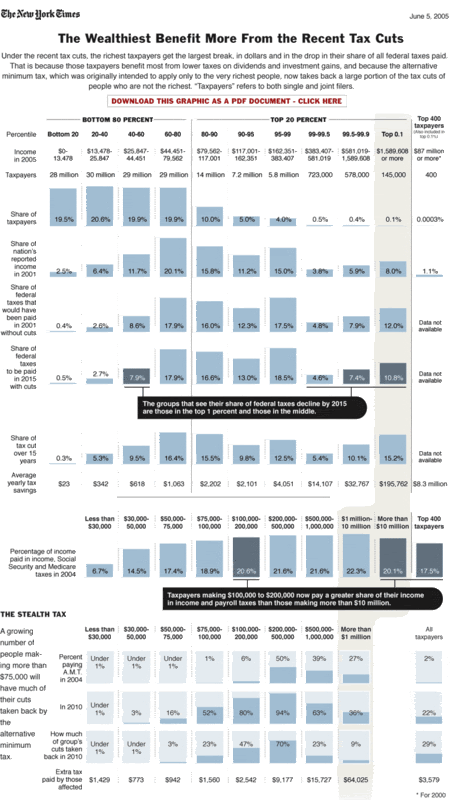 I'm sorry if that's not easy to read; you can get a better look at if you click on the image, I think. I want to point out two subtle (maybe not-so-subtle) things about this chart.
First: 80% of taxpayers make less than 80,000 dollars per year. The graph itself underplays that fact by squishing them into only 1/3 of the total space. In order to see this graph as a true illustration of income spread, you need to read the top 20% as a single data point on the top line. In other words, according to income, anyone that makes more than 80,000 is firmly upper class.
Second: The "Bush tax cuts" shift the burden largely within that top 20%, with the lion's share borne by those making from 80-380,000 dollars. That in itself is absurd, given the marginal value of money. In what way is an income of 380,000 similar to an income of 80,000? It's a vast amount more. (For a primer on the marginal value of money, see here (in a post on social security).)
Even more perverse, however, is the fact that .2% of the shift will redound to the bottom 40%. Your taxes, relative to the rest of the country, will actually increase over the next 7 years if you make 25,000 or less. How's that for a kick in the teeth? Ever try living on less than 20,000? From experience, I can tell you that Top Ramen gets old pretty quick (though you can dress it up with a can of tuna).
Anyway, back to the "middle class." Bushco pushed these cuts as a middle class tax cut. And, if you make between 25-45,000, you'll eventually see a savings of .7% (relative to the rest of the country). But if you make $580,000 or more, you'll see a savings of 1.2%. Go figure.
But what really grinds my gears (thanks, Peter), is the way this regime treats everyone from the 60th to the 90th percentile pretty much uniformly. There is nothing similar between making 44,000 a year and making 117,000 a year. Nothing.
Also notable is how the percentiles bracket incomes: Folks who pull 44k are in the same bracket as those who pull nearly twice as much. Not only have real wages stagnated, but the curve of living standards have drifted to the right given that stagnation. A 44k income today is like a 30k income a decade ago. And right on down the line. A middle class standard of living has slid up the chart, while the true middle of the income curve in real dollars has slid down the chart.
Today's economic news presages more of the same.
Start with what the Bondad article tells us (you can check out bondad's site here for more analysis) about prices and inflation. Now put it up against this:
Philadelphia Federal Reserve Chair Charles Plosser said that we'll skirt a recession. On the other hand, San Francisco Fed Reserve Chair Janet Yellen is more pessimistic. So...
We just cut the inter-bank lending rate by 1/2 a percent. We're already near 50-year lows on that. There isn't much more room to maneuver. As bondad points out, the eyes of the Fed have been on "core" inflation (not focused on commodities, in other words). In the meantime, prices for everything I use have been going up. The only thing not on the rise is the value of the dollar and the real value of my wage.
Brother can you spare a dime?

Wednesday, May 16, 2007
Soak the Poor! Down with the People!
Social Security is a compact between generations. For more than 70 years, America has kept the promise of security for its workers and their families. But now, the Social Security system is facing serious future financial problems, and action is needed soon to make sure that the system is sound when today's younger workers are ready for retirement.That's off the front page of my "Your Social Security Statement," which I got in the mail just last week. Chances are you've gotten one too, or soon will. "OH MY HEAVENS, WHATEVER SHALL WE DO?" is sort of what I said. Sort of.
...Without changes, by 2040 the Social Security Trust Fund will be exhausted. By then, the number of Americans 65 or older is expected to have doubled. There won't be enough younger people working to pay all of the benefits owed to those who are retiring. At that point, there will be enough money to pay only about 74 cents for each dollar of scheduled benefits. We will need to resolve these issues soon to make sure Social Security continues to provide a foundation of protection for future generations as it has done in the past.
On the inside of this nice letter, after first informing me that there'll be about 25% less for me than they're about to tell me I'll have, and after telling me that if that wasn't true, I'd get the equivalent of one week's 2007 pay per month (if it was going to be possible, which it isn't), I read the following:
You currently pay 6.2 percent of your salary, up to $97,500, in Social Security taxes and 1.45 percent in Medicare taxes on your entire salary. Your employer also pays 6.2 percent in Social Security taxes and 1.45 percent in Medicare taxes for you.Here's a concept I wish that congress could embrace: the marginal value of money. Everybody understands this concept completely, most of us without realizing it. To quickly demonstrate:
Johnny and Tommy are 10 years old. Johnny's Dad is an attorney. He went to work for Big Law in 2002, where they offered him 140,000 dollars a year starting salary not including benefits and bonuses. Five years later, he's making 210,000 per year, and gets a Christmastime bonus of about 10,000 if he meets his billable hours requirements. He's a tough but fair father, and every week, if Johnny does his chores and cleans his room and doesn't smart off to his mom (Dad is rarely home), Johnny's dad gives his son an allowance of $10. Pretty good, for a 10-year-old!
Tommy's Dad is also a lawyer, in fact he was a classmate of Johnny's Dad and they're still good friends (though they don't see each other as much as they wish they could). They would study together and made a great team--top of the class. Tommy's Dad went to work for Dogooders NGO in 2002 at a starting salary of 30,000 dollars a year, less benefits. Five years later, he's making $45,000 per year (more than a teacher but less than a plumber). He gets home at 6p, most nights, but there's no bonus in it for him other than the time he gets to spend with Tommy. Tommy's Dad is also tough but fair. If Tommy holds up his end of the deal, he gets $5 in allowance.
Tommy and Johnny are good friends, too. (Being a socially conscious, civic-minded guy, Johnny's Dad sends him to public school.) One Saturday, they go to Megalo Books to pick up remaindered copies of
Here is what the marginal value of money is: Tommy's dollar number 5 is his last dollar. If you take $.20 from his last dollar, you've put him eighty cents away from complete bankruptcy. If you take 20 cents from Johnny's dollar number five, he still has dollars 6,7,8,9 and 10 in his pocket. You'd have to take five more dollars from Johnny to put him in the same position.
And on the other hand, if Tommy got just one more dollar in allowance, that would mean a huge raise: a 20 percent raise! Woo Hoo! If you gave Johnny just one more dollar, that's just a %10 raise. Still not bad. But not nearly as exciting. Half as exciting, actually.
Under our current Social Security System, Tommy's Dad (TD), who makes less than 1/4 of what Johnny's Dad (JD) makes, pays $2790 in SS taxes per year. But because you stop paying social security taxes above 97,500 (seemingly arbitrary number), JD pays $6,045. More than four-and-a-half times base pay, but only twice as much in SS tax.
But here's the real pinch: That $2790 that TD pays hurts a lot more than JD's $6045. Why? The marginal value of money. $2790 is 6.2% of what TD makes every year. Because he makes so much less money than JD, the marginal value of money makes sure that that hurts him in many other ways: He gets less healthcare. He lives in a more dangerous neighborhood. He can't save as much for retirement. He can barely afford his house; thankfully his wife works. (JD's wife can stay home with J. She's deeply involved in the PTA and a local land trust, too.) When Tommy needs new glasses or shoes or a haircut or $200 for a field trip to the Science Museum in Boston, the vise tightens a little more. That vise is simply the marginal value of money. The closer your checkbook comes to zero, the more the remaining money is worth to you.
In contrast, $6045 is only about 2.9% of JD's base pay. The 97,500 cut-off means that even though his dollar figure is higher, he actually pays half as much in SS taxes as a percentage of his income. And because he has many times as much income, it pinches much, much less. In fact, even if JD paid 6.2% SS tax on all his income, he'd be much further away from feeling the same vise TD does.
That very reason is why we have a graduated income tax.
...for as many as were possessors of lands or houses sold them, and brought the prices of the things that were sold, and laid them down at the apostles' feet: and distribution was made unto every man according as he had need. Acts 4, 34-35Social Security was authored as a supplement, not the whole (as "Your Social Security Statement" makes very clear). But for a program designed as a safety net, helping to buoy those among us least able to secure savings for retirement, there isn't a whole lot of equity in evidence. A flat tax is hardest on those on the bottom and easiest for those on top. But we didn't stop there: we actually cut off the top. It naturally gets easier the more you make. But under this regime, if you make a tremendous amount, it gets even easier -- artificially easier, exponentially easier. We take an already advantaged situation and increase its advantage.
And if someone falls through the cracks? We all pay even more in medicare costs, insurance costs, social services, jails, etc. and etc. Except for the very rich: they continue to float along the top, enjoying preferential treatment for the income they get from capital gains -- a blessing those of us with no money to invest will never receive.
So here's a quick fix: make the 6.2% payroll tax applicable to all payroll salary. Here's the real beauty behind that plan: It honors the rich for their success by recognizing and multiplying their worth to society. Here's an example:
Let's say average household income is $46,000 (about what it was in 2006). That's $2852 in Social Security Taxes.
Under that assumption, with taxing for all payroll, JD is worth four and a half average guys! He's 4.5 times the man you are! He gives $13,020 in payroll taxes to Social Security every year. We'd solve the problem quickly just by taking that simple step.
Not only that, but it's more than fair. Life's still a lot easier for JD than the rest of us, the average guys who support his existence and make his job both necessary and profitable. He's still feeling less of a bite than the average working man. Why? Chorus: The Marginal Value of Money.
This makes too much sense, though. We'll have to keep shouting about this for a while--just like lobbying and campaign finance reform. They're so much more useful to the GoP and the DLC as problems that remain unsolved.
Subscribe to:
Posts (Atom)