Showing posts with label Citizenship. Show all posts

Friday, August 7, 2009

Today's GOP

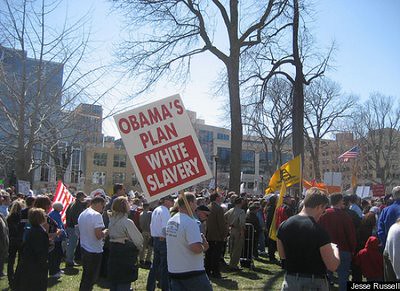
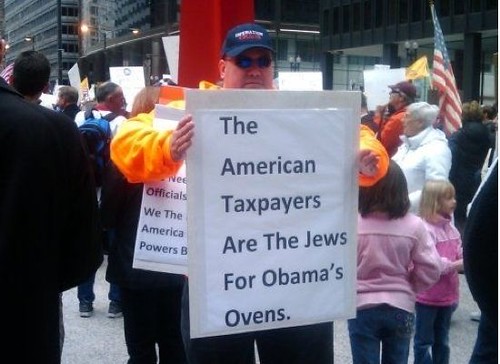
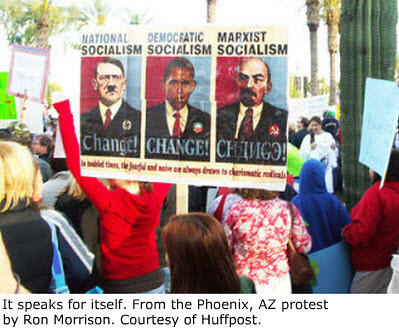
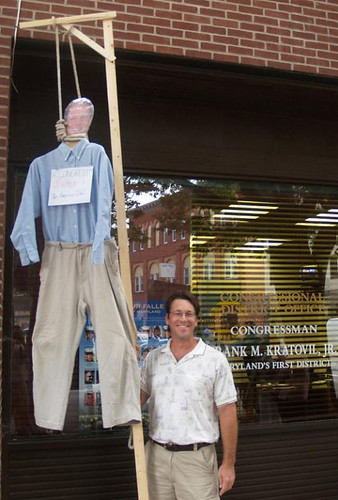
Allow me to introduce you to the "loyal opposition." This is the Republican party today: an anti-democratic, un-American wasteland of madness and spittle.

I know there are "Republicans" out there who do not fit that description -- I even know some of them. But this is the party. These are the methods they have selected to gain control.

I'm sure there will be bruises and broken bones, and there have already been deaths.

But the worse harm is the disintegration of the democratic fabric. In a nation that was once ruled by the law and by ideas, I call it treason.

Why treason? Because this isn't dissent. It isn't argument or debate. It's negation.

A pluralistic society can withstand any ideology but one: that which insists on no ideology but itself. The only political stance that is absolutely unacceptable in an open democracy (to which we still cling), is one that will brook no compromise, no difference, no alternative.

What you are seeing today is a transition. The Republican Party has been plugging its ears and shouting "I won't hear you." Now, they are taking their fists out of their ears and putting them in your face and saying, "I won't let you speak."

If you still identify with this party, when these are its methods, that means you. Sorry.


Monday, June 15, 2009

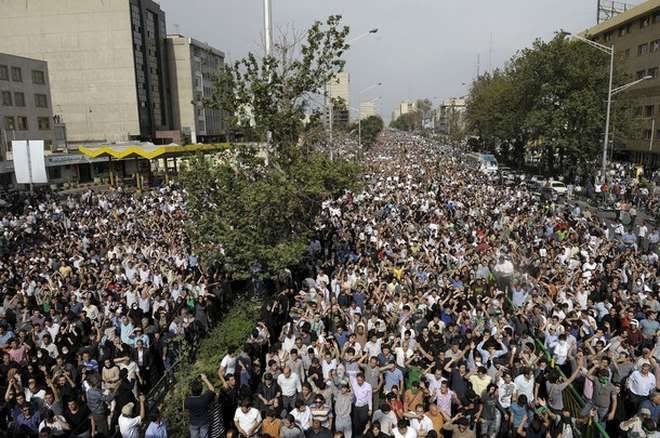
Marching in Tehran

No violence. No burning flags. Just Iranians, demanding a voice.


We took the gun away from their heads. We unclenched the first fist. Will we see an open hand by the end of the year? It is to be hoped for and encouraged.

Sunday, May 31, 2009

Name That Nominee

In today's installment on knee-jerk hypocrisy, you will be presented with a quote from a recent nominee to the Supreme Court that displays a nakedly empathetic approach to decision-making based on the ethnicity, religion or gender of the plaintiff rather than a dispassionate review of the law and facts of the case.

Then you get to guess which of the most recent activist-judge nominees made the statement in question.

The correct answer will be revealed in the comments. Good luck.

I don't come from an affluent background or a privileged background. My parents were both quite poor when they were growing up.

And I know about their experiences and I didn't experience those things. I don't take credit for anything that they did or anything that they overcame.

But I think that children learn a lot from their parents and they learn from what the parents say. But I think they learn a lot more from what the parents do and from what they take from the stories of their parents lives.

And that's why I went into that in my opening statement. Because when a case comes before me involving, let's say, someone who is an immigrant -- and we get an awful lot of immigration cases and naturalization cases -- I can't help but think of my own ancestors, because it wasn't that long ago when they were in that position.

And so it's my job to apply the law. It's not my job to change the law or to bend the law to achieve any result.

But when I look at those cases, I have to say to myself, and I do say to myself, "You know, this could be your grandfather, this could be your grandmother. They were not citizens at one time, and they were people who came to this country."

When I have cases involving children, I can't help but think of my own children and think about my children being treated in the way that children may be treated in the case that's before me.

And that goes down the line. When I get a case about discrimination, I have to think about people in my own family who suffered discrimination because of their ethnic background or because of religion or because of gender. And I do take that into account. When I have a case involving someone who's been subjected to discrimination because of disability, I have to think of people who I've known and admire very greatly who've had disabilities, and I've watched them struggle to overcome the barriers that society puts up often just because it doesn't think of what it's doing -- the barriers that it puts up to them.

Monday, November 24, 2008

"deliberative democracy"

...a conversation among adults who listen to one another, who attempt to persuade one another by means of argument and evidence, and who remain open to the possibility that they could be wrong.
--George Packer

Think calmly and well, upon this whole subject. Nothing valuable can be lost by taking time. If there be an object to hurry any of you, in hot haste, to a step which you would never take deliberately, that object will be frustrated by taking time; but no good object can be frustrated by it.
--Lincoln

Thursday, October 30, 2008

Just a few more days.


The results will soon be in. Please get out and do what you can to help.

On this end, I'll be in New Hampshire for the weekend canvassing in CD#2. On the 1st and the 2nd, I'll be GOTV in Maine, wherever they choose to send me. Just give me one shift. Get to your local office and offer to do something for a few hours this weekend. Go to this website, enter your zip code, and find something to do.

It's a bitch, this democracy racket. It only works if you do.

In other, much less important, news, the Patriots renew their rivalry with the hated Colts of Indianapolis on Sunday. These two storied franchises are struggling through similarly frustrating seasons. The fact that they're not on the top of their respective games has caused a minor detente among the fan bases -- something like Adams and Jefferson, bitter rivals who in the end realized they only had each other. Except not as vital to our country. Nor as touching.

In that spirit, Pats Pulpit, the Patriot fansite I occasionally write for, is exchanging blogging privileges with Stampede Blue, internet home of Colts faithful. My contribution is a feature on Patriots' stalwart, Kevin Faulk.

I've been enjoying writing about the Pats. It's a hell of a lot less stressful than contemplating the possibility of President McCain and Vice President Palin.

I just puked in my mouth a little.

Which is exactly why I'm going out from 11/1 through 11/4. And why you should, also.

Monday, October 27, 2008

A new conservatism?

The Public Servant has a very interesting piece up on a prospective Obama administration's 1st 100 days, titled "Rounding Third." It's a good piece, and I recommend treating yourself to its entirety. It contains this central thesis about the goals of that potential government during its first 3 or so months:
The point is to change the country in a way that will command the support of a large majority of the public before the general cynicism about government takes root.
I might modify that somewhat: The point is to hold the general cynicism about government at bay long enough to pull its teeth by fundamentally reinventing government, in practice first and then in the eyes of the people. Public Servant gets all that--I just wanted to take that extra cut for my readers, here.

I agree. This will be very interesting (provided the outcome we both wish for arrives). I don't know what BHO has in mind, of course, and the rather bold call that PS and I would make might not be on his radar at all (though the circumstances beg for original, unconventional approaches). But I've been thinking a lot lately about the need for a new, robustly intellectual conservatism. The more I think about it, the more I think that that might be just what Obama represents.

Certainly, many of his policies ring bells that 20th century conservatives would label as "liberal" (and really what I think we have in the GoP today is the rump party of 20th century conservatism, with all the real conservatives sucked out of it). But his pursuit of those policies is very measured and based on sober historical and factual analysis.

This is also to say that what was once conservative policy is now obsolete, and the new conservatism of the 21st century may very well represent a much more pragmatic cross-breeding of progressive sensibility with conservative procedure. Government will be pared back, but not to the quick, not to Norquist's bathtub-ready shrimp. It will be pared back to a purpose: the commonweal, as defined by the progressive dictum to protect the weak from the strong, the power-less from the powerful, and to secure an equitable starting gate for all citizens regardless of wealth.

I recognize that that's highly ideal, of course. But what are mission statements if not ideal? I also recognize the dissonance in claiming simultaneously that we need a dramatic shift in the nature of government and that that shift will be to a new conservatisim (a clear-cut oxymoron). So sue me.

I hope to come back to this and develop it a bit. This is a first cut, but I'd be interested to hear what you all think. What is conservatism, to you? My judgment is that the GoP is an intellectual desert right now; do you agree? I also see Obama proceeding very conservatively, in the classic sense.

Let's chat.

Sunday, October 19, 2008

The Stretch Run: Canvassing NH for Obama

click on pictures for larger images


I do not like making phone calls. I do not like meeting new people. I don't like bothering strangers. I take rejection personally.

I am not a natural canvasser.

Ian, my friend, knows this. But he also knows how to motivate me. When he called to ask me to canvass New Hampshire with him for a day he said, "I don't really want to do it either, but if John McCain wins the Presidency and there was something I could have done about it, and I didn't, I don't think I could live with myself."

So that's how I found myself in Portsmouth, New Hampshire today, standing among a group of 40 strangers and listening to a young woman give me my marching orders. She is the Field Organizer for Obama's Portsmouth office, and she knows exactly what she needs from us.

Speaking to us like adults (which we were--I estimate the average age of that morning's group at around 44), Ellen gave us our territory, and clipboards with a list of contact names on it. "Be polite, be energetic. Do not engage in a debate. Get contact information if you can, and be sure to leave literature with everyone who wants it and at every door where no one is home. Be upbeat, polite and energetic: you are the face of this campaign."
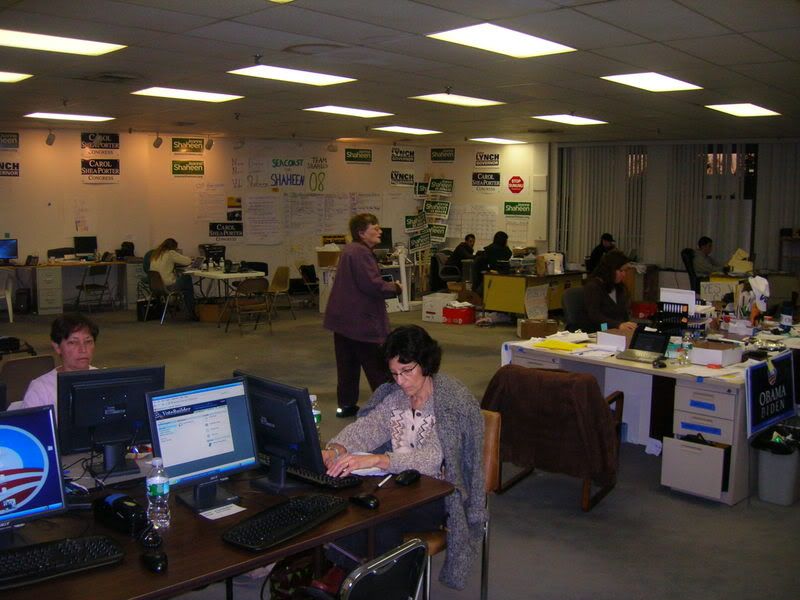
Staff at work, 6:30pm. We were late.


Canvassing right now is about data gathering -- not persuasion. At least not if you walk in off the street like we did. The lists are targeted. Everyone in the packet of addresses they give you is either undecided or as yet un-contacted. Our job was very simple: find out what they're thinking. Everyone we met would be graded on a continuum of Obama, Leaning Obama, Undecided, Leaning McCain, McCain.

Honestly, it was a bit refreshing. So late in the game, it's not like the candidates need an introduction. It opened the door to a few long conversations and it kept encounters with those who had decided to vote McCain very short and sweet. And even occasionally polite.

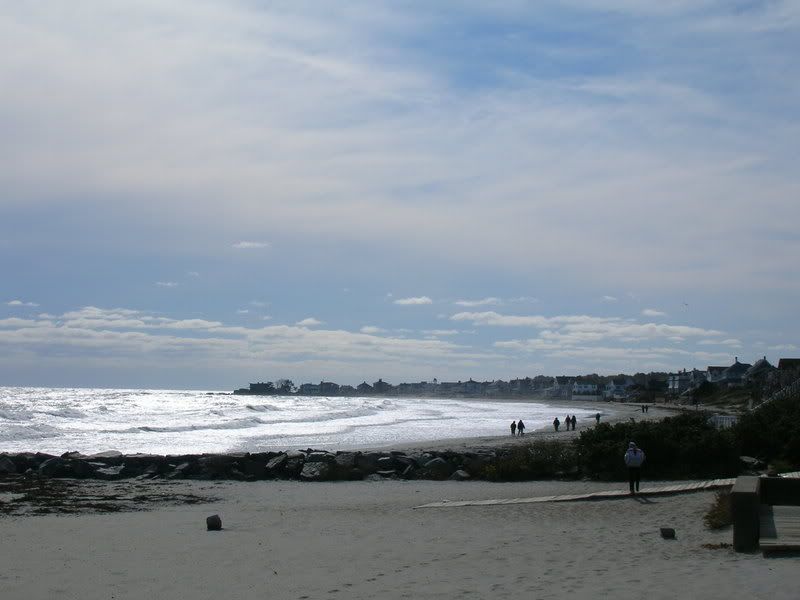
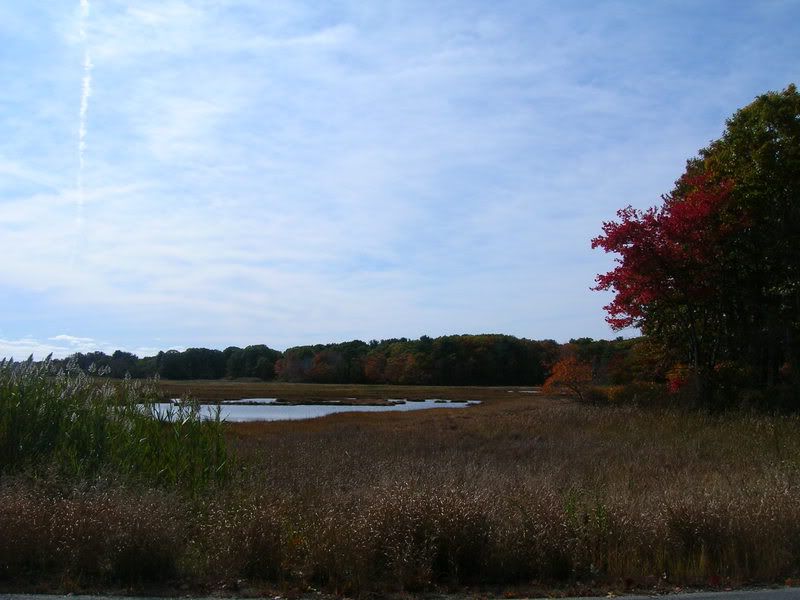
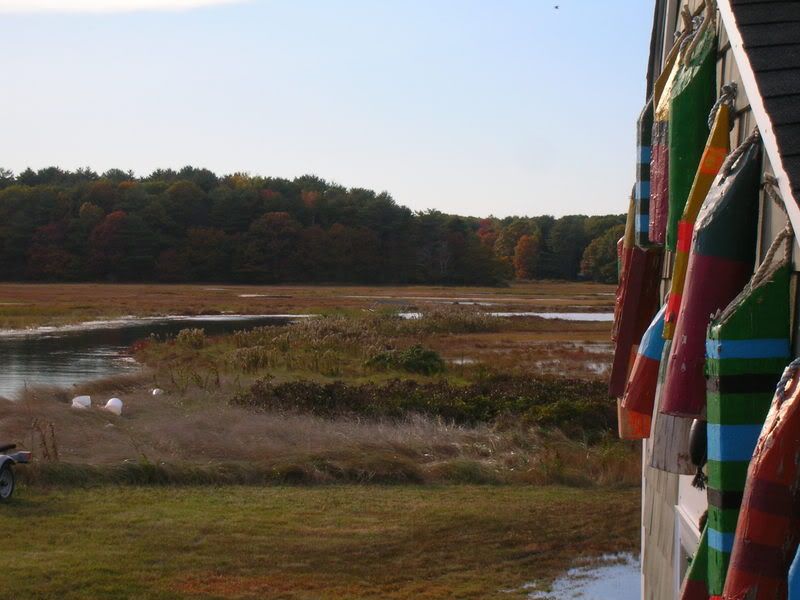
Ian and I were sent to Rye. (I wish I had a rhyme to follow that.) We counted ourselves very lucky--this stretch of US Route 1A runs right along the shingle of the coast, and it has been perhaps the most beautiful fall I can remember.


The homes in our territory were spread relatively far apart--not least because we weren't going to visit every house in the neighborhood, just a subset of a subset. Some were very clearly monuments to wealth. Others were small; some few of the old capes that have escaped trophy-hunting renovators, some 60's era single-level bungalows. A scattering of condos converted from beach houses. It took us about 5 hours to knock on about 30 doors. Many people were not home, most conversations were short. But occasionally we met someone who wanted to talk.

We met Lorraine, mowing her lawn on this beautiful day. She was looking forward to voting for Obama very much. In her 70's, she and her husband had lived in the same house for 46 years, watching this once quiet stretch of New Hampshire's coast gradually become busier and wealthier. We met another woman with a houseful of five independents and a Republican mater familias, all of whom will be voting for the Democrat this year. She was pensive, but hopeful.

Worth noting: This campaign is explicitly working for down-ticket races as well. When we queried people about their preferences for president, we also asked about Jeanne Shaheen in the Senate race and Carol Shea-Porter for the House. Obama is clearly seeking to lengthen his coattails if his bid is successful.

Our area seemed roughly 60-40 for Obama, but many of the people we spoke with claimed to still be making up their minds. This boggles me, as I can't remember or come up with two candidates less like one another in modern Presidential history. Ian's take was that anyone still thinking about it would in other years have been a McCain lock. My feeling is more along the line that if you were once a McCain lock, or you're really still undecided because they seem so similar to you, you have the same issue: brain freeze.

But there was one guy who sticks with me. He was pleased that we knocked on his door. He wasn't sure who he wanted to vote for. He'd seen Powell's endorsement this morning. To me he felt genuinely worried, afflicted by the times he found himself living through, a little adrift. His wife couldn't come to the door--she has MS. Did we think Obama would be ok? Yes, we did. Did we see that Powell had endorsed him? We had. "A lot of people think of Colin Powell as a truthful, trustworthy man," I offered. He agreed--it was a good sign, he felt. Would he take an absentee ballot for his wife? He would. Perhaps some literature, with information about Obama's plan for healthcare? Yes, and thank you. He shook our hands.

I've been thinking about him since. He was in his early 70s, but could have been anywhere between there and 55. The older I get, the younger my elders seem. He looked like he could have been my Dad's age. A wife with late-onset MS. A small house with a new ramp to the door. And a clear worry. Thinking about him now, I almost feel like he was frozen -- petrified, really. I don't know if that's fair, but it was the feeling I got from him; as if the next move he made would either set his world safely down or shatter it beyond redemption or repair.

Does any President have an answer for that man? I don't know.

In all, it was a very good day. I strongly encourage you to do this, if you have any free time. Take this Saturday or Sunday. There is a very limited amount of time left to keep our country from going completely off a cliff and there is a very specific thing you can do to stop that. Contact your local office and put in some time.

It's easy--even for the antisocial.

How will you feel on November 5th if McCain wins, and you did nothing to prevent it?


Fried lunch. Yum.


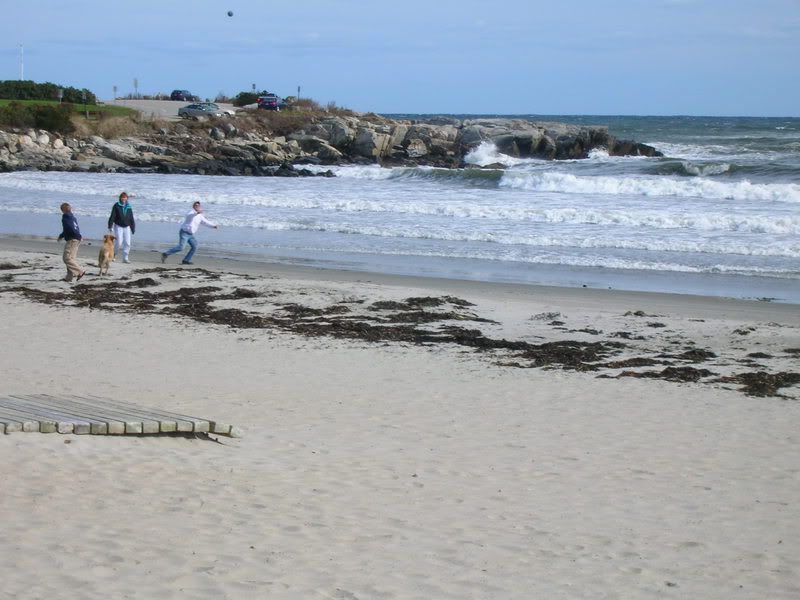
When we came back, the car was still there, but the board was gone. Way, way down the surf line you could see this guy paddling out. We don't stop up here just 'cause it's cold. It's always cold. In fact, the water is probably warmer now than it was in May. Not that I verified that for myself, you understand.

Tuesday, September 30, 2008

Palin Pity Party?

Not for Rebecca Traister:
Shaking our heads and wringing our hands in sympathy with Sarah Palin is a disservice to every woman who has ever been unfairly dismissed based on her gender, because this is an utterly fair dismissal, based on an utter lack of ability and readiness. It's a disservice to minority populations of every stripe whose place in the political spectrum has been unfairly spotlighted as mere tokenism; it is a disservice to women throughout this country who have gone from watching a woman who -- love her or hate her -- was able to show us what female leadership could look like to squirming in front of their televisions as they watch the woman sent to replace her struggle to string a complete sentence together.

Sunday, September 21, 2008

The beauty of the free market

Opening up the health insurance market to more vigorous nationwide competition, as we have done over the last decade in banking, would provide more choices of innovative products less burdened by the worst excesses of state-based regulation.
John McCain, "Contingencies" Sept/Oct 2008.

If you're lucky enough to get health insurance from your employer, you're probably also aware that your contribution to that insurance is taken out before you're taxed. In that article, McCain explains how, in addition to deregulating the health insurance market in the same way we've deregulated the mortgage market, he'd tax your contribution. Then he'd give you a $2,500 tax credit, regardless of your income, to offset your costs. A family could get up to a total of $5,000 in credits.
Individuals who currently don’t have access to employer sponsored insurance where they work can use the tax credit to purchase individual insurance coverage. Everyone purchasing health insurance would gain access to exactly the same tax benefits.
Think you can insure a family of four for $5000 a year? John McCain thinks so. In John McCain's happy world of friendly health insurance companies, "Consumer-friendly insurance policies will be more available and affordable when there is greater competition among insurers on a level playing field."

Just as with mortgages, however, the field will never be level. Not when the least among us will get whatever $5,000 pays for, while John McCain's base gets whatever they can afford. Or want.

Imagine a world where medical histories indicate "default risks" in health insurance. Imagine a world where those "default risks" are bundled and re-insured in the same way that mortgages are. Pools of people who have not yet become sick will be favored investments for these insurance companies. Pools of people with chronic or persistent illnesses (diabetes, depression, heart disease, Crohn's disease, e.g.) will become personae non grata. Hey--they're expensive! And you know they're going to cash in on their benefits. In fact, they're the very people that -- right now -- are costing you and me money!

If you have a history of breast cancer in your family, and your husband's father was diabetic, how much do you think it will cost to insure your children per year on John McCain's "open market?"

Do you think $5,000 will cover it?

I don't know how I can make this any simpler. John McCain says (and we all agree) that health insurance is too expensive to the government. His answer to that is not to find a less expensive way to insure people. His answer is to simply stop paying.

Well. That will certainly cost less. But don't worry. I'm sure that the "healthy competition" of a de-regulated health insurance market will guarantee you can afford coverage.

Right now, open market health insurance of the most basic variety (excluding Rx, hospital, or "critical illness" care) would cost $4,236 per year in my city, for a healthy family of three. Add one more kid, and the rate doubles. Add any "pre-existing conditions," and, well, it depends. And hey, who needs prescriptions anyway?

That plan is offered by a company that guarantees to cover you, as far as you are able to pay. Under McCain's plan, you'll be able to pay up to $5000 a year, plus whatever you can contribute on your own. Which is pretty good--unless something goes wrong. If you can get covered. If you don't have a high "default risk."

Anyway, don't worry about it. The same de-regulated markets that catapulted our national investment banks and mortgage companies to the top of the finance world is sure to help you out when your kid gets hit with leukemia, or something.

Obama's plan. If you care.

Here's a Boston Globe Editorial saying essentially the same thing. I hadn't read it until today (9/22), believe me or don't.

Monday, September 8, 2008

Supporting the Troops

It has always been a complex world. Most Americans would tell you that it is a more complex world today than it was in 2000, but that's just not true. Many Americans will claim that "everything changed after September 11th," but that's not true, either. The world is the same--it is we who have changed. We're paying a little more attention, right now. Not much, but a little. We're seeing a little bit deeper into the complex interrelations that move world events.

For example, Fannie Mae and Freddy Mac (private, for-profit corporations) are being taken over by the US Government amid fears that their collapse would cause a domino effect of financial ruin at home and around the world. According to the NYTimes, the government (you and me) will guarantee Freddy's debt, while allowing shareholders to twist in the wind.

As an American, you might ask, "Whose debt am I guaranteeing? If the vig comes due, who will we--the taxpayer--have to pay? Who has so much pull with our government, that they can request us to take over the largest mortgage companies in the world and guarantee their investment? Especially in a lousy housing market, where the value that debt supports is rapidly shrinking? Who, in other words, does hold my mortgage?"

Answer (from MarketWatch):
The top five foreign holders of Freddie and Fannie long-term debt are China, Japan, the Cayman Islands, Luxembourg, and Belgium. In total foreign investors hold over $1.3 trillion in these agency bonds, according to the U.S. Treasury's most recent "Report on Foreign Portfolio Holdings of U.S. Securities."
$1.3 trillion dollars. At least it isn't a buyout. You and I aren't paying China. We're just guaranteeing their investment in our mortgage industry with our taxes. And, yes, it's the same mortgage industry that's in the toilet right now.

It's complex. Always has been. The point is, things are bad enough right now that we're starting to pay attention. I know I sure didn't care about China buying our debt before a couple of years ago. I don't know if I ever gave it more than a passing thought.

So, back to September 11 and everything changing and, as the title implies, supporting the troops. I don't think I'd find much argument if I said that our military is a little ragged these days. And most people would probably agree that our veterans aren't getting the help they need. If one of your older relatives went to school on the GI Bill -- maybe your Dad or your Grandfather -- you might know that's a lot harder to do now. You might also know phrases you never knew before, like "stop-loss" and "individual ready reserve."

National security has never been more critical or seemed so complex. Many of the first choices and policy decisions our next President will have to make will deal with the health and welfare of our military. If you're in the service, or you know someone who is, you're probably assuming that John McCain is the right man for the job. After all, Republicans support the troops more than Democrats and he served in the military (you might have heard he was a POW). He never hesitates to reiterate his abiding support for our military. I'm writing this post precisely for you. If you think John McCain is the best candidate for the military, then you're using the same logic as a woman who supports Sarah Palin because she, too, has a vagina.

Here are some examples:

In April of this year, the Webb GI Bill came up for a vote in the senate. The Webb bill would have guaranteed veterans a chance to go to college. The original bill, from WWII, could have (and did) put a service member through Yale University. Currently--well, not so much. McCain opposed the Webb bill, which was co-sponsored by Chuck Hagel (R-Neb.) would have again made it possible for a soldier to go to college, with thanks from a grateful nation. McCain opposed this bill, saying it would decrease retention. Saying, essentially, that the benefits were too good.

Webb's bill would be expensive--about the same amount of money that we spend in Iraq in 36 hours. According to the Iraq and Afghanistan Veterans of America, the WWII bill returned $7 to the economy for every $1 it cost.

It is also the Army's primary recruiting tool.

On the day of the vote, only two Senators couldn't seem to make to the Senate. One was liberal Senator Ted Kennedy, at home recovering from brain surgery. The other was John McCain.

Here are some other dropped balls:

September 2007: John Sidney McCain (JSM) votes against another Webb bill that would have mandated adequate rest for troops between combat deployments (the "Dwell time" bill).

May 2006: JSM votes against providing the VA with $20 million needed for health care facilities; the money would have been provided by closing tax loopholes.

April 2006: JSM joins an elite group of 13 senators (all Republican) voting against $430,000,000 for the Department of Veteran Affairs for Medical Services for outpatient care and treatment for veterans.

March 2004: Votes against creating a reserve fund -- funded by closing tax loopholes for corporations -- to provide up to $1.8 billion in Veterans' medical care.

October 2003: JSM votes to table (essentially, to kill) an amendment that would have provided $322,000,000 of safety equipment (you know, like body armor) for troops in Iraq, funded by spending that much less on reconstruction.

In April of 2003, he voted to kill an amendment that would have appropriated $1 Billion for National Guard and Reserve Equipment in Iraq to address a shortage of helmets, tents, bullet-proof insets and tactical vests.
I'm not going to get into a discussion of how McCain voted on the war in Afghanistan or the invasion of Iraq, or how he wants to deal with Georgia or Iran. All I'm trying to say is that if you want to argue for military measures, or you want to say you support the troops, then you should be able to back it up with your voting record--since that's all you've really got.

The Iraq and Afghanistan Veterans of America has kept track of over 160 separate votes since 9/11, and graded every Senator and Congressman on their voting record. John McCain gets a "D."

The Disabled Veterans of America rated McCain at 20% for the 109th Congress.

IAVA and DVA also graded Obama. He got an 80% from DVA and a B+ from IAVA. If you're on the fence about these two guys, and the way they treat our people in uniform is something you're interested in, then I think you should take the evidence of their votes into account. One guy loves to use the military, but isn't interested in taking care of it. The other guy considers force the last resort, and would look after the health of his men.

If you find yourself surprised, and perhaps considering Obama, don't worry. You're in good company. According to the non-partisan Center For Responsive Politics, deployed troops support Obama over McCain 6:1, and he maintains a significant edge among all military personnel.

Our world is a much more complex place than some politicians try to make it seem. But this seems pretty simple to me.

Monday, September 1, 2008

Happy Labor Day!

I hope you enjoyed a day off from work today, courtesy of the people who brought you a minimum wage, child labor laws and the weekend:

The Radical Left.

Monday, August 25, 2008

Something new, something wonderful.


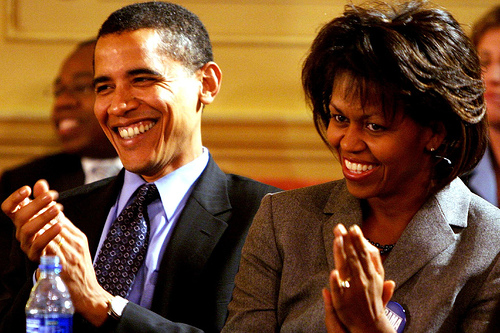
If you didn't get a chance to watch all of Michelle Obama's speech this evening, you owe it to yourself to set some time aside and see it. I think you'll agree that, with a few different forks in the road, we could easily have watched a convention on behalf of nominee Michelle Obama.

It was an address of personal politics, expressing, perhaps better than Barack himself, the deep service-oriented roots of their political philosophy. It was fitting that she shared a stage with Teddy Kennedy, in this way: Kennedy was born wealthy and could quite easily have turned his energy toward creating even greater personal wealth. Instead he devoted his personal fortune and his political career to serving the cause of those without a voice, without wealth.

The Obamas each came from modest means and each secured a ticket to the big leagues. A law degree from Harvard is a license to earn. But both Obamas have, with that opportunity, also willingly accepted an obligation to serve.

More even than that, however, this was a watershed moment for our nation. If we are lucky, we may be blessed one day to realize just how significant it was. A black woman stood before half of political America and told them in no uncertain terms of her humanity, her intelligence and her love for a black man who they should by now be compelled to elect as leader of the free world.

I'm very, very glad that I was able to see that.

Video below in two parts; runs just over 18 minutes total.


Saturday, July 5, 2008

Happy Birthday to Us

Photos of fireworks over Portland, Maine by Josh and Melanie Rosenthal.
Spent the 4th between my folks in New Hampshire and my buddy's house on Long Lake in Naples, Maine.

I feel differently about the Fourth from how I feel about Memorial Day. The Fourth, to my mind, is straight celebration. We were fortunate to have a group of earnest, intelligent and learned men together and thinking along the same lines at the same time, at a moment in western history when it was both necessary and possible to try something new.

Always remember that what they began is an experiment. It need not succeed, and if it does succeed, it need not be on their terms alone. It will be on our terms; your only obligation is to participate.


Ashland, NH, put on a very nice small-town parade--the antithesis of Portland's anemic Memorial Day parade. Yes, that means hokey: the local "Jazzercize" class danced their way down Maine Street. The local bank had a float. Jeremey Hitlz Excavation showed off his 7 new dumpers (a little excessive, Jer). Cons: only the 8 or so firetrucks who assaulted all present by running their sirens pretty much non-stop. Fellas, those things are designed to move people out of the way. 5 straight minutes of them within the confines of Ashland's small streets is painful. By the time they were done I wanted to punch a fireman in the face (sorry, Pete).

Pros: Grand Marshall Alex Ray of the Common Man restaurants, resplendent in red, white and blue, and refusing to honor the time-honored Grand Marshall tradition of riding in an open car. Instead, he circled the parade continuously on his antique high-wheel bicycle.

Other pros: a parade of old cars, including a string of immaculate Rolls-Royces; 2 brass bands pulled along on trailers and playing traditional patriotic fare (King and Sousa); a high school marching band dressed intelligently in khaki shorts and polo shirts; horses (and riders); a pooper-scooper on a bicycle; kids on bikes decked out in colored foil and streamers.

One of my father's hobbies is the New England brass band; he was on one of the floats. After the parade we went back to house for a cookout and, later, mom's strawberry shortcake. Yum.

Later on, I drove over to Long Lake to enjoy the fireworks. As the sun set, boaters began to populate the lake. By dark, the red, green and white dots of their running lights lay sprinkled up the length of the lake, beyond sight. It was beautiful. So were the fireworks.

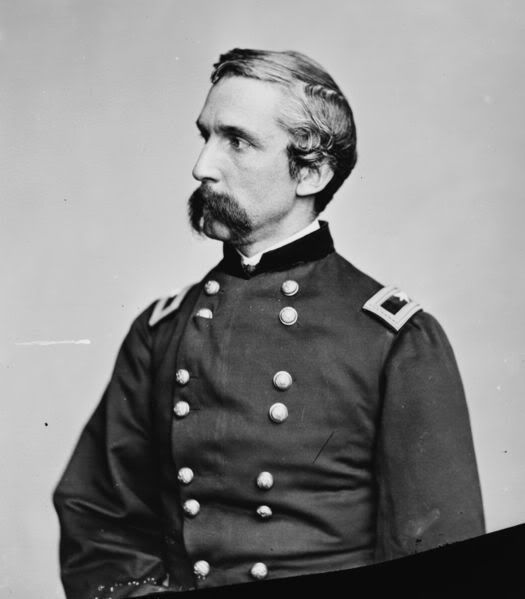
Side note: the Fourth was also the day after the great battle of Gettysburg, when Lee retreated and Meade failed to follow--probably extending the war by at least a year. I would argue that the Civil War, the reconstruction and the Civil War amendments were at least as important to our identity as a nation -- if not moreso -- as the Revolution. To celebrate that, I'm re-reading bits of "Soul of the Lion," a biography of my favorite American, Joshua Chamberlain: professor, college president, four times Governor of Maine, recipient of the Congressional Medal of Honor, citizen-soldier of the Union army chosen to receive the surrender of the Confederate infantry at Appomatox Courthouse, where he "startles the world by calling his troops to attention to salute the defeated South."

Thursday, July 3, 2008

Retroactive Immunity, FISA and you (and Obama)

There has been much gnashing of teeth and wringing of hands regarding BHO's stated support for the compromise legislation on FISA and telco immunity. I'd have said "pulling of hair," too, but that would automatically dis-qualify me and I have to say I was bummed.

And I'm still a little bummed. But I'm also starting to wonder, in that just-waking-up-what-the-hell-is-that-ringing kind of a way, why? Why would a professor of Constitutional Law decide this isn't such a big deal? And what is it about telco immunity, anyway?

Some of you may know that I used to, you know, be "into" the law. Well here's the problem: in order to sue the telco's, you first have to prove they owe you a duty. Private companies or people can not violate your civil rights. Only the government can do that. And the government almost certainly did, and we should be suing them (us?).

I encourage everyone with a stake in this election (and that's everyone -- literally) to read this very well thought-out essay on the issue at Talking Points Memo. As the author admits, "it's long and pedantic and boring." But since you're reading Borrowed Suits, I'm going to assume that's not an issue for you.

No firm conclusions are reached. In some ways, it raises more questions than answers--one of which is, if all this is true, then why hasn't Obama been more forthcoming about his change of heart?

It also contains this pointed reminder:
Q: "Even if retroactive telecom immunity isn’t so bad, Obama said he would vote against any bill that has immunity in it and I want a president who sticks to his word."

A: Well, if you want a president who takes the attitude that "I said that’s what I’m going to do and by gum I’m going to do it come hell or high water and even if I learn down the road that it’s a stupid thing to do and even if I find out that it’s not working, I’m going to keep on doing it because, by golly, I said I would" ..... then you must have been very happy for the last 7 ½ years.
But in the end, it also begs the question: Why change? FISA works, and that's a fact. It's not the telco immunity that we should be worried about--it's the startling expansion of executive powers to do whatever the hell they want to whomever the hell they please.

No matter your party affiliation, that should molest your equanimity in some way (piss you right the f*ck off).

Let me also say that no matter the whiffling on this issue, I'm very much opposed to immunity--retroactive or otherwise. Qwest, for example, simply told the NSA "no" when they came and asked, "Not without authorization in the form of an AG letter." In response, the government folded up its tents and went away. That alone would seem to indicate that at least some of the other companies didn't bother to decline.

And it may be simple politics on Obama's part. But "the optics" (ugh) are terrible for him and he's so astute politically that there's got to be something more there. I'm just not sure what it is. Uncomfortable.

(Though, when threatened with a President McCain, I quite serene by comparison.)

Monday, June 9, 2008

Ex President Quote of the Day


We annually spend on military security more than the net income of all United States corporations.

This conjunction of an immense military establishment and a large arms industry is new in the American experience. The total influence -- economic, political, even spiritual -- is felt in every city, every State house, every office of the Federal government. We recognize the imperative need for this development. Yet we must not fail to comprehend its grave implications. Our toil, resources and livelihood are all involved; so is the very structure of our society.

In the councils of government, we must guard against the acquisition of unwarranted influence, whether sought or unsought, by the military-industrial complex. The potential for the disastrous rise of misplaced power exists and will persist.

We must never let the weight of this combination endanger our liberties or democratic processes. We should take nothing for granted. Only an alert and knowledgeable citizenry can compel the proper meshing of the huge industrial and military machinery of defense with our peaceful methods and goals, so that security and liberty may prosper together.
--Dwight David Eisenhower
I think it beyond dispute that the present administration has run in exactly the opposite direction that Ike warned against--into the arms of the military-industrial complex itself. Indeed, it is often hard to tell where the government of the United States leaves off and the board-rooms and directorships of leading armaments, strategic supply corporations and energy speculators begins. The revolving door opens on K Street, Capitol Hill, Wall Street and 1600 Pennsylvania Avenue. We have, in fact, become precisely what Ike feared: a nation whose economic solvency and international relevancy has been pegged to more or less perpetual warfare.

Interestingly, this administration seems to have tightly clasped to its breast the very next warning in Ike's speech -- one less remembered. As with much that smacks of subtlety (or simply comprehension), the NeoCons have hewed to the letter and mistaken the meaning:
Yet, in holding scientific research and discovery in respect, as we should, we must also be alert to the equal and opposite danger that public policy could itself become the captive of a scientifictechnological elite.
Well, we all know how scared we're supposed to be of the (very narrowly defined) elite. In rejecting almost all science, however, these last 7.5 years of Republican rule have set a new standard for willful ignorance. But more than that, this administration has actively sought out the good science in government service and snuffed or silenced it. It's remarkable, really.

There are so-called banana republics who survived less looted by dictatorships than our public trust has been despoiled by villains we willfully chose.

Race is No Longer an Issue

At least in Delray Beach, Florida. You see, they've finally agreed to integrate their Little League! Hey, congratulations for taking the big step, Delray. Let us know how it works out for you.

The history of Delray little league is so perfectly disingenuous it'd be funny if it wasn't so sad. You've likely heard of district "gerrymandering." Theoretically, gerrymandering can be used to increase the representation of minority groups. In practice, however, it is typically used to ensure power remains in the hands of the majority, whether that majority be white or, say, Republican (and usually both). Tom Delay (R-Texas) earned his pitchfork in part by his elaborate and corrupt efforts to redistrict the state of Texas and create a permanent Republican majority with an added bonus of nearly comprehensive black disenfranchisement. *

As grim as this is on the national stage, it's just sad and small when it plays out over something like Little League. Little League International will not grant charters to organizations that discriminate. So the Delray (rhymes with "DeLay") Little League established in 1953 was gerrymandered to exclude those neighborhoods that were primarily black. Perfect.

Fifty-five years later, they're finally doing something about it.
"I was very skeptical at first," said Shelly Ann Brewster, whose son, Lamar, plays for the Sand Gnats. "I didn't know where my kid was going to have to go and who he was going to have to play with."
Well, gosh, Shelley Ann. That would be little black kids Lamar will have to play with. He might even have to go to their neighborhoods to do it, from time to time.
Tim Stebbins, a director of Delray National, described it this way: "One builds up all these fears, and then you get to the thing and say, 'Why didn't we do this two centuries ago?'"
What can I say? Res Ipsa Loquitor.


* This bit of political theater actually has some fascinating footnotes (hence this footnote). On the eve of the vote, 52 Democratic members of the Texas House secretly boarded buses for Ardmore, Oklahoma. Powerless to stop Delay's plan and fighting for time, the Dems knew that their only recourse was to deny the Republicans a "quorum" for the vote. They also knew they'd be compelled to attend if they were in town. So, as a group, the "Killer-Ds," as the media dubbed them, lit out for the territory in the middle of the night. Undeterred, Delay used your federal tax dollars to track them down and attempt to force them back to Austin. Pulling the strings from D.C., Delay was hell-bent on building an impervious Texas fortress GOP. The corruption and misappropriations of government funds ultimately found him out. Today is the last day Tom Delay will go to work in the United States Congress. For more information, especially regarding the misuse of the State power to police, see here. Typical of GOP Hubris and stupidity, Delay and his cronies were so confident of success that they never imagined what might happen if Democrats ever regained control: the same desert island to which he tried to banish them would be reserved for him.

Tuesday, June 3, 2008

Ex President Quote of the Day


America did not invent human rights. In a very real sense, it is the other way around. Human rights invented America.

Jimmy Carter

Saturday, May 31, 2008

In Memory of...

Introductory rambling: So much to write about these days, what with the rules committee hearing going on in DC (moot in any case), the war, the Democratic Convention in Augusta, the Celtics, international disasters--it's all been on my mind to comment, disparage or celebrate. Instead, I'm going to write about Memorial Day.

I've been thinking about this since I went to Portland's parade on Monday, and links sent by Petrie have kept it in the front of my mind. Last night I had pizza and beer with my city councilor and we chatted about it as well. Time to write.

Portland's Memorial Day Parade was pathetic. Embarrassing, actually, on several levels. It was thinly attended. The delegations were small. The community was not represented. The American Legion and VFW were predictably bitter. I was pissed.

I shot off a text message to the three city councilors who I know, and they all had the same general response. It is the VFW and the American Legion who organize the parade, and they only talk to each other. I don't mind beefing with those guys--you have to involve the community. Here are my thoughts, in no particular order:


In Memory of Memorial Day

If you don't tell it like it was, it can never be as it ought to be.
-- Rev. Fred Shuttlesworth
Reverend Shuttlesworth was speaking about slavery when he said that. I feel the quote is appropriate, nevertheless. Like slavery, our American wars -- and war wounded and war dead -- are self-inflicted strokes. Bear with me while I explain what I mean.

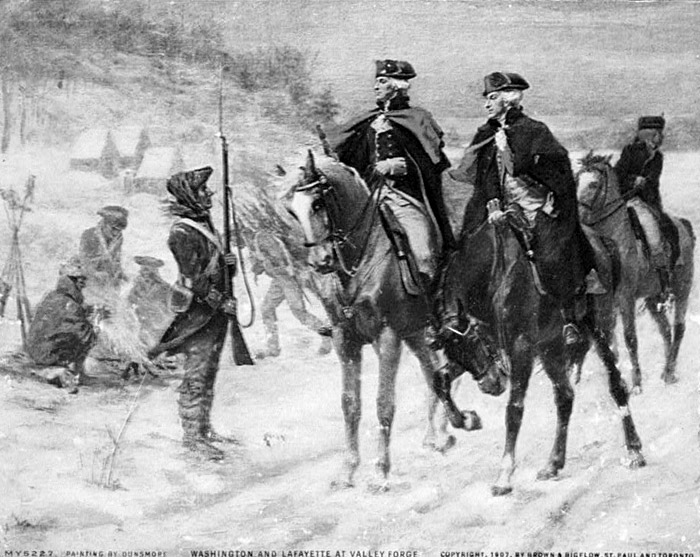
No matter how obvious the need, ultimately we take it upon ourselves to war. The Revolution was a choice -- we decided that bloodshed was necessary. We severed ourselves from England to become the cutting for a new flower.
Washington and Lafayette
Even the most obvious wars -- World War I and II, the war with Afghanistan -- reflect a policy choice that sends Americans to kill and die. The rightness of a choice is debatable; that it was a choice is not.
Joshua Chamberlain


It is also appropriate to tie the remembrance of slavery to Memorial Day because we have, in part, freedmen to thank for it.

During the Civil War, a racetrack near Charleston was converted into a military prison for captured Union soldiers. At least 257 of those men died from exposure and disease and were buried in a mass grave. In April of 1865, two dozen or so black men dug up the grave and properly reinterred the bodies of those dead Union men in the racetrack's infield. (Who cares to imagine that gruesome task?) A fence was built around the new cemetery, whitewashed, with an archway entrance inscribed, "To the Martyrs of the Racecourse." Then, on May 1st, Something remarkable occurred:
At 9 am on May 1, the procession stepped off led by three thousand black schoolchildren carrying arm loads of roses and singing "John Brown's Body." The children were followed by several hundred black women with baskets of flowers, wreaths and crosses. Then came black men marching in cadence, followed by contingents of Union infantry and other black and white citizens. As many as possible gathering in the cemetery enclosure; a childrens' choir sang "We'll Rally around the Flag," the "Star-Spangled Banner," and several spirituals before several black ministers read from scripture. No record survives of which biblical passages rung out in the warm spring air, but the spirit of Leviticus 25 was surely present at those burial rites: "for it is the jubilee; it shall be holy unto you ... in the year of this jubilee he shall return every man unto his own possession."

Following the solemn dedication the crowd dispersed into the infield and did what many of us do on Memorial Day: they enjoyed picnics, listened to speeches, and watched soldiers drill. Among the full brigade of Union infantry participating was the famous 54th Massachusetts and the 34th and 104th U.S. Colored Troops, who performed a special double-columned march around the gravesite. The war was over, and Decoration Day had been founded by African Americans in a ritual of remembrance and consecration.
(Of course, the "official" Memorial Day wasn't established until 1868, when General John Logan, Commander of the Grand Army of the Republic, signed General Order No.11.)

Finally, the act of warring ploughs deep furrows in the mind. This is not to say that years on the battlefield are one-to-one in ratio to lifetimes of slavery. It is simply to note a consonance of mental rupture.

The "double consciousness" of WEB DuBois that many black Americans live in is not unlike the double consciousness of the soldier in autumn (even if it's still his or her spring). Whether lately returned from the war in Iraq or guarding the memory of the last "Great War;" whether nursing a beer at the VFW or quietly living with all the horror clamped down and only the fierce memories of heightened life and comradeship allowed to percolate to the surface; whether having found an equipoise (no matter how delicate) or desperately seeking to replicate, or escape from, the high of combat; whether a soldier, a marine, an airman or a sailor, that person is always searching for a place in civil society, and for the right tone of life in the place to which that service was rendered. To paraphrase DuBois, it is a struggle to be both a warrior and a civilian, both from within and from without.

For myself, I struggle to harmonize my love of this nation with my sickness at the things we've been up to lately. My heart is broken; I long to be as proud of this nation as I am of many of her soldiers. And once we open this window into the contradictions of American citizenship, we can see it is a fun-house mirror-maze of double images. Like all mazes, though, there is the promise of finding a way out.

Memorial Day is a day to acknowledge the wounds on the body politic. To see, no matter our own position on any of the litany of conflicts in which our nation has engaged, that those wars have torn a hole in the civic fabric. It is a day for us to acknowledge our national wounds: psychic, moral, bodily -- even political. To look at that place where we have gashed ourselves in the throes of this experiment and say, "Here have we hurt, and yet, we are."

The fulcrum of "and yet" is why the parade. Early Memorial Day parades had two distinct parts: A procession to the cemetery on the edge of town and a recession from there to the town center. On the way to the cemetery, the marchers would be solemn. The band would play a hymn-like tune. The procession would arrive for a dedication and "Taps" -- a Civil War bugle call that once simply signaled the end of the day -- would be played. But on the return to the center of the town, the march becomes a celebration--not of victory, but of enduring hope.

Here have we hurt, and yet, we are.

Hope in this setting is so important. It is the feeling that we are still moving forward, together. A belief that the dream is still viable, still worthwhile. That whatever we do, we do together. That however bitterly we tear at one another, we share a nation and, at root, hold the same essential liberties sacred. That above all we might one day come to a place where discord is marginal, not central, to civic life.

Memorial Day, therefore, is about our community. In order to celebrate it, we should be drawing the community in. This isn't a celebration for the VFW and the Legion (an organization that I am ambivalent about to say the least), though they may be its organizers. Rather than organizing the Day and then expecting the public to come, we need to be reaching out the public and inviting them to participate, not just watch.

I "marched" in my first Memorial Day parade wearing a T-Ball uniform and sneakers. And I marched in every one after that until I graduated from High School. I marched as a Cub Scout, a Boy Scout and a member of the High School Band. In our parade we had: the 4-H; the Pony Club; every kid who played in the town's recreational T-ball, Softball, Jr. Little League and Little League; Mr. Criz and his clydesdales; the community garden group; the Lions Club; the Kiwanis; the High School Band; the Combined Jr. High Bands; the Bethany Community School band, pounding away on their drums and glockenspiels; the Library; the Bethany VFD; the Staties; the Governor's Horse Guard (stabled in town); the EMT's; the Downs brothers, dressed as clowns to pick up after the horses; the Brownies and Girl Scouts; the Bethany Wanderers (hiking group); the Bethany Conservation Commission (us. w/ the Wanderers); the Shriners; at least half a dozen antique automobiles. And that's just off the top of my head.

The parade route was 1.7 miles long. Yes, it was. I mapped it on Google maps. It included two right-wheels (three if you count the start): one onto Peck Road (a steep uphill), and one just past the reviewing stand (yes, there was a reviewing stand) into the parking lot of the Town Hall. Gordon Carrington was always on the reviewing stand (1st Selectman for about 80 years), and the kid who played "Taps" during the laying of the wreath hid out on the side stairs of the Town Hall and always seemed to crack a note or two. Then, after the wreath, we'd all troop back down Peck Road to the Fire Station and get hotdogs from Mr. DiMayo, who grilled squinting into the smoke with a little bit of dip in his lip, and we'd play on the fire trucks.

In 1990, the year before I graduated high school and left town, the population of Bethany was 4,670. The population of Portland is 64,000. The Portland Parade could have chased itself around the monument in Monument Square, around the base of Columbia, "To Her Sons Who Died for the Union." There were few people on the street.

There are a couple of reasons, I think. One is that it has become a three-day holiday weekend. The other is that no one has asked them, or their kids, to participate. Where were the neighborhood groups? Munjoy Hill, Bayside, East Bayside, Western Promenade and the West End all have neighborhood groups. What about the Friends of Deering Oaks Park? What about the historical society/Portland Monuments? Portland Parks and Rec? Friends of Evergreen Cemetery? Portland Trails? A Company of Girls Theater Group? Were the Kiwanis there? What about the Portland Boxing Club? What about our new immigrant communities--don't you think we can do a better job with that? Don't they have something to celebrate here? And shouldn't we, a nation of immigrants, be equally excited to celebrate them? (I guarangoddamtee you the Legion didn't reach out to them.) What about PATHS and Casco Bay HS? I bet those PATHS guys could make up a ripping float.

My point is, this should be a community event. It should be a moment to look around and see who we are, to come together to share sorrow, to honor sacrifice and loss, and then to celebrate ourselves for moving this democracy forward, one day at a time.

We're in an historic moment where the only sacrifice we've been called to make as a community is to support the troops by shopping. But Memorial Day is a chance to stitch the fabric of our Community (capitalized on purpose) a little tighter together.

We need to take that chance.

KJG 1919-2001

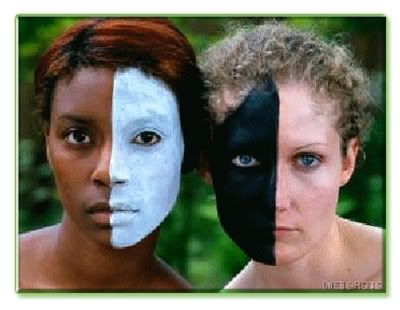
If you're a black American...

...how long have you waited for this day?

It's stirring to me, and I was born well into the power structure, and have wormed my way even closer since.

Thursday, May 8, 2008

Bill Moyers is a smart person


Bill Moyers, in an interview yesterday with Amy Goodman of Democracy Now! had some intelligent things to say about the media. Here's a slice of fried gold:
...the media doesn’t allow complicated thought to be articulated in ways that enlighten instead of misinform people.

...Politics often exposes us to the corroding acid of the politics of personal destruction, but I’ve never seen anything like this, this wrenching break between pastor and parishioner. Both men, no doubt, will carry the grief to their graves. All the rest of us should hang our heads in shame for letting it come to this in America, where the gluttony of the nonstop media grinder consumes us all and prevents an honest conversation on race. It is the price we are paying for failing to heed the great historian Jacob Burckhardt, who said, "Beware the terrible simplifiers."
More of this, please. You can read the transcript or listen (or watch) the entire interview through the link to Democracy Now!, above.

In the words of Martin Luther King, Jr., "Rarely do we find men who engage in hard, solid thinking. There is an almost universal quest for easy answers and half-baked solutions. Nothing pains some people more than having to think."

Moyers has always been both willing to think and unwilling to simplify, which I suppose is why he wound up in public broadcasting. There is little of commercial value in considered exposition, as the booksellers will tell you. It's past cliche to say that the media caters to the lowest common denominator. This has always been true--just think of the Spanish-American War and cries of "Remember the Maine!" Sensational or yellow or whatever you'd like to call it, American media has rarely upheld the ideals of the freedom under which it operates.

Like Novak, however, it is never beneath extolling those ideals to protect its pursuit of profit -- never so eloquent nor so subtle as when there is a threat to the golden tap.
Burke said there were Three Estates in Parliament; but, in the Reporters' Gallery yonder, there sat a Fourth Estate more important far than they all. It is not a figure of speech, or a witty saying; it is a literal fact,--very momentous to us in these times.
--Thomas Carlyle, "On Heroes and Hero Worship"
It has been "very momentous to us in these times" since freedom of the press was enshrined. And even though self-abasement by the media is not new, I would argue that never in American history has the media so clearly abandoned its role as the fourth estate. And where once that failure doomed only our country and the foe of the moment, in these days of hegemony, our illness of ethics and money threaten to catch the world on fire. In a moment when we must be at our best--for we are never as before a city on a hill--we have been at our worst. We have followed Dick Cheney into the shadows. You may recall:
We also have to work, though, sort of the dark side, if you will. We’ve got to spend time in the shadows in the intelligence world. A lot of what needs to be done here will have to be done quietly, without any discussion, using sources and methods that are available to our intelligence agencies, if we’re going to be successful. That’s the world these folks operate in, and so it’s going to be vital for us to use any means at our disposal, basically, to achieve our objective.
That quote is from a Meet the Press interview on September 16, 2001. Fittingly, it is the press that has provided the Emperor with the clothes he needed to do this "work in the shadows." Now, far too late (though we should well have seen its inevitability), we have followed the strings of torture back to the hands of the puppeteer.

What we can be sure the press will never report is that between the puppeteers and their audience, holding up the curtain to maintain the fiction, stands the press. And here we sit, like fools at a show, and believe it's all for our benefit.

The fact: The fact is that there is really only one thing that separates the good guys from the bad guys: There are things that bad guys do, which good guys will not.

It is their "will" not to do -- or to do -- that makes the difference.

I'm glad there are people like Bill Moyers to remind us that we were supposed to have been the white hats in this drama. But we've helped ourselves to a black 10 gallon Stetson and a bandanna to hide our features. In the confusing cross-fire of like against like we've used the Constitution to plug the bullet holes. It was never made for that.

And we enshrined freedom of the press, because the people should always know what the government is doing in their name.