Showing posts with label Iraq War. Show all posts

Monday, September 8, 2008

Supporting the Troops

It has always been a complex world. Most Americans would tell you that it is a more complex world today than it was in 2000, but that's just not true. Many Americans will claim that "everything changed after September 11th," but that's not true, either. The world is the same--it is we who have changed. We're paying a little more attention, right now. Not much, but a little. We're seeing a little bit deeper into the complex interrelations that move world events.

For example, Fannie Mae and Freddy Mac (private, for-profit corporations) are being taken over by the US Government amid fears that their collapse would cause a domino effect of financial ruin at home and around the world. According to the NYTimes, the government (you and me) will guarantee Freddy's debt, while allowing shareholders to twist in the wind.

As an American, you might ask, "Whose debt am I guaranteeing? If the vig comes due, who will we--the taxpayer--have to pay? Who has so much pull with our government, that they can request us to take over the largest mortgage companies in the world and guarantee their investment? Especially in a lousy housing market, where the value that debt supports is rapidly shrinking? Who, in other words, does hold my mortgage?"

Answer (from MarketWatch):
The top five foreign holders of Freddie and Fannie long-term debt are China, Japan, the Cayman Islands, Luxembourg, and Belgium. In total foreign investors hold over $1.3 trillion in these agency bonds, according to the U.S. Treasury's most recent "Report on Foreign Portfolio Holdings of U.S. Securities."
$1.3 trillion dollars. At least it isn't a buyout. You and I aren't paying China. We're just guaranteeing their investment in our mortgage industry with our taxes. And, yes, it's the same mortgage industry that's in the toilet right now.

It's complex. Always has been. The point is, things are bad enough right now that we're starting to pay attention. I know I sure didn't care about China buying our debt before a couple of years ago. I don't know if I ever gave it more than a passing thought.

So, back to September 11 and everything changing and, as the title implies, supporting the troops. I don't think I'd find much argument if I said that our military is a little ragged these days. And most people would probably agree that our veterans aren't getting the help they need. If one of your older relatives went to school on the GI Bill -- maybe your Dad or your Grandfather -- you might know that's a lot harder to do now. You might also know phrases you never knew before, like "stop-loss" and "individual ready reserve."

National security has never been more critical or seemed so complex. Many of the first choices and policy decisions our next President will have to make will deal with the health and welfare of our military. If you're in the service, or you know someone who is, you're probably assuming that John McCain is the right man for the job. After all, Republicans support the troops more than Democrats and he served in the military (you might have heard he was a POW). He never hesitates to reiterate his abiding support for our military. I'm writing this post precisely for you. If you think John McCain is the best candidate for the military, then you're using the same logic as a woman who supports Sarah Palin because she, too, has a vagina.

Here are some examples:

In April of this year, the Webb GI Bill came up for a vote in the senate. The Webb bill would have guaranteed veterans a chance to go to college. The original bill, from WWII, could have (and did) put a service member through Yale University. Currently--well, not so much. McCain opposed the Webb bill, which was co-sponsored by Chuck Hagel (R-Neb.) would have again made it possible for a soldier to go to college, with thanks from a grateful nation. McCain opposed this bill, saying it would decrease retention. Saying, essentially, that the benefits were too good.

Webb's bill would be expensive--about the same amount of money that we spend in Iraq in 36 hours. According to the Iraq and Afghanistan Veterans of America, the WWII bill returned $7 to the economy for every $1 it cost.

It is also the Army's primary recruiting tool.

On the day of the vote, only two Senators couldn't seem to make to the Senate. One was liberal Senator Ted Kennedy, at home recovering from brain surgery. The other was John McCain.

Here are some other dropped balls:

September 2007: John Sidney McCain (JSM) votes against another Webb bill that would have mandated adequate rest for troops between combat deployments (the "Dwell time" bill).

May 2006: JSM votes against providing the VA with $20 million needed for health care facilities; the money would have been provided by closing tax loopholes.

April 2006: JSM joins an elite group of 13 senators (all Republican) voting against $430,000,000 for the Department of Veteran Affairs for Medical Services for outpatient care and treatment for veterans.

March 2004: Votes against creating a reserve fund -- funded by closing tax loopholes for corporations -- to provide up to $1.8 billion in Veterans' medical care.

October 2003: JSM votes to table (essentially, to kill) an amendment that would have provided $322,000,000 of safety equipment (you know, like body armor) for troops in Iraq, funded by spending that much less on reconstruction.

In April of 2003, he voted to kill an amendment that would have appropriated $1 Billion for National Guard and Reserve Equipment in Iraq to address a shortage of helmets, tents, bullet-proof insets and tactical vests.
I'm not going to get into a discussion of how McCain voted on the war in Afghanistan or the invasion of Iraq, or how he wants to deal with Georgia or Iran. All I'm trying to say is that if you want to argue for military measures, or you want to say you support the troops, then you should be able to back it up with your voting record--since that's all you've really got.

The Iraq and Afghanistan Veterans of America has kept track of over 160 separate votes since 9/11, and graded every Senator and Congressman on their voting record. John McCain gets a "D."

The Disabled Veterans of America rated McCain at 20% for the 109th Congress.

IAVA and DVA also graded Obama. He got an 80% from DVA and a B+ from IAVA. If you're on the fence about these two guys, and the way they treat our people in uniform is something you're interested in, then I think you should take the evidence of their votes into account. One guy loves to use the military, but isn't interested in taking care of it. The other guy considers force the last resort, and would look after the health of his men.

If you find yourself surprised, and perhaps considering Obama, don't worry. You're in good company. According to the non-partisan Center For Responsive Politics, deployed troops support Obama over McCain 6:1, and he maintains a significant edge among all military personnel.

Our world is a much more complex place than some politicians try to make it seem. But this seems pretty simple to me.

Wednesday, July 2, 2008

Blood n' Oil -- Follow-up

This is a quick response to a comment on my There Has Been Blood post about the oil companies and their shiny new Iraq contracts. The best layout of these topics is actually in my Memorial Day post from last year. It's worth it to me to make the arguments again, though. The ties are too tight, the cost--in blood and money--too high.

I'm not trying to "call-out" my commenter. He's a reasonable, thoughtful guy. But it's worth looking a little more closely at the way this war has played out, and it's worth continuing to do it because history won't be kind if we fail to learn from it. In a country where people truly believe that a major party candidate is a possibly gay African-born closet-islamist who doesn't recite the pledge to the flag (more later), revisiting the facts is critical. As one of those benighted citizens said, "He's a good speaker, but you've got to dig deeper than that for the truth. Politicians tell you anything. You have look beyond the surface, and then there are some real lies."

Yup.

Now, I don't claim to know how much influence the oil industry has inside the White House. But I think we're foolish if we think it's negligible. Here's part of the comment that spurred this response:
If Iraq didn't sit on a huge bed of oil, we probably wouldn't have invaded when we did. I do have a hard time saying this is a war for oil. I've been more inclined to believe we went there because we thought he had WMD, President Bush & Co. thought we could bring "peace and stability" to the middle east, and Iraq sits on a big bed of oil. The western oil companies will get their oil and make a nice profit, but the Iraqi government will make a tidy sum as well.
I agree with a lot of this. But the WMD thing was a charade. It was made up. And I'll go along with "peace and stability" (incidentally, not a success), as long as by that you mean "democracy will flow like a river and all we have to do to make that happen is kill the right people." Which by itself is pretty incredibly naive on their part.

Almost every last person involved in the administration who is not currently in the administration has admitted that the Pres, V-P, then-SecDef Rummy and Wolfie conspired to cook the intelligence to make the case for war. This goes for every jettisoned principal from George Tenet to latest traitor Scotty McClellan. Almost every shred of evidence--including the "mobile weapons labs" that were part of the slideshow C.Powell gave at the UN--were ginned up from single-source informants with an ax to grind, and in one case, an international reputation as a con-man. The only people not admitting to this are still gainfully employed by the White House.

I haven't written a comprehensively sourced blog on this since a year ago because, frankly, it depresses the shit out of me.

The "peace and stability" canard is a true beauty of selective sociology combined with a religious (small "r") -- not factual -- view of democracy and how successful democratic institutions coalesce from human populations. The idea itself is not the crystallizing agent the neoconservatives wish that it was. For more reading on how they began to convince themselves of these theoretical underpinnings for the policy of "oil-forward" and "aggressive democracy" dig into information about "The Project for a New American Century," or PNAC.

Led by "liberal" New York Times, no newspapers or reporting agencies asked hard questions (or even follow-up questions to their own softballs) during the run-up to the invasion. Reporter Judith Miller beat the war drum most loudly. It was later revealed that her only significant source was Ahmad Chalabi and that she didn't do any fact-checking. (She was later compelled to quit her job, but not before covering for I. Scooter Libby.)

There was, and is, a lot of complicity on both sides of the aisle to either use public fear to get what they wanted (Patriot Act, AUMF) or to stay out of the way of the zeitgeist lest they be voted out of office or *gasp* labeled un-American or traitorous (see, John Kerry, Hillary Clinton, e.g.). Of course, they were too naive to understand that they'd get that label anyway, as Democrats.

The use of fear continues. The recent "compromise" on the FISA legislation is a response to that fear--again either a willingness to exploit it or an unwillingness to stand up to it and make a principled case. Now FISA (which worked just fine, by the way) has been greatly expanded and the only assurance that the government won't spy on you is their say-so. And the telecommunications companies that broke 4th Amendment law in order to help the government spy on you are no longer subject to accountability.

Commenter:
Don't cry for Lukoil and Putin. Their role in helping Hussein circumvent food-for-oil is criminal. It's too bad most of the world has ignored it.
I cry for no oil companies--those run by Russian oligarchs least of all (we have plenty of our own, anyway). But they had plenty of help in subverting oil-for-food. According to the CIA, the list includes Chevron and ExxonMobil to name two off the top of my head. Chevron alone admitted to paying over 30million in kickbacks (while Condi Rice was on its board of directors, no less). It's too bad that we in the west have ignored that.

I pointed out that the Russians lost out on the contract to indicate that the pay-to-drill arrangement involved the deaths of US Soldiers, not Russian ones, and the regime in Iraq understands that.

In a war of straight policy, the first preemptive war fought by the US since before WWI, reasons are paramount. Like Ellerby, Alec Baldwin's character in "The Departed," it makes sense to ask "Cui bono? Who benefits?"

In the case of the Iraq invasion, the press and congress and many Americans' response was Matt Damon's: "Cui gives a shit? It's got a fucking bow on it!"

But who has benefited? Certainly not our over-deployed and under-supplied military. Certainly not our economy, strapped with the largest deficit in its history (both as a raw number and as a percentage of GDP) as a result of a war habit that costs $430 million per day [CNNMoney 6/12/08]. According to the President and Congress, we aren't any more secure--that was their main argument for renewing the Patriot Act and the new FISA "compromise."

According to the AP, on the other hand:

Chevron Corp. put yet another exclamation point on the oil patch's long run of prosperity Friday with a first-quarter profit of $5.17 billion, or $2.48 per share. That was up 10 percent from net income of $4.72 billion, or $2.18 per share, last year.

The performance exceeded the lofty expectations of analysts, helping lift Chevron shares 38 cents to $95.32.

It was the second-highest quarterly profit in the company's 129-year history and marked the most money that it has ever made during the January-March period. That puts the No. 2 U.S. oil company on track for its fifth straight year of record earnings.
AP report, 5/2/08.

The same goes for their buddies around the world. These companies have benefited from an energy policy -- literally a secret energy policy -- formulated by Dick Cheney and their own board members behind closed doors. I'm not trying to be hyperbolic--you can't make this shit up. He literally met in secret with oil industry executives to lay out our energy policy in 2001. When newspapers and interest groups sued to see non-classified documentation of the meetings to understand how our official oil use and development policy was crafted, the case was thrown out of court.

Now we're occupying the largest untapped oil reserves in the world with American soldiers (pretty successfully) policing a religious civil war that we set loose. About the only people set to gain from this situation are American oil companies: I ask again, "Cui bono?"

So, it may not have been the only reason. But it was a big one. And when it comes time for these guys to count their chips when they pack up the boxes next year, it will be the most important one, and the only one that succeeded.

The answer may have a bow on it, but if you're a taxpayer, the box itself is full of a big shit sandwich. Nom nom nom ... tastes great! Thanks, George!

Tuesday, June 24, 2008

There Has Been Blood

In an interview with Newsweek last fall, the former chief executive of Exxon, Lee Raymond, praised Iraq’s potential as an oil-producing country and added that Exxon was in a position to know. “There is an enormous amount of oil in Iraq,” Mr. Raymond said. “We were part of the consortium, the four companies that were there when Saddam Hussein threw us out, and we basically had the whole country.”
"...the whole country." Gentle reader, hear in that phrase the lacrimose longing of a dream deferred. "The Whole Country," when it comes to Iraq, represents perhaps the largest un-tapped oil reserves in the world. Untold black gold, lying beneath the sands -- wasted, if you happen to value it (word is, some do).

As conservative commentator Kevin Phillips has detailed,
From the 1930s to the 1960s, in the words of oil historian Anthony Sampson, the reorganized Middle East had "two kinds of maps: some showing the names and outlines of nations, most of them comparatively new; and others showing the region cut up into squares along the coast, marked with the initials -- IPC, KOC, ARAMCO, AOC -- representing the consortia of oil companies, nearly always including some of the Seven Sisters. To the companies, it was these squares which were the real geography: Saudi Arabia was Aramco-land; Iran meant all seven; Kuwait was Gulf and BP.

The oil maps, in short, had long been the ones that mattered. For the US and British oil companies, losing these concessions to the nationalizations of the 1970s was infuriating. The irony with respect to Iraq was that for one reason or another, the 1970s were the only decade of heavy pumping and large oil revenues. Production had been kept low during the glutted thirties, and it then stagnated during WWII. ...Over the last decade or so this chronology of Iraq's surprisingly limited oil production had become relevant again for a simple reason: given that relatively little of Iraq's oil has been pumped, most of it is still in the ground. "American Theocracy, pp. 75-76
"The whole country." Rivers, oceans of oildollars, buried treasure in the sand, now obscured by the clamour of war. Yet fear not, o countryman, for the honor of our purpose. There's no chance whatsoever that we're there to get the oil. As Donald Rumsfeld has said:
if anyone looks at the history of the United States of America, they would know that we don’t want Iraqi oil. That oil belongs to the Iraqi people. ... Our interest is not the oil, and it will be clear that that is the case. The money and revenues from that oil belong to Iraqi people and they will have that.

Colin Powell
:
the one thing I can assure you of is that it will be held in trust for the Iraqi people, to benefit the Iraqi people. That is a legal obligation that the occupying power will have.
Rummy again:
The President has also requested funds ... to help with emergency fire fighting and repair of damage to oil facilities. It is important that we have these resources available.

But let me be clear: when it comes to reconstruction, before we turn to the American taxpayers, we will turn first to the resources of the Iraqi government itself and the international community. ...Once Saddam Hussein is gone, the U.S. will work with the Iraqi Interim Authority that will be established to tap Iraq’s oil revenues...
Paul Wolfowitz exercising strong message discipline:
the oil revenues of that country could bring between $50 and $100 billion dollars over the course of the next two or three years. ... We are dealing with a country that can really finance its own reconstruction and relatively soon.

...time passes...

...like 5 or 6 years...

June 19, 2008:
Exxon Mobil, Shell, Total and BP — the original partners in the Iraq Petroleum Company — along with Chevron and a number of smaller oil companies, are in talks with Iraq’s Oil Ministry for no-bid contracts to service Iraq’s largest fields, according to ministry officials, oil company officials and an American diplomat.
That story also says:
The revenue would be used for reconstruction, although the Iraqi government has had trouble spending the oil revenues it now has, in part because of bureaucratic inefficiency.
See if you can find the missing phrase. Here's a hint: It goes between "reconstruction," and "although" and it goes like this: "after paying the contract fee to these western oil companies.

It could be argued that these contracts are simply the thanks of a grateful Iraqi nation. After all, these companies had been providing (free of charge!) "advice" to the Iraqi government (still peopled with American policy-makers) on how to develop the very fields for which they were awarded contracts. Well, at least for most of the fields for which they were awarded contracts:
In all cases but one, the same company that had provided free advice to the ministry for work on a specific field was offered the technical support contract for that field, one of the companies’ officials said.The exception is the West Qurna field in southern Iraq, outside Basra. There, the Russian company Lukoil, which claims a Hussein-era contract for the field, had been providing free training to Iraqi engineers, but a consortium of Chevron and Total, a French company, was offered the contract. A spokesman for Lukoil declined to comment.
Russian Go Home! Your charity will not be rewarded here!
These no-bid contracts are simply to help the Iraqis to extract the oil. They are not a license to the oil itself. But it is as plain as the sun that the "free advice" was never free--that it was, in fact, merely the nose of the camel. Soon, the entire dromedary, and its spit and its shit, will be inside the tent.
“The bigger prize everybody is waiting for is development of the giant new fields,” Leila Benali, an authority on Middle East oil at Cambridge Energy Research Associates, said in a telephone interview from the firm’s Paris office. The current contracts, she said, are a “foothold” in Iraq for companies striving for these longer-term deals.
"Giant new fields." Actually, they're ancient. They're waiting for us -- well, some of us. Derrick Z. Jackson of the Boston Globe made many of these connections in his editorial of today, linked in the headline, and inspired me to dig up the old quotes from Phillips' book. I don't know why. I've written about this before, extensively. It's pretty clear that the camel has been inside the tent for some time now. I guess I'm still seduced by the crazy liberal notion that you can put 1,2 and 3 in order next to 5,6 and 7, and expect people to see that #4 is in the middle.

Monday, May 28, 2007

On Memorial Day: Why we don't fight

May 28, 2007 and the list of those we're called to honor and remember continues to grow. Like many people, I needn't search for soldiers to honor. Both of my grandfathers (US Army, US Navy), my uncle (USN) and my father (US Army and Army Reserve) have worn the uniform of my country.

I have deep admiration for my father's service. But in the example he offered to me was a lesson of ambivalence and caution and, ultimately, the reason I've never signed on the line: you cannot trust this government to use honorable men honorably. There is always the chance that you will be sent to kill for a mistake, or a lie.

I've been tempted more than once. Often, in fact. I regret not serving as often as I know it was the right choice for me. My father also taught me by his example that there are many ways to serve your country. Perhaps the best way is by being an active citizen. Take an interest in your community, your city, your state and your nation. His father lived that way, and he does as well. And I'm trying.

My Dad's legacy to me, on this day that is reserved for memory of service in war, is this: let us never spend the blood of our fellow citizens for any but the most righteous and unavoidable reasons. Let us value the blood of the stranger as highly, and let violence be our last, regrettable option.

This is my Memorial Day post, dedicated to my Dad and to everyone who has served our Nation. It is a long post, but incomplete. I will return to its themes again, particularly those I raise at the end of this entry. For the moment, this is a small expression of one of my obligations as a citizen: to see that our men and women are never wrongly or vainly used. To ask, "Have we set ourselves to violence and war in service of our Nation, or only of the government?"

A while ago, I stuck up a post titled, Remind Me: This was necessary why?. Well, I got an answer. It's free of snark, sarcasm or superiority. Here it is in full:
Because all men and woman deserve a right to be free of tyranny. To have the right to speak, protest live and die of their own accord. It is too easy to forget the evil that existed before free men did something to act. It is easy to take for granted that freedom isn't free. That Iraqis will one day have a choice to post a blog on the internet without fear of torture. If I had died in that country or go back and die there it will have been my honor. If the commander in chief be he or she black or white republican whig or democrat want to bring freedom and democracy to those who need, then I say suit up, it's time to go. To defend an idea or make a statement of our own convictions, sometimes we need action. Is it hard? Your goddammn right it's hard. Is it often unfair, will the ends justify the means? Time will tell but in the meantime because of these actions throughout history we have the right to debate it. What you don't see on the news are the millions of pictures depicting minor victories. You want to see some ask any soldier.
A man who had gone and returned -- and may yet have to do so again -- deserves a thorough airing of my position. Progressives and liberals who spend a lot of time talking and thinking about the war in Iraq work under a series of conclusions that aren't always represented in the commentary we write. Using this comment as a jumping-off point, I want to walk through many of the arguments that underlie how I feel and think about Iraq.

I couldn't agree more strongly with the basic philosophy of my commenter. You do have to fight for freedom, sometimes with bullets and always with vigilance. And sometimes it is morally necessary to take up your gun and fight for someone else's freedom -- even if they haven't asked for your help. British soldiers in Sierra Leone, for example. Of course, the Kurds begged for our help after the first Gulf War. Instead, we let Saddam gas them (with gas we had sold to him in the 80's). But when we invaded Iraq this time, it wasn't to liberate the Iraqis or to bring democracy. That reason got tacked on after the fact. Long after the fact.

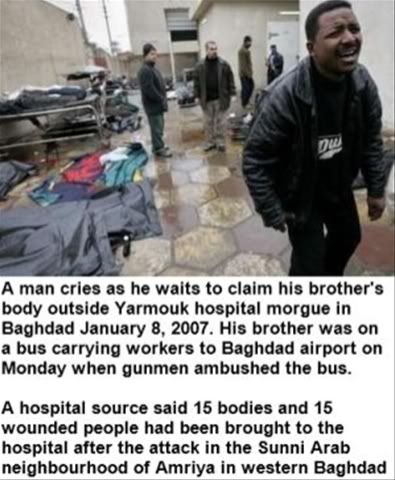
When I asked the question, "why was this necessary," it was posted above a photo of an anguished man who had been searching the morgue for his brother, and above a story about a man whose children are slowly dying from starvation and dehydration. The question has two levels: why was this (the Iraq war) necessary, and why was this (murder and anarchy on an unprecedented scale; starvation and the creation of refugees) necessary?

The first thing I have in mind when I think about the war in Iraq is this: we chose it. Iraq and Saddam Hussein had no hand in planning or supporting the attacks of September 11. This is so well recognized that Dick Cheney and George Bush are both on record to that effect. In fact, they were more interested in making a case for invasion than actually targeting known terrorists. We were told by the President and the Vice President and the Secretary of State and the Secretary of Defense that Iraq had weapons of mass destruction, and that Iraq constituted an imminent threat to the safety of the United States. We were told that if we waited for evidence of that fact, "the smoking gun would come in the shape of a mushroom cloud."

At the time, UN weapons inspector Hans Blix (whose name has become a punch-line) was saying a) that there was no evidence that this was so, and b) that it would take a couple of months to prove it: "It will take not years, nor weeks, but months." In spite of Blix's excellent reputation, we, with the support of Great Britain, declined to give him the time he needed. We created an arbitrary deadline for a process that was ongoing, and then we went to war. As we know, Blix has been proven right. There were no weapons of mass destruction, and there was no ongoing weapons program. (Although that did not stop the President from making a big joke about it -- right about the time, I think, that my commenter had his boots in the sand.)

So those were the two big themes: Iraq poses a threat to the US, and Iraq has weapons of mass destruction. This wasn't a war for freedom, in the beginning. It was a war of self-defense. That's how it was sold to us. This is the beginning of my anger: If the administration had come to the American people and said, "Saddam Hussein is a terrible tyrant. He is oppressing his people, jailing and torturing them on the basis of their religion (Shiites) and their ethnicity (Kurds). The Iraqi people are so beaten down that they need a hand up, and we're the ones to give it to them," I think that would have worked. Not only that, but working through the United Nations and other diplomatic channels, I think the administration could have marshaled the significant coalition that would be necessary to topple a dictator and occupy a country -- a much larger force than we have ever committed to Iraq.

International support would have fallen away quickly, of course, once other nations started researching Iraq and its history of internal violence and strife. We would have quickly been forced to see that this would be a much more complicated task than we thought. But when yours is the only voice that matters, you believe your own propaganda.

The invasion and occupation of Iraq was never about freedom for Iraqis -- at least not for their sake. If the Iraqi people obtain freedom, we'll be very happy about that, but we didn't go there to deliver them from tyranny. It is important to distinguish between why we said we went and the real reasons for going. If it is your belief that the President always tells the truth, the whole truth and nothing but the truth, the following argument will not have much weight for you. But since I don't think you honestly believe that, here it is. He didn't go with "freedom for Iraqis." He went with "our freedom is threatened by Iraq." It was only much later, when the weapons and weapons programs hadn't been found, that he fell back on the 'liberators' theme.

Had those arguments been true, or even supportable, perhaps I could understand the decision. But for some reason, the rest of the world wasn't buying it. Not even after Colin Powell did his thing at the UN. Sure, Britain signed up. At the time, their interests seemed indistinguishable from ours (at least to Jack Straw and Tony Blair). And there were a few countries that offered aid in transport and rear-echelon support (and billed for it). But where was the coalition, really? If Saddam was such a threat, regionally and globally, why weren't the Arab nations lining up behind us as they had done in the first Gulf War? And why were the chief military powers of Europe and the Soviet Union so against this?

Obviously, one answer is oil. I'll discuss that in a bit. But the other answer is that there was no real evidence of the things Bush claimed. There was no evidence of a nuclear program. There was no evidence of a chemical weapons program. There was no indication that Saddam was a threat outside his own borders. Why then did the US seem to have this great case? If the evidence was there and we failed to act (as happened on 9/11), then that would be a crime. But how is it that we had this evidence that no one else had? And were our intelligence agencies really that bad? How could they have gotten this wrong?

Well, the truth is that they didn't. As George Tenet has finally seen fit to reveal in a book basically designed to redeem himself from the firey pit, good intelligence was ignored, censored and thrown in the trash in order to make the case for war. As the Baltimore Sun has explained in a scathing editorial [ed. note: original link, now dead, replaced w/copy of editorial cached at Common Dreams]:
Because Mr. Tenet lacked a background in intelligence analysis, he relied heavily on a deputy, John McLaughlin, who was a career intelligence analyst. But instead of giving Mr. Tenet proper guidance, Mr. McLaughlin relied on single-source and poorly sourced intelligence to make the case for war, and he ignored credible intelligence that pointed to an absence of WMD in Iraq.

The claim that Saddam Hussein was reconstituting his nuclear capability was based upon a single source - an intelligence fabrication. Similarly, the sole source for claims about mobile biological laboratories was unstable and untrustworthy. And the sole source for links between Iraq and al-Qaida had been tortured and abused in his interrogations and eventually recanted.

How is it that the chief deputy of the director of the CIA came to rely on only one source? Bad information, fed directly to the administration without any vetting by the people who had the most to gain by a US invasion, people like Ahmed Chalabi. Our 1997 intelligence budget is larger than the 2006 GDP of Qatar (106 world wide). More money than 123 countries and only one source on Iraqi nuclear capacity?

Stovepiping:
The point is not that the President and his senior aides were consciously lying. What was taking place was much more systematic—and potentially just as troublesome. Kenneth Pollack, a former National Security Council expert on Iraq, whose book “The Threatening Storm” generally supported the use of force to remove Saddam Hussein, told me that what the Bush people did was “dismantle the existing filtering process that for fifty years had been preventing the policymakers from getting bad information. They created stovepipes to get the information they wanted directly to the top leadership. Their position is that the professional bureaucracy is deliberately and maliciously keeping information from them.

“They always had information to back up their public claims, but it was often very bad information,” Pollack continued. “They were forcing the intelligence community to defend its good information and good analysis so aggressively that the intelligence analysts didn’t have the time or the energy to go after the bad information.”

The Administration eventually got its way, a former C.I.A. official said. “The analysts at the C.I.A. were beaten down defending their assessments. And they blame George Tenet”—the C.I.A. director—“for not protecting them. I’ve never seen a government like this.”
If you read nothing else on this blog, ever, please read that article.

The military strategist von Clauswitz famously described war as "the continuation of policy by other means." (A phrase fraught with substantial ambiguity. See here.) As an observation, perhaps this is true. But there is a piece missing: why must policy that leads to war be continued at all? The answer is supplied by Tony Benn who, on the last day of the Gulf War said to the House of Commons, "All war represents a failure of diplomacy."

Ten years later, as Bush mounted the war horse, Benn didn't get a chance to be right. Diplomacy didn't fail -- it ceased. Hussein was contained. We didn't even get to manufacture our own "Gulf of Tonkin incident." The Iraqis couldn't -- or didn't -- even shoot down one of our planes. Instead, we simply called off the weapons inspections and invaded.

People who want to argue this point often point to the failure of the UN "Oil for food" program as evidence that diplomatic means would never work. But why did Oil-for-food fail? It failed because it enriched Saddam Hussein, rather than starving him. How? Because American oil companies paid he and his government substantial kick-backs on the oil he sold them. As Condoleeza Rice has said:
Now, we understood when we came to power here in Washington several months ago that we had a problem, for instance, on Iraqi sanctions; that people believed, or that Saddam Hussein was claiming that the sanctions that were in place were somehow harming the Iraqi people. We do not believe that they were harming the Iraqi people because in the north, where the U.N. administers the oil-for-food program, Iraqi people are doing well. It's only where Saddam Hussein administers oil-for-food that there is a problem with the Iraqi people.
Of course, she probably knew about the kickbacks for some time. Iraq started asking for the grease back in 2000. Rice was a member of the Chevron Board of Directors for 10 years -- until she resigned to join the Bush administration in 2001. I think it's at least even money that the Board was aware of the cash flow, because it wasn't small change: Former chairman of the Federal Reserve, Paul Volcker, has determined that Chevron paid Saddam Hussein a tip of $20 million from 2000-2002. But they weren't alone: the Coastal Corporation, a subsidiary of El Paso; Texaco; BayOil, and Mobil. All American companies, all on the hook for big bucks.

So how did oil-for-food fail? Oil companies subverted it. Did we go to war to free Iraqis? Or did we go to war to free their oil? Or do we just not give a shit? After all, these are the very same companies who wrote our energy policy.

Last year, a man named Kevin Phillips wrote a book called American Theocracy: The Peril and Politics of Radical Religion, Oil, and Borrowed Money in the 21st Century. I confess that I haven't finished it yet. It's hard to take 400 pages of relentlessly rational and documented bad news. Phillips is an interesting cat: He was a young hot-shot political strategist who helped elect Nixon. He penned "The Emerging Republican Majority" in 1969. He also authored one of the more cynical political tactics ever: the Republic party's "southern strategy." Just a refresher on that:

The "southern strategy" was to exploit racial hatred to raise Republicans. Phillips, in 1970:
From now on, the Republicans are never going to get more than 10 to 20 percent of the Negro vote and they don't need any more than that... but Republicans would be shortsighted if they weakened enforcement of the Voting Rights Act. The more Negroes who register as Democrats in the South, the sooner the Negrophobe whites will quit the Democrats and become Republicans. That's where the votes are. Without that prodding from the blacks, the whites will backslide into their old comfortable arrangement with the local Democrats.
Phillips has changed a little since then, but not too much. Instead what has happened is that the GoP has moved steadily to the right on social issues, while becoming more and more "big government" in support of business -- particularly the military support business. His account of neo-conservatism as practiced by Bush and Cheney is an education, as follows:
The Bush-Cheney administration, on taking office, embraced and oil "forward strategy" with instant intensity: Plans were discussed in the spring and summer of 2001 -- well before the events of September -- for hamstringing Iraq and convincing the Taliban in Afghanistan to accept construction of an American (Unocal) pipeline from Turkmenistan through Kabul to Karachi, Pakistan. Talks with the Taliban continued in the summer of 2001 but apparently soon collapsed. (p. 83)
Until the towers came down, the US was negotiating with the Taliban for oil rights in Afghanistan. What more evidence do you need to believe that ideology, that human rights, that democracy are simply not that important? We weren't looking to leverage them out, we were looking to work with them.
From the 1930s to the 1960s, in the words of oil historian Anthony Sampson, the reorganized Middle East had "two kinds of maps: some showing the names and outlines of nations, most of them comparatively new; and others showing the region cut up into squares along the coast, marked with the initials -- IPC, KOC, ARAMCO, AOC -- representing the consortia of oil companies, nearly always including some of the Seven Sisters. To the companies, it was these squares which were the real geography: Saudi Arabia was Aramco-land; Iran meant all seven; Kuwait was Gulf and BP.

The oil maps, in short, had long been the ones that mattered. For the US and British oil companies, losing these concessions to the nationalizations of the 1970s was infuriating. The irony with respect to Iraq was that for one reason or another, the 1970s were the only decade of heavy pumping and large oil revenues. Production had been kept low during the glutted thirties, and it then stagnated during WWII. ...Over the last decade or so this chronology of Iraq's surprisingly limited oil production had become relevant again for a simple reason: given that relatively little of Iraq's oil has been pumped, most of it is still in the ground." p. 75-76
"As the dust of the first Gulf War settled ... if Saddam Hussein could escape UN sanctions and give Iraq's lush concessions to non-Anglo-American companies, he could realign the global oil business.

In the meantime, UN sanctions were essential in preventing Iraq from exporting oil beyond the middling amount allowed and also in preventing competitive foreign investments. So long as the United States and Britain could keep these sanctions in place, using allegations concerning weapons of mass destruction, Saddam could not implement his own plan to extend large-scale oil concessions (estimated to be worth $1.1 trillion) to the French, Russian, Chinese, and other oil companies. ...

...This brings us to the next critical set of maps, the ones used in 2001 by Vice President Dick Cheney's National Energy Policy Development Group [the one visited so frequently by oil company exec's] to mesh America's energy needs with a twenty-first century national-security blueprint. ...

Never intended for public scrutiny, the three Middle East maps and their supporting documents came to light in the summer of 2003 under a federal court order. The most pertinent displayed Iraq's oil fields, pipelines, and refineries, with a supporting list of 'Foreign Suitors for Iraqi Oilfield Contracts.' As of 2001, more than sixty firms from thirty countries -- most prominently France, Russia, and China, but also India, Japan, Indonesia, Canada and Germany -- had projects either agreed upon or under discussion with Baghdad. Nothing could have been less popular in Washington or London" pp.76-7
But as we have already seen, the oil companies weren't just relying on the good graces and efforts of the government: they were supplying Saddam with serious cash in the form of kick-backs. This cash was clearly meant to woo the dictator to their side in this desperate race to secure Iraqi oil-field contracts. But they were losing. As Phillips details, the Russians and the French were in the lead.

For his part, Saddam was playing both ends against the middle: dangling contracts in front of all comers to squeeze cash out of them up front. Concessions that lingered with non-US names on them were insurance against the day when the Chevrons and Exxons of the world tired of paying the vig. A backstop at the end of the streak that would leverage Saddam's position by threatening the complete upheaval of the global oil game. But the US oil companies had something the French and Russians didn't: a government composed of oilmen.

But not just oilmen: oilmen with a new religion.

The church these men worship in is better known as the Project for a New American Century (PNAC). Here is the sum of their statement of Principles:

• we need to increase defense spending significantly if we are to carry out our global
responsibilities today and modernize our armed forces for the future;

• we need to strengthen our ties to democratic allies and to challenge regimes hostile to our interests and values;

• we need to promote the cause of political and economic freedom abroad;

• we need to accept responsibility for America's unique role in preserving and extending an international order friendly to our security, our prosperity, and our principles.

If you read the whole thing, on the website linked to above, you may find yourself in agreement with many of the ideas expressed therein. I do. But when we break out some of these things, and lay them next to the policy decisions of the Bush administration, things get spooky:
"challenge regimes hostile to our interests and values"

"promote the cause of political and economic freedom abroad"

"accept responsibility for ... preserving and extending an international order to our security, our prosperity, and our principles."
Whose prosperity? Whose principles? What does it mean to "challenge" regimes hostile to our interests and values? The prosperity is the prosperity of the obscenely rich. The principles are those of oilgarchy. It means preemptive war. That is, war without provocation. War of choice:
We cannot defend America and our friends by hoping for the best. ...If we wait for threats to fully materialize, we will have waited too long.

...[T]he war on terror will not be won on the defensive. We must take the battle to the enemy, disrupt his plans, and confront the worst threats before they emerge. In the world we have entered, the only path to safety is the path of action. And this nation will act.

2001 is not some new dawn. This isn't the first time we've lived in a world that seeks to harm us. But it is the first time that we've claimed the right to attack not just those that threaten us, but those that might threaten us.

Yet, somehow, we didn't attack Iran, which had a nuclear development program at the time. Nor did we attack North Korea, which had an indisputably advanced nuclear armament program at the time. We attacked the country with the most oil. Even though they had nothing to do with 9/11 and they had no significant regular military and no WMDs or program to develop WMDs. Even though they did not harbor al-Queda, nor al-Zarqawi. What constitutes a threat that justifies invasion and occupation? I promise you, we weren't there to liberate Iraqis.

How do I know that the doctrines outlined by PNAC on their website informed our decision to invade Iraq? On that same page is a list of the signatory members to PNAC's prinicples, including Elliot Abrams, Bill Bennett, Florida Governor Jeb Bush, Steve Forbes, Donald Kagan (architect of the "surge"), Scooter Libby (convicted of lying to a grand jury and obstruction of justice), Dan Quayle, Donald Rumsfeld, Paul Wolfowitz and Dick Cheney.

I think that answers the first level of the question: why was this necessary. It wasn't. This war wasn't about freeing the Iraqi people. It was about some combination of preserving our perceived right to the oil under the sand and a desire to protect American hegemony by attacking an unstable dictatorship that wouldn't get with the program. We didn't bargain for the hornet's nest.


The second level of the question is "why is the incredible suffering of the Iraqi people necessary?" And if you've come this far, doubtless you know my answer to that question is also "it wasn't."

This isn't just "hard." This is unconscionable:
Every day local police haul bodies from the Tigris bearing signs of torture. Locals who live near the river constantly see floating bodies.

The situation is even worse in Suwayrah, a southern area of the capital, where the government has built barriers with huge iron nets to trap plants and garbage dropped in the river but now this is also a barrier for bodies.

"Since January 2006 at least 800 bodies have been dragged from those iron nets, and this figure does not include those collected from the central section of the river. Most of the bodies are unidentified and buried without family claims," said Col Abdel-Waheed Azzam, a senior officer in the investigation department of the Ministry of Interior.

According to Azzam, 90 percent of the bodies found in the river show signs of serious torture.
But those are the people that stay.

What would it take to make you leave the United States? How bad would things have to get before you would beg to be allowed to leave this land?

The invasion of Iraq has caused a deeper humanitarian crisis than the simple death and torturing of thousands of Iraqi civilians. It has created over two million refugees:
The UN estimates that 2.6 million Iraqis have fled violence in their country since 2003 and at least 40-50,000 more Iraqis are leaving their homes every month. Two million have fled to surrounding countries, while some 1.8 million have vacated their homes for safer areas within Iraq. ...

"Iraqis who are unable to flee the country are now in a queue, waiting their turn to die," is how one Iraqi journalist summarizes conditions in Iraq today. While the U.S. debates whether a civil war is raging in Iraq, thousands of Iraqis face the possibility of death every day all over the country. All Iraqis, whether Sunni, Shi'a, Christian, or other groups such as the Palestinian, are threatened by armed actors.
2 million refugees is not normal. This isn't just par for the course when it comes to nation-building. It bespeaks a dramatic failure to plan, coupled with a depraved unwillingness to acknowledge reality and alter course accordingly. In other words: 1. It didn't have to be this way. 2. It is this way. Failure to address this state of affairs isn't just unbecoming to a nation that claims the values we claim; it is actually depraved. We are the cause of a humanitarian crisis of immense proportions, and we aren't doing anything to fix it.

Let me say this again: Forming a democracy does not require this. It does not require torture. It does not require refugees. It does not require Haditha. It does not require Abu Ghraib.

What ends will ever justify these means?

?

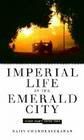
A great deal has been written about the way we prepared for an executed our post-invasion behavior. Perhaps one of the more readable accounts is Rajiv CHandrasekaran's Imperial Life in the Emerald City. I'm not going to delve too deeply into it here. Suffice it to say that you wouldn't want these guys planning a tea-party, much less the occupation and rehabilitation of an entire country. But there was more to it than that: The inherited factionalism of Iraq went completely unplanned-for. The fact that we expected Iraq to transition instantly from a soviet-style command economy into a full-blown free-market capitalistic society (such that doesn't even exist in America) was taken for granted. No preparations were made for employment, few for healthcare, none for provisioning. No one seems to have entertained the idea that the power vacuum we created would invite exploitation by any number of warlords and ex-pat terrorists.

I've summed his book before, saying:
The scope of ignorance is so broad one can only assume incompetence or criminal intent. Based on a few tidbits I'm leaning toward the latter: 1. the few competent people who found their way to Iraq were overborne by the weight and volume of useless information and people they were forced to accomodate, and 2. the vast (and by vast I mean 99%) majority of contracts and appointments were handed out not based on competence or suitability, but on connections and a neoconservative litmus test.

What's sad is that the remaining 1% appear to have been genuinely talented and dedicated individuals. What's tragic is the cost of this cock-up. What's criminal is that it appears to have been intentional.


We pay for the results every day. But out casualties have only barely outstripped all the dead from 9/11 (though there are more every day and over 100 this May). The Iraqis have died by the tens of thousands.

Now we come to the hard part, as a nation, the deeply personal part.

You are a soldier. Your duty is to go when ordered and to "stay in your lane." To back up the man to your right and your left and fulfill the mission. How can I ask you to risk your life and the lives of your squad by allowing even a sliver of doubt?

And what right do I have to risk your honor by questioning the use to which it has been put?

And here we find the difference between the civilian and the soldier.

My father served in Vietnam. My grandfather served in World War II. I used to dress up in dad's old fatigues and run through the woods. I wore out my school's supply of books on WWII and WWI and all the "Colby's" catalogs of armaments. Jane's on planes and ships and helicopters. I practiced my salute in the mirror and crept up to his office on rainy Saturday afternoons to scrabble in the deep back of the bottom drawer of the filing cabinet to find the boxes of his medals and his service ribbons. Later I read Clauswitz "On War" and Keegan on the "Face of Command." And on and on.

In spite of that, I never enlisted in the armed forces, although there have been times when the temptation has been very strong. Even lately. And the reason was (and is) this: I knew, from Vietnam, that if I did, there was a chance I would be sent where I didn't belong and asked to kill a man that shouldn't be killed and for all the wrong reasons. It wouldn't be up to me. And I wouldn't have a say in it. And I don't trust my government enough to believe they wouldn't do that to me.

They would. In a heartbeat.

It is my deepest obligation as a citizen of the United States of America to do everything in my power to ensure that my government never asks my fellow citizens in uniform to die or to kill for anything other than the highest moral aim in just and righteous combat. Anything less erodes the glory of my nation.

My nation's glory has taken a savage beating over the last four years. There's not much left.

Senator Webb made the point bluntly in his State of the Union response: “We owed [our leaders] our loyalty, as Americans, and we gave it. But they owed us…sound judgment, clear thinking, concern for our welfare, a guarantee that the threat to our country was equal to the price we might be called upon to pay in defending it. The president took us into this war recklessly.”

What we haven't spent in foreign fields we have, incomprehensibly, corroded and attacked from within: law-breaking surveillance of our own citizens, the evisceration of the Writ of Habeas Corpus -- the Great Writ -- being only two examples. I have, and will, go on at length about these things elsewhere. And this post is far too long already. But for today, Memorial Day, I ask for more than memory of our servicemen and women. I ask for help remembering who We are: I can scarcely recognize us now.

Columbia, so disfigured! Only fear, hate and deceit can yield such a face.

Wednesday, May 2, 2007

His lips were moving, so...

Yesterday, Congress passed an emergency supplemental spending bill to continue funding the occupation of Iraq and the war in Afghanistan. The billion-dollar appropriation to continue the war included a hard date in October to begin pulling out troops from Iraq. The rest of the withdrawal was to be phased, with those phases keyed to benchmarks for the Iraqi government (such as it is).

Exactly four years after declaring "mission accomplished" in full flightsuit/codpiece regalia, Bush refused to offer a horizon for this never-ending journey. For just the second time in his two-term Presidency, Bush pulled out the veto pen. (The only other veto was to block American science and medicine from exploring, with the rest of the civilized world, stem-cell research.) In doing so, he uttered two of the more blatant hypocrisies in a career rife with them. (There were more, of course, but these two stuck out.)
First, "It makes no sense to tell the enemy when you plan to start withdrawing. All the terrorists would have to do is mark their calendars and gather their strength and begin plotting how to overthrow the government and take control of the country of Iraq."
Factually untrue, of course, since the pullout proceeds only as the Iraqi government meets various goals. Only once a given goal is met would we know when a certain draw-down would occur. But that's not hypocrisy in itself -- just misleading. What makes it hypocritical is this:

On April 20 of this year, W defended the surge in a speech before a group of high school kids and an international affairs civic group.
Like a general outlining his battle plan, the president delivered a step-by-step analysis of the conflict in Baghdad, Anbar Province and the outskirts of Baghdad. He began with a map that used red triangles to pinpoint the location of joint security stations, posts in Baghdad where American and Iraqi forces are supposed to work to root out terrorists.
What's the difference between saying "we might leave, eventually, sometime in the future but not before next year," and saying, "see these little triangles? Well, that's exactly where our troops are." Here's a hint: one gets troops killed. Rightnow.

Here's the other biggie: Bush said, "members of the House and the Senate passed a bill that substitutes the opinions of politicians for the judgment of our military commanders." The phrase "cognitive dissonance" has lost its meaning. (Hey, first they killed satire. It was only a matter of time.)

Substituting the requirements of politics for the judgement of the military is Bush's stock-in-trade. From the moment Powell took his cooked intelligence before the UN, through the forced resignations of tens of his leading generals and the merry-go-round that is the seat on which Petraeus now sits, forcing the military (and every branch of the civil service as well) to ignore reality and toe his line is W's only legacy. But don't take my word for it.
Dear Mr. President,

Today, in your veto message regarding the bipartisan legislation just passed on Operation Iraqi Freedom, you asserted that you so decided because you listen to your commanders on the ground.

Respectfully, as your former commander on the ground, your administration did not listen to our best advice. In fact, a number of my fellow Generals were forced out of their jobs, because they did not tell you what you wanted to hear -- most notably General Eric Shinseki, whose foresight regarding troop levels was advice you rejected, at our troops' peril.

Those are the opening lines of an open letter from Major General Paul D. Eaton, USA, Retired. Click, read, and be edified. You've got to hand it to Bush, though. He's getting a lot better at letting this bullshit trip lightly from his tongue. His conscience hasn't improved, but I'd say his diction is getting a little better.

It'd be enough to boggle the mind, but after six years of this crap, my boggle is broken.

Friday, April 20, 2007

Heroes Revisited

A little while ago, I wrote this about Heroes, with the disclaimer that it needed some finishing. Got a comment, thought I'd touch on it some more.

There are certainly heroic acts that occur in battle, or at the scene of a fire. But not all acts of warfare or public safety are heroic, so not all soldiers or public servants are automatically heroes. It wouldn't be necessary for me to point that out if it weren't for the fact that we're increasingly encouraged to think in those terms.

A letter in the Boston Herald on the eve of the marathon this year referred to the "20,000 heroes" who would be running in the race the following day. Bullshit. They're not heroes -- they're runners. As far as I know, there was only ever one hero associated with marathons, and that was this guy, and even that story probably isn't true.

On the other hand, no one can overstate the heroic value a man has to the man whose life he was wounded or killed saving or serving, nor his friends or brothers-in-arms.

So I begin to see that my irritation with the way we use the word has to do with the way were encouraged to make all potential heroes into public heroes. It has killed the word. The common use forces people to have to distinguish real Heroes from all the heroes out there, which they shouldn't have to do.

And since my objections have more to do with the way the word is used than the word itself, I'm starting to drill down to this:

Once the media have labelled a hero, their supposed heroism isn't allowed to stand for its own sake. Instead it is used as a sword to defend its larger context. I'm thinking, of course, of the invasion and occupation of Iraq. If all soldiers are heroes, then the war is an heroic endeavor. They seep into each other, such that criticism of the war becomes de jure criticism of the heroes.

The reason we permit this is that we're lazy with language. And we wind up fooling ourselves. But the real hurt is done to our soldiers, some of whom can't see that in our hatred and dismay over the war, we don't hate or despise them. At least, I don't, in general. The trick has robbed us of allowing heroism whilst condemning its context. That impossibility highlights the distinction between public heroes and intimate heroism. It also might explain why I wander off this map and into a discussion of our cultural heroes.

I think that's what we're fighting over, really. Because we can't agree on the justness of the war, we seem to rob the hero of his due. If the war were just (if any war is just), the men and women who fight it get public glory. Public glory is what they sell you as a kid. And I have a hunch it's what the recruiter is peddling as well, at least by implication. Perhaps a soldier comes to think of it as part of his pay.

But we've come so far and fought so many questionable wars, that most Americans aren't willing to offer the unfettered adulation our grandfathers received at the end of WWII. And that must hurt.

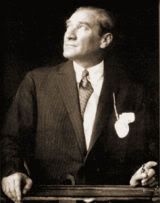
The more I write about this and think about it, the more hollow the note of "hero" is starting to sound. I'm thinking of a personal 'hero' of mine, Kemal Ataturk (pictured) -- a quintessentially public hero. He was often brutal and mean. But he had great vision and force of will, and an egalitarian and democratic dream.

The more I play this song, the more I think "hero" can't be a word that applies to a man.

I think it is a word about myths and gods, and that only our acts can be heroic, never our selves.

More to come, no doubt.

Monday, March 26, 2007

The "Pull out of DC" email

I keep getting this stupid email:
There has been a monthly average of 160,000 troops in the Iraq theatre of operations during the last 22 months, and a total of 2,112 deaths. That gives a firearm death rate of 60 per 100,000 soldiers.

The firearm death rate in Washington D.C. is 80.6 per 100,000 persons for the same period. That means that you are about 25% more likely to be shot and killed in the U.S. Capital than you are in Iraq.

Conclusion: The U.S. should pull out of Washington
Maybe people think this is funny. Maybe they give a little laugh and say, "Gee. Sure is dangerous in the old chocolate city. Thank goodness I live in Baltimore." Or they shake their heads and say, "Wow, guns sure are dangerous. We should get rid of them."

More often, I get this email from some gun nut or other who uses it to buttress their argument that D.C.'s gun ban has actually caused an increase in violence (demonstrably untrue).

Most commonly, though, this comes from some chucklehead who's trying to make the point that the Iraq conflict is the least dangerous military engagement in US history (actually true in terms of death, less so in outright casualties), and we should therefore stop our fatuous whining about it, roll up our sleeves and get in there and finish the job (whatever job that might be--no one seems to have a coherent answer for that question).

Well, I finally got tired of it when I got the email from my Mom. Mom's a progressive, but she can be a little credulous about things that come in through her email.

This email isn't glib and funny. It's venal and factually wrong. It is a perfect case-in-point example of rightwing mendacity. A lie, I say. At some point, someone purposefully put this little turd into circulation to make a point (any one of several tired points the right likes to harp on). This is not "an important conclusion." It is a bunch of crap.

Fortunately, we have a very fine myth-busting tool available to us thanks to the Brookings Institution's Iraq Index (warning: .pdf). That Index, updated and released every week, can tell you almost everything you need to know about what it's possible to know about Iraq.

That Index, and a little internet research into DC crime statistics and population, give you everything you need to disprove this bullshit quote. But looking into it all is a pain in the butt (which is what the sender is counting on).

Well, I've taken all the work out of it for you. I've even done the math.

If you're guilty of passing along that nice little piece of garbage, you owe it to everyone you've sent it to to send them this (all page numbers refer to the Index):

First of all, the quote gives an overall death figure but then uses it to claim firearm deaths. You can't actually determine "firearm" deaths from anything the US military gives out. Plus, there are so many other sources of hostile death in Iraq that it seems silly to limit yourself. Is it any more vicious to be intentionally killed with an IED than it is with a Kalashnikov (or, for DC purposes, a Glock 9)? But that's fine: it's easier (and logical) to compare overall homicide statistics with overall hostile-action deaths. DC doesn't break out its firearm crime, either.

The information in the quote is also out of date (as people keep getting killed). The close-to-current death toll is well over 2,112. And the average troop strength over the last 22 months is a bit lower than 160,000.

Actual US troop strength per month is 145,000 for the last 22 months. (p.21) Over the past 22 months, there have been 1,562 total casualties for US forces in Iraq. Of those, 191 died from non-hostile causes, leaving 1,371 total deaths due to hostile action (p.8). This is off a little bit, because the report is only current through March 21. But it's more than half of what the email claims, while troop numbers remained proportionately higher. So that actually helps Mr. Free Republic.

At an average of 62.3 deaths per month, that's roughly 43 per 100 thousand -- less than the 60 per 100k Mr. Freep claims. Wow! It's even safer in Iraq than we thought!

In 2006, there were 196 homicides (of all kinds) in Washington, D.C.; 198 in 2005. That's according to the Metropolitan Police Department.

According to the US Census Bureau, DC's estimated 2005 population was 550, 521. They lost 3.8% of their population over the previous 5 years. Assuming that trend continued in 2006, the 2006 DC population was about 546,337. So the average population over 2005-6 should be about 548,429. That's roughly 40 homicides per 100,000 people per year, or 3.34 per month.

3.3 per 100k per month in Washington. 43 per 100k per month in Iraq. Well, I've never been very good at math, but I think 43 > 3.3. Right?

Comparing hostile-action deaths in Iraq to homicides in DC, Iraq is about 13 times more dangerous than DC. Or, in the language of the email, you're over a thousand percent more likely to be killed in Iraq.

But the comparison is even more full of bullshit than it seems at first blush. For the DC statistics, we looked at all homicides. Because DC isn't at war, that accounts for all wrongful deaths in the District of Colombia. But when we looked at Iraq, we only looked at US military deaths due to "hostile action." We didn't even consider that Iraqi military and police killed, by month for the last 22 months, averaged 189. Per month. (p. 11) So if you're an Iraqi policeman, Iraq is about 57 times more dangerous than Washington D.C.

Or the average of 2,871 Iraqi civilians killed per month during 2006 (p.13). That's almost as many as the death toll on September 11. Actually, it's more as if Saudi Arabians killed 2,871 Americans every month for at least one year. Or perhaps if they killed Canadians, instead. Since Iraq had nothing to do with 9/11.

So I hope we can can sacrifice this stupid email to the recycle bin. It's flat-out wrong. But that hasn't kept it from popping up repeatedly. It's even made it on to the TeeVee (OK, Fox). And when you started sending it to my mother, you pissed me right off.

Anyway, the actual conclusion (the email-author's logic) is that we should invade DC. Don't think I haven't thought about it...

Sunday, February 25, 2007

Appeal for Redress on 60 Minutes

Per deadissue, tonight's 60 Minutes will feature the active-duty GI's who are filing the Appeal for Redress with regard to the Iraq War. These are regular troops, taking their careers in hand to halt the war the only way they honorably can. They aren't bailing, or hiding under a bush or going AWOL (not that those things may not be justified under the circumstances). This is the entire text of the Appeal:
As a patriotic American proud to serve the nation in uniform, I respectfully urge my political leaders in Congress to support the prompt withdrawal of all American military forces and bases from Iraq . Staying in Iraq will not work and is not worth the price. It is time for U.S. troops to come home.
You can read more about it here.

Sunday, February 18, 2007

The Coming War with Iran

I know there is a fair amount of content on this blog about the war. It isn't supposed to be a war blog, but as long as people are being killed in my name, I intend to have my say about it, however ineffectual.

There will soon be two US Navy carrier groups in the Persian Gulf.

At this point, there should be little argument that we haven't the troops to engage in a land war against Iran. Even the staunchest neoconservative must agree that our ground-based military is just about over-committed to Iraq and Afghanistan. The same, however, cannot be said for our air forces.

Carrier groups have little to do with ground war. Jets can't occupy territory. Carriers don't exist to carry troops (even if we had some). They do, however, make excellent platforms from which to launch bombing attacks.

Last month, in what may go down as the most ironic statement of the year, General Michael V. Hayden, director of the CIA, said "Iran seems to be conducting a foreign policy with a sense of dangerous triumphalism." I'll ignore for the moment what our presence in Iraq says about the sense informing our own foreign policy. Instead I'll focus on the hubris behind the remarks--an arrogance so great that it borders on naivete. Or it would if it weren't so transparently propaganda.

Instead, I ask this simple question: if Iran were conducting a bungled yet extensive invasion of Canada, causing hundreds of thousands of Canadians to flee to the United States as refugees, would the Government of the United States be involving itself in that conflict in some way? Do you think we might care, just a little, about how it turned out?

Just the same, the Bush people are unhappy that Iran is taking an interest in their little experiment in Iraqi democracy. In the past couple of months, Bushco have been at pains to reiterate that US forces have been encouraged to employ lethal force in dealing with Iranians in Iraq.
Though U.S. forces are not known to have used lethal force against any Iranian to date, Bush administration officials have been urging top military commanders to exercise the authority.

The wide-ranging plan has several influential skeptics in the intelligence community, at the State Department and at the Defense Department who said that they worry it could push the growing conflict between Tehran and Washington into the center of a chaotic Iraq war.

...A senior intelligence officer was more wary of the ambitions of the strategy.

"This has little to do with Iraq. It's all about pushing Iran's buttons. It is purely political," the official said. The official expressed similar views about other new efforts aimed at Iran, suggesting that the United States is escalating toward an unnecessary conflict to shift attention away from Iraq and to blame Iran for the United States' increasing inability to stanch the violence there.
Bush has spent the last week firing verbal warning shots. At least, the mainstream press has been treating them as warning shots. Given his track record, however, I would say that Bush's accusations, however substantiated, are not directed at Iran. He can not reasonably expect the Iranians to stand by and wait politely on the outcome of the fearsome sins of our occupation.

No, Bush is not talking at Tehran. He is talking at you. He is preparing you for the bombing of Iran.

Whatever happens must happen within the scope of the Iraq Occupation. Congress (and the public) have been clear that however timid and retiring they have been in attempting to rein in the White House in Iraq, their tolerance for a de novo war with Iran is much more limited. So Bush is beginning to pick up the beat on the war drums, sure as switchgrass grows in Texas. He wants you to want bombs.

"I can say with certainty that the Quds Force, a part of the Iranian government, has provided these sophisticated I.E.D.’s that have harmed our troops," Mr. Bush said.

That's the first step. He's just getting you primed. As the chairman of the Joint Chiefs of Staff stated in that same article, while some bomb materials were made in Iran, “that does not translate that the Iranian government, per se, for sure, is directly involved in this." That accusation will come later. That's how foreplay works, you see. First you kiss them in the ear. Then you step up the rhetoric, inch by inch, until they're ready for the fireworks.

Iran is a long way from home for me. I don't know any Iranians. I may have gone to school with one or two at some point, but I don't remember. If I ever knew. I do know they're having some troubles over there. Seems a pretty conservative guy is leading their country right now. He's being a little belligerent. The religious right really likes him, though he isn't really religious enough for some of them.

Sound familiar?

The point of this longish post is to share these pictures with you. "Tehran, the pivot of the axis of evil." I swiped that off of someone else's site. Apparently "Peace Train" is playing in the background (I don't have sound on my computer). Take a good long look at the people we are getting ready to bomb. This is a brief glimpse. If you wonder about those evil freedom haters on the other side of the world, those war-hungry, a-bomb seeking oil mavens, here are a few photos.

So when the high-tech catapult slings the first sortie of fire-dropping US fighter jets off the deck of the USS Nimitz to wipe out apartments and office blocks and symphony halls and parks and schools and, in fact, pretty much everything in Tehran except the oil ministry, you'll know where they're headed.

Tuesday, February 6, 2007

No no no--My Check, I insist.

Wages of War: No one can predict the long-term consequences of the Iraq War, but we note that only last summer did the U.S. stop collecting a 3 percent tax on long-distance telephone calls that was begun in 1898 to help pay for the Spanish-American War--a war that only lasted several months.

Christian Century, January 9, 2007


Let that one sink in for a minute.

Did you know you were paying a 3% tax on your long distance phone calls from the day you were born until the end of 2006 to pay for the SPANISH-AMERICAN WAR?

I don't really know what to say about that.

It feels so good to finally pay off those debts, doesn't it? Looks like we're all going to need to pick up a few extra hours. For the next 2 thousand years or so.

Saturday, January 13, 2007

Remind me: This was necessary why?

Actually, I had five children until three months ago when the smallest one died from dehydration. Hassan, who was only two years old, got very sick from diarrhoea caused by drinking bad water and because we couldn’t afford to buy him nutritious food. My wife, Samiha, was pregnant again and couldn’t breastfeed him so he died.

Our situation is one of misery.

Read the rest here.


I just know we did this for a reason. Can someone please remind me what it was?

Friday, January 12, 2007

The Dark at the End of the Street

cross posted at DailyKos

We’ve been down this road before. That Bush et al have steadfastly refused to learn their history is axiomatic. But I can’t help but wish that someone at PNAC or the American Enterprise Institute or the Federalist Society (ideally several someones at all three) had read T.E. Lawrence before they stooped to whisper in Bush’s ear.

I’ve always known that writing a ‘blog on the “internets” was mainly a labor of self-satisfaction. OK, mental masturbation. But as events spiral to even more insane depths, I just can’t help myself. As long as the President continues in his insane course, I will continue in my inconsequential one.

As I noted in my review of Imperial Life in the Emerald City, complete inaccuracy and naivete were the hallmarks of the CPA and all concomitant efforts at ruling the city of Baghdad and the state of Iraq. The nerve center of the disaster has been, from the start, a strange mishmash of the Vice President’s office and the President’s advisory group. I don’t think we’ll ever be permitted to pick apart the strands of influence and come to an accurate understanding of the theory underlying the invasion and occupation. As time goes by, I’m inclined to think that’s because there isn’t one. I begin to believe that this has all been seat-of-the-pants policy making, informed by Bush’s ‘gut,’ his prayers and his political needs.

Everything we’ve done since American boots hit the sand has been wrong-headed. Not militarily—we know no master in the arts of conventional warfare. But sociologically, politically. We seem to have moved on the assumption that hearts and minds were already won. We failed, most spectacularly, to understand just how unique 1776 was, and why simple freedom from tyranny was no guarantee of stability, nor of democracy. We assumed people gravitate first toward the underlying principles of a democratic republic. People gravitate toward stability. Toward safety. Only when they’re confident of that do they move toward ideals.

Vietnam ought to have taught us that. But who cares about history? It’s in the past.
Eleven days after he arrived in Iraq, Bremer issued CPA Order Number 2, which dissolved not just the army, but the air force, the navy, the Ministry of Defense, and the Iraqi Intelligence Service. With the scrawl of his signature, he created legions of new enemies. …

If Bremer had asked the American military for its opinion, he would have heard what Lieutenant General David McKiernan, the first commander of ground forces in Iraq, said the day the order was issued: “There are a large number of Iraqi soldiers now unemployed. That is a huge concern.”

…Bremer eventually announced that army officers who were not senior Baathists would receive monthly stipends. He also unveiled plans for a new army. It would consist initially of forty thousand soldiers, all of them infantrymen. There would be no tanks or artillery, and the army would be limited to guarding Iraq’s borders. Former soldiers were not guaranteed positions. They’d have to go to boot camp.

By then, however, it was too late. In a land of honor and tradition, the viceroy had disrespected the old soldiers. I never ran into Omir again, but months later, I did see another former soldier who had been at the protest.

“What happened to everyone there?” I asked. “Did they join the new army?”
He laughed.
“They’re all insurgents now,” he said. “Bremer lost his chance.”

Imperial Life in the Emerald City pp.76-77

“A land of honor and tradition.” Mesopotamia. Cradle of civilizations. Seedbed of the west. Ignore the quisling press, scribbling about the “front line of the war on terror.” Iraq was not that until Bush birthed it so.

That our errors in Mesopotamia mirror our errors in Vietnam has been very well documented by others. But I wish that, in our unwillingness to learn from our own history, we at least might have been persuaded to learn from the wars of others.

T.E. Lawrence advised and encouraged (and deceived) the Arab Revolt against the Turks during WWI. In the early stages of the rebellion, as he help Feisal to muster an army, Lawrence realized that there was no way any Arab army could face down the Turks in a conventional sense. In sickbed, trying to recover from boils and fever, the idea of guerrilla war urged its logic on him:
…I began idly to calculate how many square miles: sixty: eighty: one hundred: perhaps one hundred and forty thousand square miles. And how would the Turks defend all that? No doubt by a trench line across the bottom, if we came like an army with banners; but suppose we were (as we might be) an influence, an idea, a thing intangible, invulnerable without front or back, drifting about like a gas? Armies were like plants, immobile, firm-rooted nourished through long stems to the head. We might be a vapour, blowing where we listed. Our kingdoms lay in each man’s mind; and as we wanted nothing material to live on, so we might offer nothing material to the killing. It seemed a regular soldier might be helpless without a target, owning only what he sat on, and subjugating only what, by order, he could poke his rifle at.

Then I figured out how many men they would need to sit on all this ground, to save it from our attack-in-depth, sedition putting up her head in every unoccupied one of those hundred thousand square miles. I knew the Turkish army exactly, and even allowing for their recent extension of faculty by aeroplanes and guns and armoured trains (which made the earth a smaller battlefield) still it seemed they would have need of a fortified post every four square miles, and a post could not be less than twenty men. If so, they would need six hundred thousand men to meet the illwills of all the Arab peoples, combined with the active hostility of a few zealots.

And how many zealots could we have? At present we had nearly fifty thousand: sufficient for the day. …The Turks were stupid; the Germans behind them dogmatical. They would believe that rebellion was absolute like war, and deal with it on the analogy of war. Analogy in human things was fudge, anyhow; and war upon rebellion was messy and slow, like eating soup with a knife.

The Seven Pillars of Wisdom pp. 192-3

These short paragraphs can tell Bush everything he needs to know about what is happening in Iraq right now, and why his "surge" won’t work. The idea is loose in Iraq that the United States must be expelled. It competes with other urges —the sectarian leanings are becoming Syrian, Saudi and Iranian proxies— but Bush has so far failed to be a uniter in that sense. If he succeeds in that, the trickle of US casualties will rise to a torrent. Not enough to match the deaths of Iraqi citizens at our hands, but more than enough to make even Joe Lieberman regret the invasion.

Still, a successful "surge" might yield a tense stability in Baghdad. If it is large enough. If we keep settled neighborhoods settled with a garrison on every corner—like Lawrence’s posts every four square miles. Keane and Kagan, AEI darlings and the authors of Bush’s escalation policy, have stated that
It is difficult to imagine a responsible plan for getting the violence in and around Baghdad under control that could succeed with fewer than 30,000 combat troops beyond the forces already in Iraq.
Furthermore,
The United States faces a dire situation in Iraq because of a history of half-measures. We have always sent "just enough" force to succeed if everything went according to plan. So far nothing has, and there's no reason to believe that it will. Sound military planning doesn't work this way. The only "surge" option that makes sense is both long and large.

Well, I’m no mathematician, but I know that 21,500 is less than 30,000. But wrapping up the violence is only a part of the problem, and a relatively superficial part at that. The principal flaw in the Bush administration’s method has always been its superficiality. Putting lipstick on a pig, as it were. By its own terms, the escalation is twisted from the root. But even if it was successful in subduing the violence in Baghdad, the larger problem remains: the United States, by itself, is not capable of credibly addressing the deep civic ills of Iraq as Iraq now is.

“Our kingdom lay in each man’s mind,” said Lawrence. He was party to the careful balancing of diverse minds — many of which now make up the tribes and sects vying with each other and with Bush. Through the strength of Fiesal's character and a shared vision of overthrowing the Turks (a vision that was ceaselessly preached, at every non-fighting moment) the Arab Revolt managed to succeed long enough to occupy Damascus, and, eventually, to gain some measure of independence for Iraq in 1932. But stability was never its hallmark. From its inception Iraq was a construct, “nation” not a concept that leaped first to the minds of its people.

This is not a concept that the neoconservative mind can accommodate. Lawrence and the Arabs thought the Germans were dogmatical. Next to the neocon, the German of WWI looks an intellectual contortionist.

Even if such an idea could penetrate the Bush mind(s), it would be dismissed as irrelevant. The extended “rebuilding” of Baghdad is merely an assurance of deeper war profits to the corporate interests served by the White House. As detailed by Chandrasekaran in “Imperial Life,” what matters is that the money continues to flow. It will flow as long as our blood and Iraqi blood continues to flow.

It might be possible, with a deep internationalization of the occupation, to salvage this failed state. The longer Bush remains, however, the dimmer this possibility becomes. No matter where we go from here it will be tragically messy. Considerably moreso than eating soup with a knife.

Friday, January 5, 2007

Hitchiker's Guide to the Galaxy: Sci-fi comedy or Anthropological Authority?

I got a bunch of books for Chrismahaunakwanzica Yultide Solstice this year and have delved deeply into one and thoroughly into another. I had begun T.E. Lawrence's Seven Pillars of Wisdom to the tune of about 100 pages or so when I received Rajiv Chandrasekaran's Imperial Life in the Emerald City: Inside Iraq's Green Zone. I don't like to have more than a couple of books going at once. Inevitably, one winds up getting pushed to the back and it becomes doubtful if it will ever be finished. (This has most recently happened to American Theocracy, though I am determined to finish that and soon.) But Rajiv begins his book with this great quote from Lawrence:
Do not try to do too much with your own hands. Better the Arabs do it tolerably well than that you do it perfectly. It is their war, and you are to help them, not to win it for them. Actually, also, under the very odd conditions of Arabia, your practical work will not be as good as, perhaps, you think it is.
Having read that and skimmed the first page of text, I knew I could whip through Chandrasekaran's work in a hurry and be better for it. So I did. It took me about a day to turn it over and I can highly recommend it. You'll know more than you did when you come out the other side, having been entertained by some very smooth prose along the way.

Rajiv starts by touching Lawrence and it would have been well for America and many thousands of other people if anyone in the Neoconservative Cabal had done so as well. Perhaps the most striking thing of all is not how bad the preparation for occupation was but that there really wasn't any. None. Plans were made on a single set of assumptions and no contingency plans or even contingency theories were developed. The scope of ignorance is so broad one can only assume incompetence or criminal intent. Based on a few tidbits I'm leaning toward the latter: 1. the few competent people who found their way to Iraq were overborne by the weight and volume of useless information and people they were forced to accomodate, and 2. the vast (and by vast I mean 99%) majority of contracts and appointments were handed out not based on competence or suitability, but on connections and a neoconservative litmus test.

What's sad is that the remaining 1% appear to have been genuinely talented and dedicated individuals. What's tragic is the cost of this cock-up. What's criminal is that it appears to have been intentional.

Rajiv never comes close to that conclusion. But he recites so many instances of graft and despoiliation and nepotism that it's hard to conclude other than that at least some portion of the administration realized the invasion of Iraq was the Great Heidlburg Tun of war profiteering, and worked to be sure that there were sufficient holes in the sieve.

In the main, this was accomplished by installing the most criminally incompetent band of monkeys ever to assume governance of a war zone. To the extent anything was accomplished it was accomplished through swift infusions of cash designed to polish the turd in time for US Elections. It was so stunning that about halfway through the book, I realized where I had heard this all before: Douglas Adams' Hitchiker's Guide to the Galaxy.

As a young teenager, I steeped myself in these books--they were a great escape, especially for a young person who wanted nothing more than to leave this world. Adams had an explanation for why I might feel that way and it comes in the second "Hitchhiker's" book, "The Restaraunt at the End of the Universe."

His main characters find themselves on Earth, before the start of human history. They got there when, after having made several haphazard jumps through time and space, they wind up on an interstellar frieghter that has been programmed to crash-land on our backwater, unsettled planet. The frieghter is packed with all the useless, inane and unnecessary people from the planet Golgafrincham. 15 million people from all walks of life, all sharing one characteristic: incompetence. Incompetent hairdressers, joggers, telephone sanitizers, secondhand car salesmen, advertising account executives, TV producers, insurance salesmen, management consultants, security guards. All in suspended animation in a ship captained by an incompetent and manned by two sub-fools (#1 and #2).

The ship is programmed to crash-land on Earth as a means of, frankly, eliminating this ship of fools from Golgafrincham. Of course, when they get there, those that survive the crash have no idea of how to manage themselves. In the scene that came flooding back to me as I read Imperial Life, they've finally settled on a fiscal policy. This notwithstanding the fact that they haven't figured out what to eat, or how to build shelter from the weather, or settled any of Maslow's basic needs:
"If," he said tersely, "we could for a moment move on the subject of fiscal policy..."
"Fiscal policy!" whooped Ford Prefect. "Fiscal policy! [...] How can you have money if none of you actually produces anything? It doesn't grow on trees you know."
"If you would allow me to continue. . ."
Ford nodded dejectedly.
"Thank you. Since we decided a few weeks ago to adopt the leaf as legal tender, we have, of course, all become immensely rich. [...] But we have also run in to a small inflation problem on account of the high level of leaf availabiliy, which means that, I gather, the current going rate has something like three deciduous forests to one ship's peanut. [...] So in order to obviate this problem, and effectively revalue the leaf, we are about to embark on a massive defoliation campaign, and. . .er, burn down all the forests. I think you'll all agree that's a sensible move under the circumstances."

The Coalition Provisional Authority would be proud. In Adams' books, the Golgafrinchans ultimately, somehow, survive to become us. Along the way, they depress into extinction the planet's original denizens who lose their will to live in the face of the Golgafrinchans unbelievable inanity. But the strength of Golgafrinchan DNA has been proved beyond question by the CPA.

Anyway, I'd like to recommend Chandrasekaran's book. Also Lawrence's. TE Lawrence (of Arabia--yes, that one) provided British aid to the "Arab Revolt" that occupied Turkey's southern and eastern flank during the First World War. Lawrence's vision was to prod the Arabs into creating a new nation that would, hopefully, protect that people from what Lawrence could see would be the abusive subjegation of their land by the west. As we know, he, and they, ultimately failed at that. But his insights to the people and the region were prescient. Becuase they spring from a concern for the welfare of Arabs, or more properly perhaps, the Arab Tribes, and have nothing to do with preserving the oil economy for the west, however, Lawrence's insights have never been seriously adopted and his advice, clearly, has never been heeded.

As for Douglas Adams' Hitchhiker's Guide? Avoid the movie. It stinks.